
• Contact us
  • Cookie Privacy Policy
  • Disclaimer
  • DMCA
  • Get the latest Health and Fitness News on
  • Privacy Policy
  • Terms and Conditions
Your Fitness News Today
No Result
View All Result
  • Home
  • Fitness
  • Mental Health
  • Skincare
  • Weight Loss
  • Workout
  • Nutrition
  • Yoga
  • Home
  • Fitness
  • Mental Health
  • Skincare
  • Weight Loss
  • Workout
  • Nutrition
  • Yoga
No Result
View All Result
Your Fitness News Today
No Result
View All Result

Fungal Toxins for Breakfast?

December 4, 2025
in Nutrition
59 3
0
Home Nutrition
Share on FacebookShare on Twitter


One of the few food contaminants found at higher levels in those eating plant-based diets are mycotoxins, fungal toxins in moldy food ingredients, such as oats.

In France, exposure to dietary contaminants was compared between vegetarians and meat-eaters, and the results showed that exposures to persistent organic pollutants like PCBs and dioxins were dramatically lower among those eating more plant-based foods. This was due to their avoidance of foods of animal origin, though they did have higher estimated exposure to some mycotoxins, fungal toxins present in moldy food.

There are many types of mold on the planet, possibly millions, and the vast majority are harmless. However, over the last several years, certain mold toxins, such as aflatoxin and ochratoxin, have been popping up in breakfast cereals. Hundreds of samples were taken off store shelves, and about half were found to be contaminated with ochratoxin, but those store shelves were in Pakistan, which has a sub-tropical climate with monsoons and flash floods, leading to fungal propagation. Similar results have since popped up in Europe, in Serbia, for instance. They’ve also been found in Spain and seen in Portugal. Then, mycotoxins were discovered in breakfast cereals in Canada. What about breakfast cereals sold in the United States?

Researchers collected 144 samples and, similar to other countries, found that about half contained ochratoxin, but only about 7% exceeded the maximum limit established by the European Commission. What is the significance of finding ochratoxin in U.S. breakfast cereals? In the largest study to date, which included nearly 500 samples of cereal off store shelves across the United States, overall detection rates were about 40%, though only 16 of the samples violated the European standards. All the cereals with ochratoxin were oat-based; however, about 1 in 13 of the oat-based cereal samples tested were contaminated.

Ochratoxin has become increasingly regulated by many countries to minimize chronic exposure. Shown below and at 2:23 in my video Ochratoxin in Breakfast Cereals are the current regulations for mycotoxins in cereal-based baby foods, for example, worldwide.
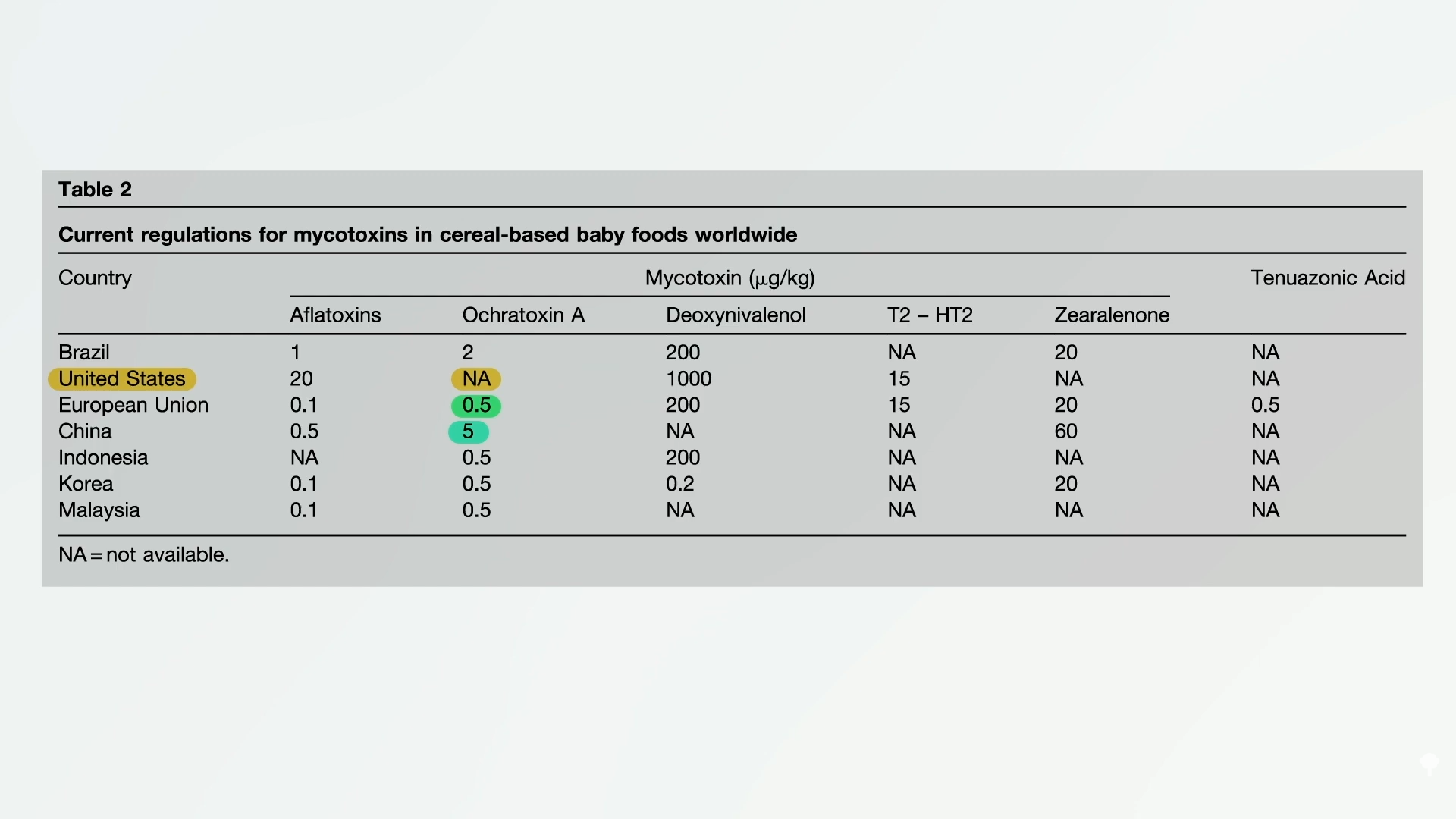
Some countries are very strict, like in the European Union; other countries are less so, and one country in particular has no standards at all. Ochratoxin is not currently regulated at all in the United States.

What about sticking to organic products? One might expect them to be worse due to the fact that fungicides are not allowed in organic production. However, “mycotoxin concentrations are usually similar or reduced in organic compared with conventional products.” For example, in one of the breakfast cereal studies, researchers found similar contamination, and the same was found for infant foods. It cannot be concluded that organic is better than conventional from a mycotoxin perspective. “Despite no use of fungicides, an organic system appears generally able to maintain mycotoxin contamination at low levels.” But how much is that saying, given how widespread it is? How concerned should we be about the public health effects from “long-term exposure to this potent mycotoxin”?

If you look at blood samples taken from populations going back decades, sometimes 100% of people turn up positive for ochratoxin circulating in their bloodstream. In some sense, mycotoxins “are unavoidable contaminants of food,” since they are not easy to detect and many of them can remain hidden. And, once foods have become contaminated, mycotoxins aren’t destroyed by cooking. So, are there some foods we should simply try to avoid due to a higher risk of contamination? That’s exactly the question I’m going to address next.

Doctor’s Note

This is the first video in a four-part series on mold toxins. Check related posts below for the other three.





Source link

You might also like

Can It Lower Your Cancer Risk?

What Does Personalized Nutrition Actually Deliver?

Is the Longevity Movement Headed for a Backlash?

Share30Tweet19

Recommended For You

Can It Lower Your Cancer Risk?

by Your Fitness News Today Staff
March 5, 2026
0
Can It Lower Your Cancer Risk?

Does choosing organic over conventional foods protect against cancer? What are the effects of pesticides on cancer risk? In a review updating the evidence on human exposure and...

Read more

What Does Personalized Nutrition Actually Deliver?

by Your Fitness News Today Staff
March 3, 2026
0
What Does Personalized Nutrition Actually Deliver?

There’s a lot of focus on personalized nutrition, but maybe we should focus on taking personal responsibility for our health. “Personalized nutrition (PN) is rooted in the concept...

Read more

Is the Longevity Movement Headed for a Backlash?

by Your Fitness News Today Staff
February 28, 2026
0
Is the Longevity Movement Headed for a Backlash?

Somewhere along the way, longevity stopped being about living well and started being about living perfectly. What began as a movement grounded in prevention has ballooned into biohacking...

Read more

The Link Between Milk and Parkinson’s Disease

by Your Fitness News Today Staff
February 26, 2026
0
The Link Between Milk and Parkinson’s Disease

Is the brain damage associated with milk consumption due to the banned pesticide heptachlor or the milk sugar galactose? Parkinson’s disease is a neurodegenerative brain disorder that affects...

Read more

Digestive Health: How it Fuels Energy, Movement, and Momentum

by Your Fitness News Today Staff
February 26, 2026
0
Digestive Health: How it Fuels Energy, Movement, and Momentum

Have you ever noticed how spring has a way of stirring up an urge inside of us? Suddenly, we’re craving longer walks, fresher meals, earlier mornings, and a...

Read more
Next Post
2026’s Biggest Weight Loss Trend? Building Muscle, Not Losing It

2026’s Biggest Weight Loss Trend? Building Muscle, Not Losing It

Leave a Reply Cancel reply

Your email address will not be published. Required fields are marked *

Browse by Category

  • Fitness
  • Mental Health
  • Nutrition
  • Skincare
  • Weight Loss
  • Workout
  • Yoga

Recent Posts

  • This Seated Stretch Helps Quiet Your Internal Chatter
  • Simple Balancing Exercises You Can Do in 30 Seconds (or Less)
  • Can It Lower Your Cancer Risk?
  • 5-Minute Bedtime Yoga to Unlock Tight Hips
  • 6 Ways to Use a Wall in Yoga to Stretch & Strengthen

Recent Comments

No comments to show.
RSS Facebook

CATEGORIES:

Your Fitness News Today

Get the latest Health and Fitness News on YourFitnessNewsToday.com.

Wellbeing tips, weight Loss, workouts, and more...

SITE MAP

  • Contact us
  • DMCA
  • Disclaimer
  • Privacy Policy
  • Cookie Privacy Policy
  • Terms and Conditions

Copyright © 2024 Your Fitness News Today.
Your Fitness News Today is not responsible for the content of external sites.

No Result
View All Result
  • Home
  • Fitness
  • Mental Health
  • Skincare
  • Weight Loss
  • Workout
  • Nutrition
  • Yoga

Copyright © 2024 Your Fitness News Today.
Your Fitness News Today is not responsible for the content of external sites.

Welcome Back!

Login to your account below

Forgotten Password?

Retrieve your password

Please enter your username or email address to reset your password.

Log In