Published December 9, 2025 09:54AM
In Yoga Journal’s Archives series, we share a curated collection of articles originally published in past issues beginning in 1975. These stories offer a glimpse into how yoga was interpreted, written about, and practiced throughout the years. This article first appeared in the December 2003 issue of Yoga Journal. Find more of our Archives here.
We all need survival strategies to help us maneuver through life’s difficult days with some measure of sanity and grace. When the world threatens to overwhelm us, we need a way to hold ourselves together until the stormy weather passes—or perhaps simply a way to let everything fall apart without losing ourselves completely. Here’s my favorite survival strategy: I close the door, tune in to my favorite Savasana track, hit the repeat button, slide into Legs Up the Wall Pose (Viparita Karani), exhale as soulfully as possible, and then invite the posture’s quietness to sink into every cell of my body.
I breathe. I surrender. I melt. As my legs drain, my mind empties. I linger here for 10 minutes, 20 minutes, sometimes half an hour or more until the pose has drawn every last drop of angst and agitation from my soul. And when I can bear to pull myself back to reality, I roll over and slowly sit up renewed. Invariably, I feel better able to manage life’s challenges with clarity and balance.
I’d wager that Viparita Karani can do the same for you. This soothing, restorative posture calms the nervous system, eases muscle fatigue, and helps restore restful breathing. Many yoga instructors offer it as an antidote to exhaustion, illness, and weakened immunity. In addition, it invites us to drop beneath the surface of life into quieter and more introspective realms.
Legs Up the Wall Benefits
- Soothes frazzled nerves
- Eases muscle fatigue
- Restores tired legs and feet
- Cultivates restful breathing
- Promotes balanced energy and well-being
Who Should Avoid Legs Up the Wall Pose?
Anyone with…
- Hiatal hernia
- Glaucoma or a detached retina
- Severe hypertension
- Pregnancy after the first trimester
What Viparita Karani Means
Viparita Karani (vi-par-EE-tah kar-AHN-ee)
viparita = inverted or reversed
karani = doing, making, action
How to Practice Legs Up the Wall
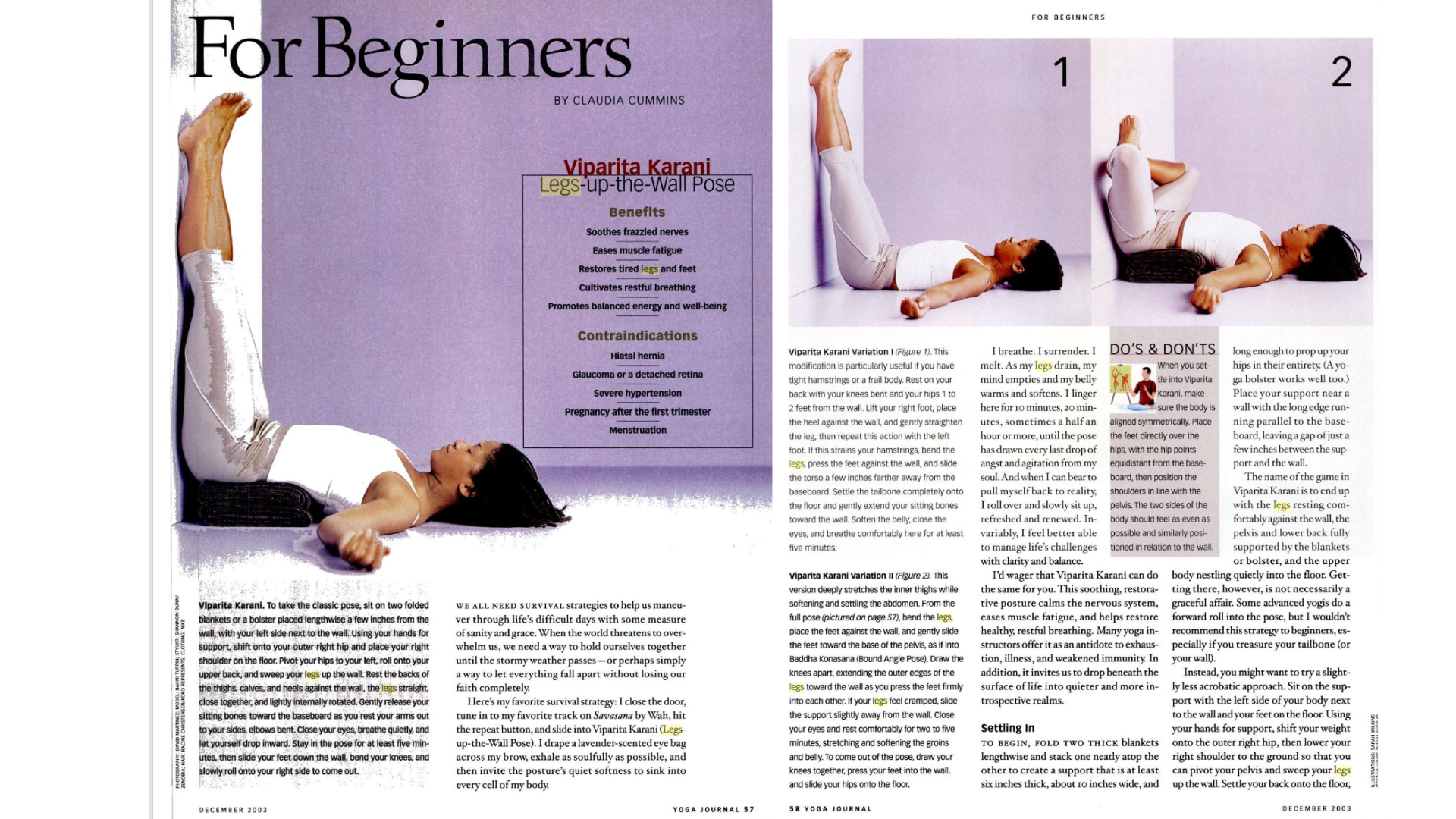
The name of the game in Viparita Karani is to end up with the legs resting comfortably against the wall with the feet directly over the hips, the pelvis and lower back fully supported by the blankets or bolster, and the upper body nestling quietly into the floor. Getting there, however, is not necessarily a graceful affair. Some experienced yogis do a forward roll into the pose, but I wouldn’t recommend this strategy to beginners, especially if you treasure your tailbone (or your wall).
Instead, you might want to try a slightly less acrobatic approach. Sit on the support with the left side of your body next to the wall and your feet on the floor. Using your hands for support, shift your weight onto the outer right hip, then lower your right shoulder to the ground so that you can pivot your pelvis and sweep your legs up the wall. Settle your back onto the floor, aligning your spine so that an imaginary line drawn from your nose to your navel would be perpendicular to the baseboard.
There should be ample room for your shoulder blades to rest comfortably on the ground, and just enough space between your hips and the wall to allow your tailbone to dip gently toward the floor.
As always in yoga, it’s worth spending a few moments attending to the details of the pose before diving into its depths. You’ll be rewarded for your care and precision with a more profound and restful state once you’ve settled in.
Legs
Let’s start with the legs. Ideally in Viparita Karani, the legs should be straight, the ankle-bones should touch each other, and the backs of the thighs should rest against the wall, offering a gentle support that increases the restorative benefits of the pose. If the backs of your thighs are not touching the wall and you feel like they could without strain, bend your legs and shimmy your hips a few inches closer to the wall, settling more of your lower back onto the support.
If moving close to the wall causes your hamstrings to protest, that’s okay. Come out of the pose, slide the support a few inches away from the baseboard, and try again. Experiment with the distance between the support and the wall until you find a position that gently stretches the backs of your legs but doesn’t cause any pain. It’s difficult to find inner peace, after all, if your thighs are shrieking in protest.
Hips
Next, consider your hips. Your pelvis should rest comfortably on the support, with your two sitting bones squared with the wall and equidistant from it. The blankets should support you from the top of your tailbone all the way to your kidneys (at the midback), allowing the belly to settle evenly into the back body. To lend a sense of spaciousness to your midsection, release the base of the tailbone gently downward into the little gully between the support and the wall. At the same time, extend the sitting bones away from the belly, as if they were being magnetically drawn toward the wall.
Shoulders
Check to see that your upper body is balanced and spacious too. Pick up your left shoulder, slide the shoulder blade down toward the waist, and then release the shoulder back onto the ground. Notice how much space you’ve created between the shoulder and the ear. Repeat this action on the second side. Rest your hands in a comfortable position, either out to the sides, on top of your floating ribs, or perhaps on the floor beyond your head, arms soft and hands unclenched.
Classic Legs Up the Wall
To take the classic pose, sit on 2 folded blankets or a bolster placed lengthwise a few inches from the wall, with your left side next to the wall. Using your hands for support, shift onto your outer right hip and place your right shoulder on the floor. Pivot your hips to your left, roll onto your upper back, and sweep your legs up the wall. Rest the backs of the thighs, calves, and heels against the wall with the legs straight and lightly internally rotated. Gently release your sitting bones toward the baseboard as you rest your arms out to your sides, elbows bent. Close your eyes, breathe quietly, and let yourself drop inward. Stay in the pose for at least 5 minutes and then slide your feet down the wall, bend your knees, and slowly roll onto your right side to come out.
Legs Up the Wall Variation 1
This modification is particularly useful if you have tight hamstrings or a frail body. Rest on your back with your knees slightly bent and your hips 1 to 2 feet from the wall. Lift your right foot, place the heel against the wall, and gently straighten the leg, then repeat this action with the left foot. If this strains your hamstrings, bend the legs, press the feet against the wall, and slide the torso a few inches farther away from the baseboard. Settle the tailbone completely onto the floor and gently extend your sitting bones toward the wall. Soften the belly, close the eyes, and breathe comfortably here for at least 5 minutes.
Legs Up the Wall Variation 2
This version deeply stretches the inner thighs while softening and settling the abdomen. From the classic pose, bend the legs, place the feet against the wall, and gently slide the feet toward the base of the pelvis, as if into Bound Angle Pose (Baddha Konasana). Draw the
knees apart, extending the outer edges of the legs toward the wall as you press the feet firmly into each other. If your legs feel cramped, slide the support slightly away from the wall. Close your eyes and rest comfortably for 2 to 5 minutes, stretching and softening the groins and belly. To come out of the pose, draw your knees together, press your feet into the
How to Experience Ease in Viparita Karani
Your only remaining task is to close your eyes, exhale completely, and surrender to the softness of the pose. Scan your body, limb by limb, inviting any residual knots of tension to dissolve completely: Let your brain grow easy and tranquil, relinquishing its grip on any lingering worries or fears. See if you can enjoy the chance to spend time grasping for absolutely nothing.
Then drop inward, layer by layer, to observe the subtle sensations within. First, shift your focus to the breath and observe how much freedom this pose offers the diaphragm at the base of the lungs and invites the mid-body to participate wholeheartedly in each of your inhalations and exhalations. Let your belly ride the waves of the breath.
Invite the breath to deepen, and let every exhalation feel soul satisfying and complete. As your body softens, you may even discover a delightful pause developing at the very end of each exhalation, a moment or two of total stillness and spaciousness. Feel the tranquility and deep rest of this settled silence.
Now draw your awareness beneath the breath, toward the shifting sensations of life pulsing through you. Trace the flow of energy that travels from your heels through the waterfalls of your legs, into the warm lake of the belly, over the gentle waves of the rib cage, through the grotto of the heart, and all the way out through the channels of the neck and head before dissolving into the ocean of life beyond you. Embrace the feeling of being drained and emptied, and notice how calming this gentle inversion can be for both the heart and the head.
Pause, breathe, and when you’re ready, drop inward again. Notice that beneath the body’s surface, beneath the rise and fall of the breath, even beneath the flow of inner energy, there lies a tranquil sea of quiet and ease.
Observe how this stillness supports you, how even when you let everything you know about yourself dissolve, you are still buoyed by the world. With each quiet exhalation, see if you can drift a little closer to the stillness that lies at the very heart of the universe. Let yourself float in this soothing silence for as long as you desire.
When your body signals that it is ready to move back into the world of action, slowly slide your legs down the wall, bending your knees close to your chest. Rest here for a few moments before pressing your feet into the wall and sliding your hips past the blankets and onto the floor.
Don’t hurry—you’ve just emerged from the depths and may need a few moments to reacclimate to the world around you.
When you do sit up, observe how you feel in your body, your breath, your mind, and your heart. Ask yourself whether you feel a little softer and more centered than you did before you took the pose. Perhaps you also feel smoother, quieter, and more at ease. Your journey through Viparita Karani may have even left you feeling a bit more like the calm, balanced, and tenderhearted creature you were always meant to be.