Published December 16, 2025 10:14AM
In Yoga Journal’s Archives series, we share a curated collection of articles originally published in past issues beginning in 1975. These stories offer a glimpse into how yoga was interpreted, written about, and practiced throughout the years. This article first appeared in Yoga Journal in 1981. Find more of our Archives here.
While this asana (pose) appears to be a simple forward bend, Paschimottanasana (Sanskrit for intensive stretch to the West or back of the body) is the most difficult forward bend for most students to practice correctly. What makes the pose so difficult is that the hamstring muscles in the back of the thigh must lengthen in order for the pelvis to rotate forward. This allows the spinal column to remain relatively straight while bending forward.
During the forward movement, emphasis should be placed upon lifting up rather than forward. This actually elongates the spine so the forward bend can be done without curving. Curving the back to bend forward creates imbalance in the structure of the back. By overstretching the thoracic (mid) spine, the normal curve of this area may be increased. Continued practice over time can cause an overstretch to the posterior (back) structures of the thorax enhancing the tendency for a rounded back.
Benefits of Paschimottanasana
Paschimottanasana is an extremely quieting pose mentally, when practiced correctly. But if the emphasis is on putting the forehead on the knees, the back rounds and the pose becomes aggressive and goal-oriented. The element of striving to reach the goal of forehead to knee, for example, colors the attitude one has toward the pose; it generates anxiety about success or failure; it also creates tension in the student, so that more force must be used to overcome the body’s resistance.
When, on the other hand, the emphasis is on lifting the spine up out of the pelvis, with the forward movement coming as a secondary effect, the pose becomes a much more inward one. The concentration then is on the quality of the spinal extension rather than the quantity of the forward movement. The subjective result is quietness and release.
The forward bending poses as a whole are symbolic of the need for surrender in the practice of yoga, yet the concept of surrender is often misunderstood. Surrender does not mean collapse; surrender implies a conscious choice. This manifests itself in the great strength that is required to let go of whatever one is attached to, whether that is the attachment of tight hamstrings, the attachment to success in yoga, or to a myriad of other attachments which can keep us from the peace and joy we only occasionally feel. Surrendering to the pose with conscious strength and awareness teaches us how yoga can be used, how yoga is a state of being, not just a formalized practice of meditation, breathing and postures.
Why I Appreciate Paschimottanasana
Paschimottanasana is my favorite pose because while practicing it in class I had my first experience of what “asana” means. Something released in my mind and body; when the teacher said “Come up” I was confused. I had no sense of doing anything so there was nothing to stop doing. Finally, I felt ready to come up, but had no way of gauging the length of time I had spent in the pose. Through this experience I had a glimpse of what Patanjali meant in Yoga Sutras (Chapter II v. 46) when he defined asana as “comfortable easy position.”
I have also learned that the practice of asana has very little to do with the physical body. By placing the body in a certain position and holding it, one can observe the workings of the mind. At first the pose is hard and resistance occurs. This is felt physically in the tightness of the hamstrings and mentally as resentment or anger toward myself, the pose, or the teacher who “made me” do the pose.
As these feelings fade, the mind becomes more and more quiet. The practitioner moves beyond what Patanjali calls the dvandas, the extremes like heat and cold. The two mental extremes of like and dislike for the pose dissolve and it is then that the true practice of asana begins. At this point, meditation is a spontaneous state. The asana has allowed the student to transcend the normal agitations of the mind so that there is no need to move or to think. One gains the ability to be still. This is the rarest of states and one which cannot be described. To experience it, however, is to experience the true essence of asana.
Paschimottanasana is a receptive, quieting, feminine asana. It brings out the opposite feelings in the student, allowing them to be released. The student can get free of those mental patterns which always exert themselves when discomfort and difficulty arise in life. This asana can—as can all asanas—be viewed as a formalized expression of an internal state. In Paschimottanasana that state is one of quiet, surrender, and peace.
A Note About Breathing
The importance of breathing in practicing the asana cannot be overlooked, as the breath is the key to the harmony of body and mind. The breath of surrender is the exhalation, therefore movement in Paschimottanasana should be done on exhalation. The student prepares to move with the inhalation, but moves with the exhalation, using the breath to release the legs and back, where the tension is felt.
Always the breath should be soft and free. By gauging the breath one can gauge the mind. An irregular straining breath designates the same quality of mind; a slow relaxed breath will effect the mind similarly. By beginning to watch the physical and mental effects of the breath in asana, the student is preparing for the formalized breathing practices of pranayama.
How to Do Paschimottanasana
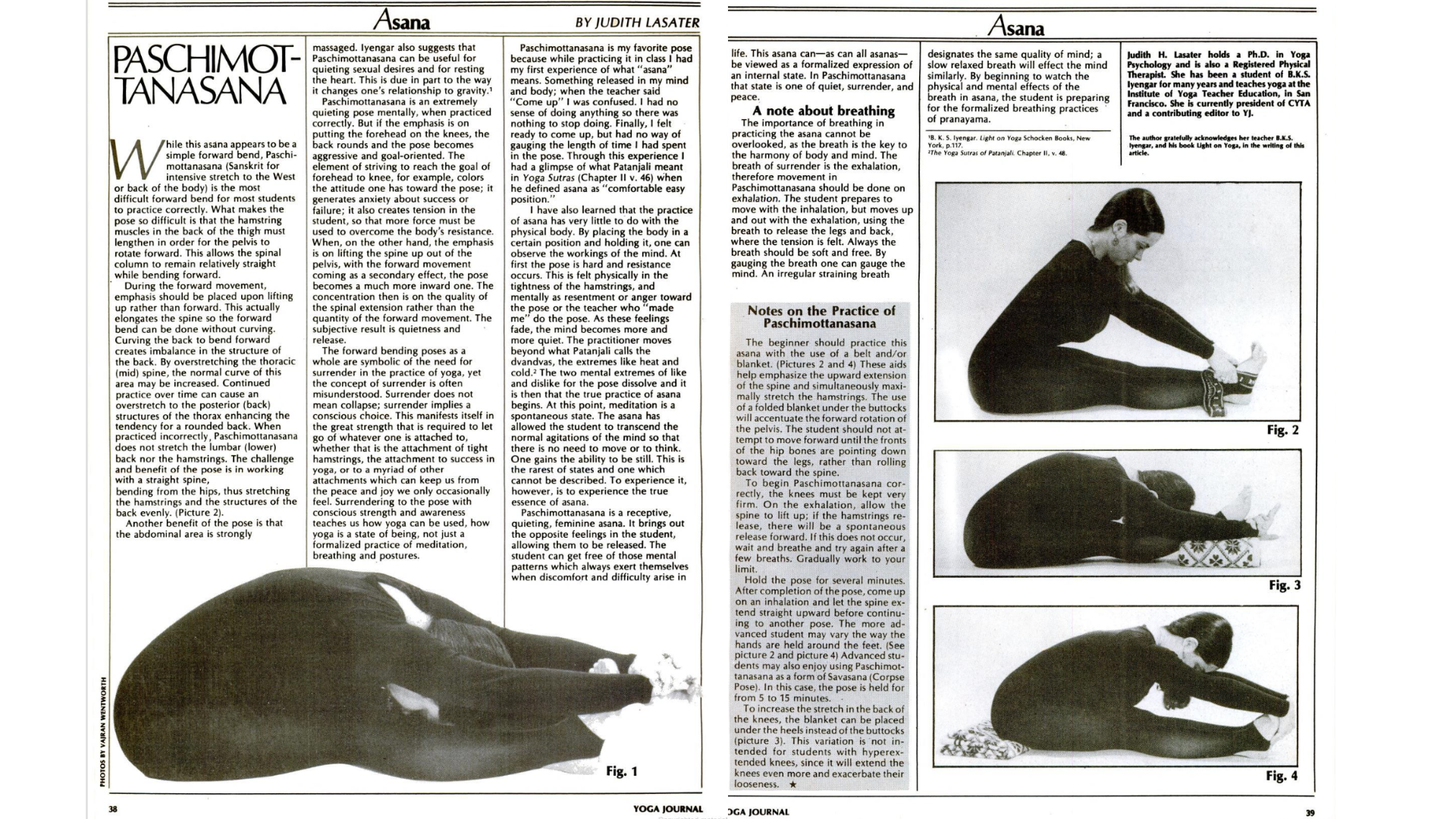
When practiced incorrectly, Paschimottanasana does not stretch the lumbar (lower) back nor the hamstrings. The challenge and benefit of the pose is in working with a straight spine, bending from the hips, thus stretching the hamstrings and the structures of the back evenly (see picture 2).
Another benefit of the pose is that the abdominal area is strongly massaged. B.K.S. Iyengar also suggests that Paschimottanasana can be useful for quieting sexual desires and for resting the heart. This is due in part to the way it changes one’s relationship to gravity.*
To begin Paschimottanasana correctly, the knees must be kept very firm. On the exhalation, allow the spine to lift up; if the hamstrings release, there will be a spontaneous release forward. If this does not occur, wait and breathe and try again after a few breaths. Gradually work to your limit.
Hold the pose for several minutes. After completion of the pose, come up on an inhalation and let the spine extend straight upward before continuing to another pose.
RELATED: How to Do Seated Forward Bend
Beginners
The beginner should practice this asana with the use of a belt and/or blanket (see pictures 2 and 4). These aids help emphasize the upward extension of the spine and simultaneously maximally stretch the hamstrings. The use of a folded blanket under the buttocks will accentuate the forward rotation of the pelvis. The student should not attempt to move forward until the fronts of the bones are pointing down toward the legs, rather than rolling back toward the spine.
Experienced Students
The more advanced student may vary the way the hands are held around the feet (see pictures 2 and 4). Advanced students may also enjoy using Paschimottanasana as a form of Savasana (Corpse Pose). In this case, the pose is held for 5 to 15 minutes.
To increase the stretch in the back of the knees, the blanket can be placed under the heels instead of the buttocks (see picture 3). This variation is not intended for students with hyperextended knees, since it will extend the knees even more and exacerbate their looseness.
*B.K S. Iyengar. Light on Yoga. Schocken Books, New York, p.117.
The author gratefully acknowledges her teacher B.K.S. lyengar, and his book Light on Yoga, in the writing of this article.