Published December 21, 2025 04:42AM
In Yoga Journal’s Archives series, we share a curated collection of articles originally published in past issues beginning in 1975. These stories offer a glimpse into how yoga was interpreted, written about, and practiced throughout the years. This article first appeared in the May-June 1984 issue of Yoga Journal. Find more of our Archives here.
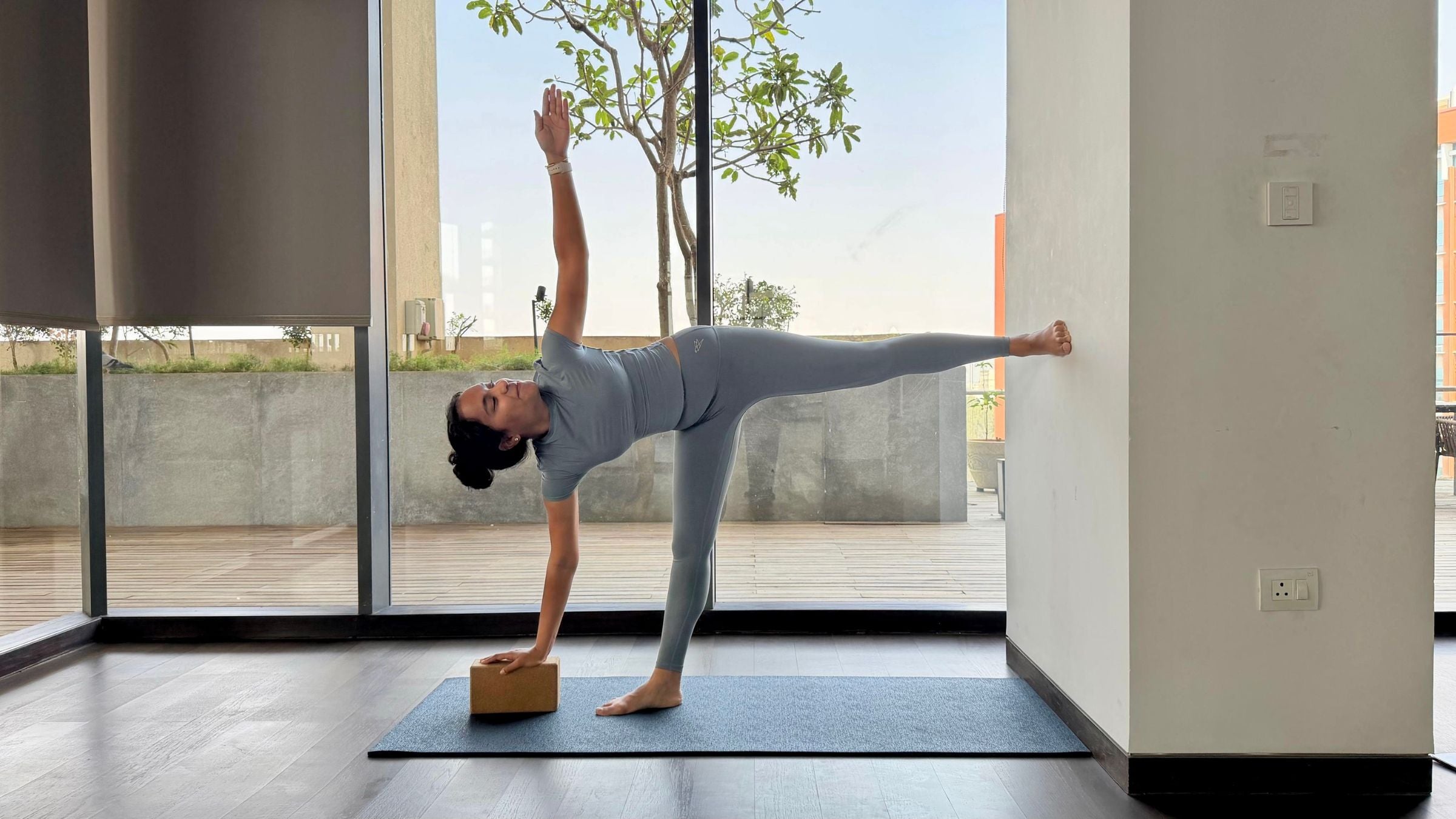
Because it involves a twist, Revolved Side Angle Pose (Parivrtta Parsvakonasana) is more difficult than most other standing poses and has a more powerful effect upon the spinal column. This pose requires tremendous awareness of the legs. If the stretch on the back leg is lost, the entire pose collapses. If the leg over-rotates, the knee bends, and if it under-rotates, no twist is possible. To create the proper twist, the student must learn to turn the back knee out while rotating the pelvis in the opposite direction.
Any twisting position stretches the small intrinsic muscles of the spinal column while compressing the intervertebral discs. Thus, it is important to elongate the spinal column as much as possible while twisting to avoid creating imbalances.
The twist itself should feel somewhat relaxed. This means that the arm crossing the knee should not be used aggressively to force the twist. Rather, the student should concentrate on elongating the spinal column and freeing the diaphragm. If the diaphragm is compressed by the ribs, twisting will be difficult. One should allow the spine to assume the twist rather than forcing the body into a preconceived position. This principle is an important one in the whole practice of yoga.
Softness Is Strength
Too often yoga students assume they know what an asana should be, thereby closing their minds to change and growth. With this all-knowing attitude comes a form of aggression, of forcing the body to perform the asana according to an intellectual framework. This is not the true practice of yoga. Yoga does not denigrate the intellect, but teaches that while the intellect has a place in our understanding, it should not dominate. In yoga, intuitive knowledge is of primary importance if one is to transcend the limitations of the intellectual mind.
If one practices yoga solely from the intellect, the asanas can become aggressive, routine and dull. But if one approaches each asana with a softer feeling, allowing the asana to express itself from the inside out, then the intellectual mind is just as fresh as the next inhalation and exhalation, and each asana becomes a form of meditation. Softness in asana does not mean weakness; it implies receptivity to the newness of each moment.
With this attitude of receptivity in Revolved Side Angle Pose, the twist is an expression of the length of the spine, not a goal to be achieved. In fact, the spine should be “sensation-less” in the asana. With this in mind, the strength of the legs becomes the foundation from which the lightness and freedom of the spine can be expressed. This means that the work of the asana should be felt in the limbs, while the spine feels totally free and silent in the midst of the rest of the body. This is the perfection of asana that we are all working toward.
One is approaching the balance of Revolved Side Angle Pose when the arms and legs can say “Enough, please!” while the spinal column says “More!” Yoga should not be practiced from the spine, but should be received by the spine. When this occurs, silence flows from the inside out and allows one to express yoga, not practice it. This expression of silence is what makes the asana beautiful, stable and a living prayer.
How to Practice Revolved Side Angle Pose
The student should first have a good understanding of Extended Side Angle Pose (Utthita Parsvakonasana), which is Side Angle Stretch without the twist. (Please see Light on Yoga by B.K.S. Iyengar for an explanation of this pose.)
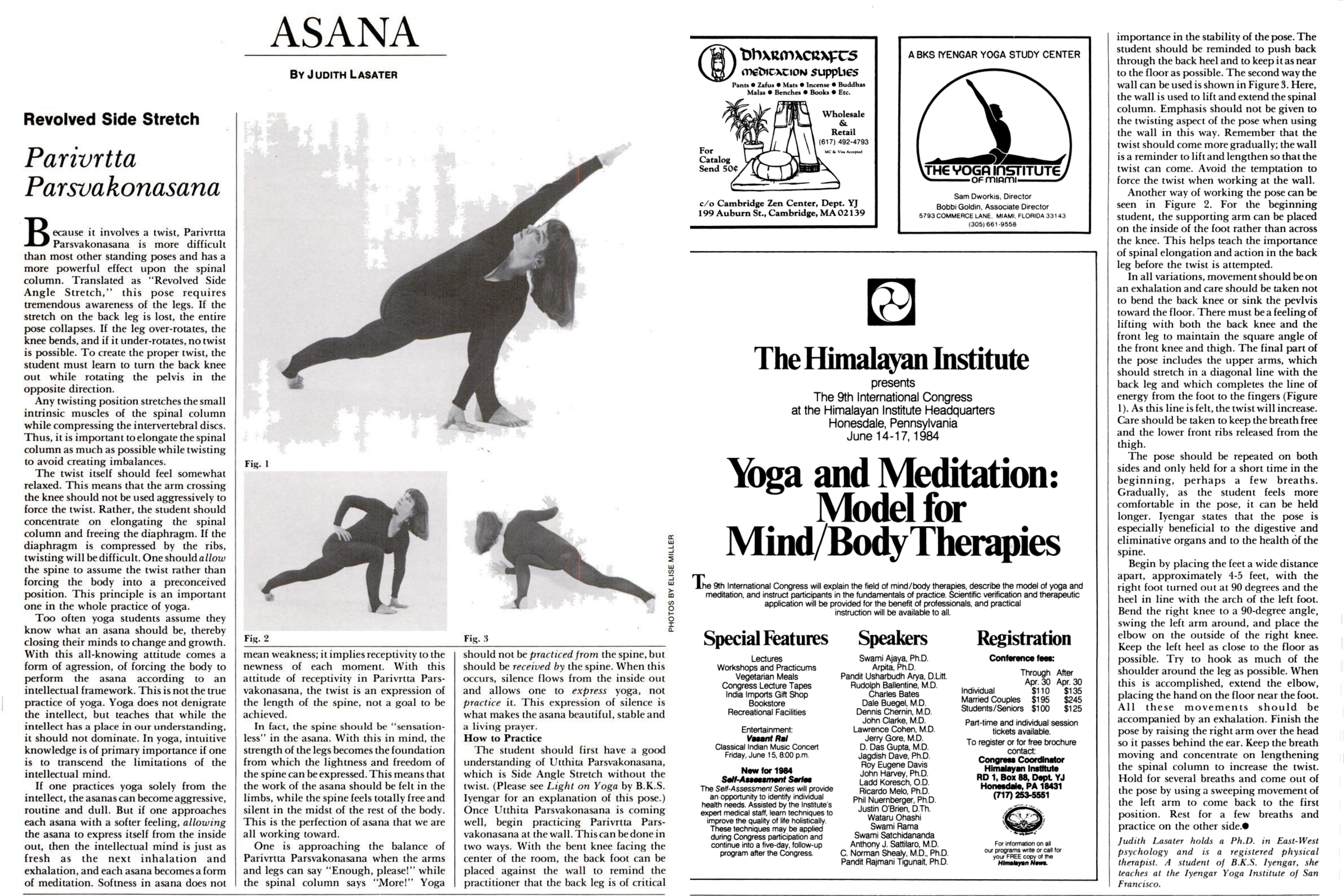
Once Extended Side Angle Pose is coming well, begin practicing Revolved Side Angle Pose at the wall. This can be done in two ways. With the bent knee facing the center of the room, the back foot can be placed against the wall to remind the practitioner that the back leg is of critical importance in the stability of the pose. The student should be reminded to push back through the back heel and to keep it as near to the floor as possible. The second way the wall can be used is shown in Figure 3. Here, the wall is used to lift and extend the spinal column. Emphasis should not be given to the twisting aspect of the pose when using the wall in this way. Remember that the twist should come more gradually; the wall is a reminder to lift and lengthen so that the twist can come. Avoid the temptation to force the twist when working at the wall.
Another way of working the pose can be seen in Figure 2. For the beginning student, the supporting arm can be placed on the inside of the foot rather than across the knee. This helps teach the importance of spinal elongation and action in the back leg before the twist is attempted.
In all variations, movement should be on an exhalation and care should be taken not to bend the back knee or sink the pelvis toward the floor. There must be a feeling of lifting with both the back knee and the front leg to maintain the square angle of the front knee and thigh. The final part of the pose includes the upper arms, which should stretch in a diagonal line with the back leg and which completes the line of energy from the foot to the fingers (Figure 1). As this line is felt, the twist will increase.
Care should be taken to keep the breath free and the lower front ribs released from the thigh.
The pose should be repeated on both sides and only held for a short time in the beginning, perhaps a few breaths. Gradually, as the student feels more comfortable in the pose, it can be held longer. Iyengar states that the pose is especially beneficial to the digestive and eliminative organs and to the health of the spine.
Begin by placing the feet a wide distance apart, approximately 4-5 feet, with the right foot turned out at 90 degrees and the heel in line with the arch of the left foot. Bend the right knee to a 90-degree angle, swing the left arm around, and place the elbow on the outside of the right knee.
Keep the left heel as close to the floor as possible. Try to hook as much of the shoulder around the leg as possible. When this is accomplished, extend the elbow, placing the hand on the floor near the foot.
All these movements should be accompanied by an exhalation. Finish the pose by raising the right arm over the head so it passes behind the ear. Keep the breath moving and concentrate on lengthening the spinal column to increase the twist.
Hold for several breaths and come out of the pose by using a sweeping movement of the left arm to come back to the first position. Rest for a few breaths and practice on the other side.