It’s about so much more than the arm balance.

Published December 29, 2025 05:36AM
In Yoga Journal’s Archives series, we share a curated collection of articles originally published in past issues beginning in 1975. These stories offer a glimpse into how yoga was interpreted, written about, and practiced throughout the years. This article first appeared in the January-February 1985 issue of Yoga Journal. Find more of our Archives here.
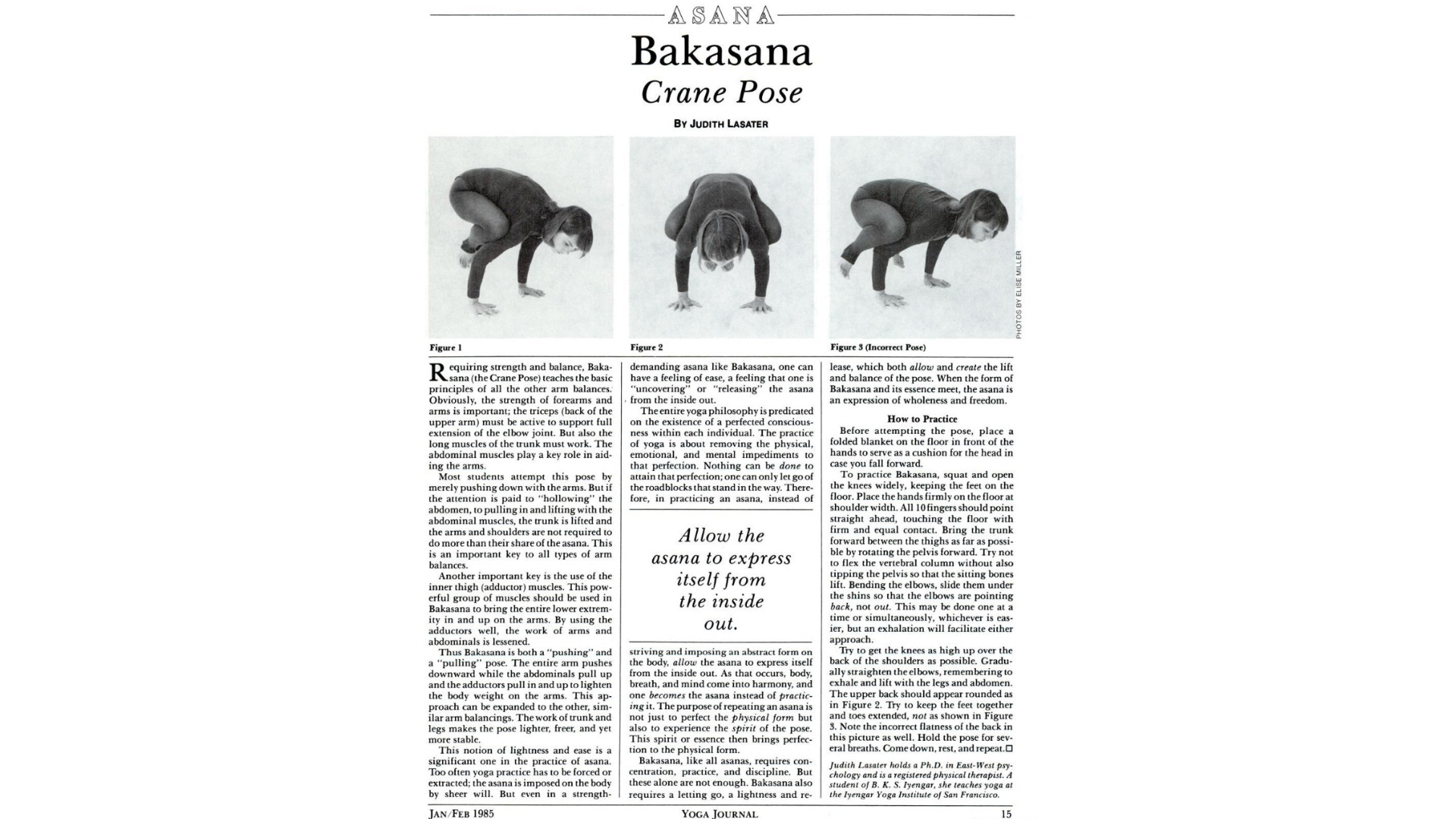
Requiring strength and balance, Bakasana (Crane Pose) teaches the basic principles of all the other arm balances. Obviously, the strength of forearms and arms is important; the triceps (back of the upper arm) must be active to support full extension of the elbow joint. But also the muscles of the core must work. The abdominal muscles play a key role in aiding the arms.
Most students attempt this pose by merely pushing down with the arms. But if the attention is paid to “hollowing” the abdomen, to pulling in and lifting with the abdominal muscles, the trunk is lifted and the arms and shoulders are not required to do more than their share of the asana. This is an important key to all types of arm balances.
Another important key is the use of the inner thigh (adductor) muscles. This powerful group of muscles should be used in Bakasana to bring the entire lower extremity in and up on the arms. By using the adductors well, the work of arms and abdominals is lessened.
Thus Bakasana is both a “pushing” and a “pulling” pose. The entire arm pushes downward while the abdominals pull up and the adductors pull in and up to lighten the body weight on the arms. This approach can be expanded to the other, similar arm balancings. The work of trunk and legs makes the pose lighter, freer, and yet more stable.
This notion of lightness and ease is a significant one in the practice of asana. Too often yoga practice has to be forced or extracted; the asana is imposed on the body by sheer will. But even in a strength-demanding asana like Bakasana, one can have a feeling of ease, a feeling that one is “uncovering” or “releasing” the asana from the inside out.
The entire yoga philosophy is predicated on the existence of a perfected consciousness within each individual. The practice of yoga is about removing the physical, emotional, and mental impediments to that perfection. Nothing can be done to attain that perfection; one can only let go of the roadblocks that stand in the way. Therefore, in practicing an asana, instead of striving and imposing an abstract form on the body, allow the asana to express itself from the inside out. As that occurs, body, breath, and mind come into harmony, and one becomes the asana instead of practicing it.
The purpose of repeating an asana is not just to perfect the physical form but also to experience the spirit of the pose. This spirit or essence then brings perfection to the physical form.
Bakasana, like all asanas, requires concentration, practice, and discipline. But these alone are not enough. Bakasana also requires a letting go, a lightness and release, which both allow and create the lift and balance of the pose. When the form of Bakasana and its essence meet, the asana is an expression of wholeness and freedom.
How to Practice Bakasana Pose
Before attempting the pose, place a folded blanket on the floor in front of the hands to serve as a cushion in case you fall forward.
To practice Bakasana, squat and open the knees widely, keeping the feet on the floor. Place the hands firmly on the floor at shoulder width. All 10 fingers should point straight ahead, touching the floor with firm and equal contact.
Bring the trunk forward between the thighs as far as possible by rotating the pelvis forward. Try not to flex the vertebral column without also tipping the pelvis so that the sitting bones lift.
Bending the elbows, slide them under the shins so that the elbows are pointing back, not out. This may be done one at a time or simultaneously, whichever is easier, but an exhalation will facilitate either approach.
Try to get the knees as high up over the back of the shoulders as possible. Gradually straighten the elbows, remembering to exhale and lift with the legs and abdomen. The upper back should appear rounded as in Figure 2.
Try to keep the feet together and toes extended, not as shown in Figure 3. Note the incorrect flatness of the back in this picture as well.
Hold the pose for several breaths. Come down, rest, and repeat.