(Photo: Miriam Alonso | Pexels | Laura Harold)
Updated January 8, 2026 09:09AM
In Yoga Journal’s Archives series, we share a curated collection of articles originally published in past issues beginning in 1975. These stories offer a glimpse into how yoga was interpreted, written about, and practiced throughout the years. This article first appeared in the May-June 1985 issue of Yoga Journal. Find more of our Archives here.
Most forward-bending asanas are practiced by bringing the trunk to the legs. Krounchasana (Heron Pose) is more difficult than other forward bends because the leg must be lifted against gravity rather than the trunk being allowed to drop with gravity toward the floor.
As in any forward bend, the student must pay particular attention to the alignment of the vertebral column when practicing this pose. As much as possible the column—including the cervical (neck), thoracic (mid-back), and lumbar (lower) portions of the spine—should retain its natural or resting shape. When this pose is attempted, the pelvis must move over the heads of the femurs (thigh bones) at the hip joint. The pelvis is then tipped forward to the take strain out of the spinal column, especially the lumbar spine, which is especially mobile in flexion and extension (forward and backward bending).
When the pelvis is tipped forward, the spinal column comes into a position relative so the pelvis is very similar to an erect sitting posture. The column is therefore not tipped in any direction. This position reduces physiological strain and allows the student to feel the calmness of mind that is at the core of the practice of asana.
To allow the correct tipping of the pelvis in Krounchasana, the hamstring muscles at the back of the thigh must be lengthened. Instead of exerting effort or force, one should let go of the hamstrings and allow them to stretch. Because Krounchasana requires considerable stretch in the hamstrings, it is more difficult than most other forward bends and is therefore recommended for students with loose hamstrings and an awareness of how the vertebral column should be lifted and the lumbar curve maintained. To prepare the hamstrings for the stretch required by this asana, one should practice all the standing poses and the standing forward bends. If these as well as the simpler seated forward bends are progressing well, one can attempt Krounchasana.
Why Your Mindset Matters in Heron Pose
Besides understanding the importance of alignment in Krounchasana, the student also needs to be aware of the attitude they bring to the asana. The thought or attitude one brings will be magnified in the moments of practice. If one brings an attitude of aggression, the pose will become aggressive. If one doubts one’s abilities, then doubt will be magnified in the mind. But if one brings an attitude of surrender and release, then one will surrender and release into the pose.
The last thought one has before practicing an asana is caught and echoed throughout the body and mind during practice. By cultivating positive and equanimous thoughts, one is creating a milieu that allows the asana to become positive and equanimous. By learning to create self-awareness during the practice of asana, one learns to practice self awareness in other challenging situations. The continued discipline of releasing where needed, stilling what needs to be willed, and focusing the mind on the task at hand is tremendously valuable not only in the practice of Krounchasana and other difficult postures, but in life as well.
How to Practice Krounchasana
Sit on a blanket with the buttocks between the heels. Make sure the buttocks rest firmly on the blanket. The feet should be next to the buttocks, the soles facing the ceiling (Virasana). Strain on the knee may be minimized if the flesh of the calf is pulled out to the side near the knee to create more space for the joint.
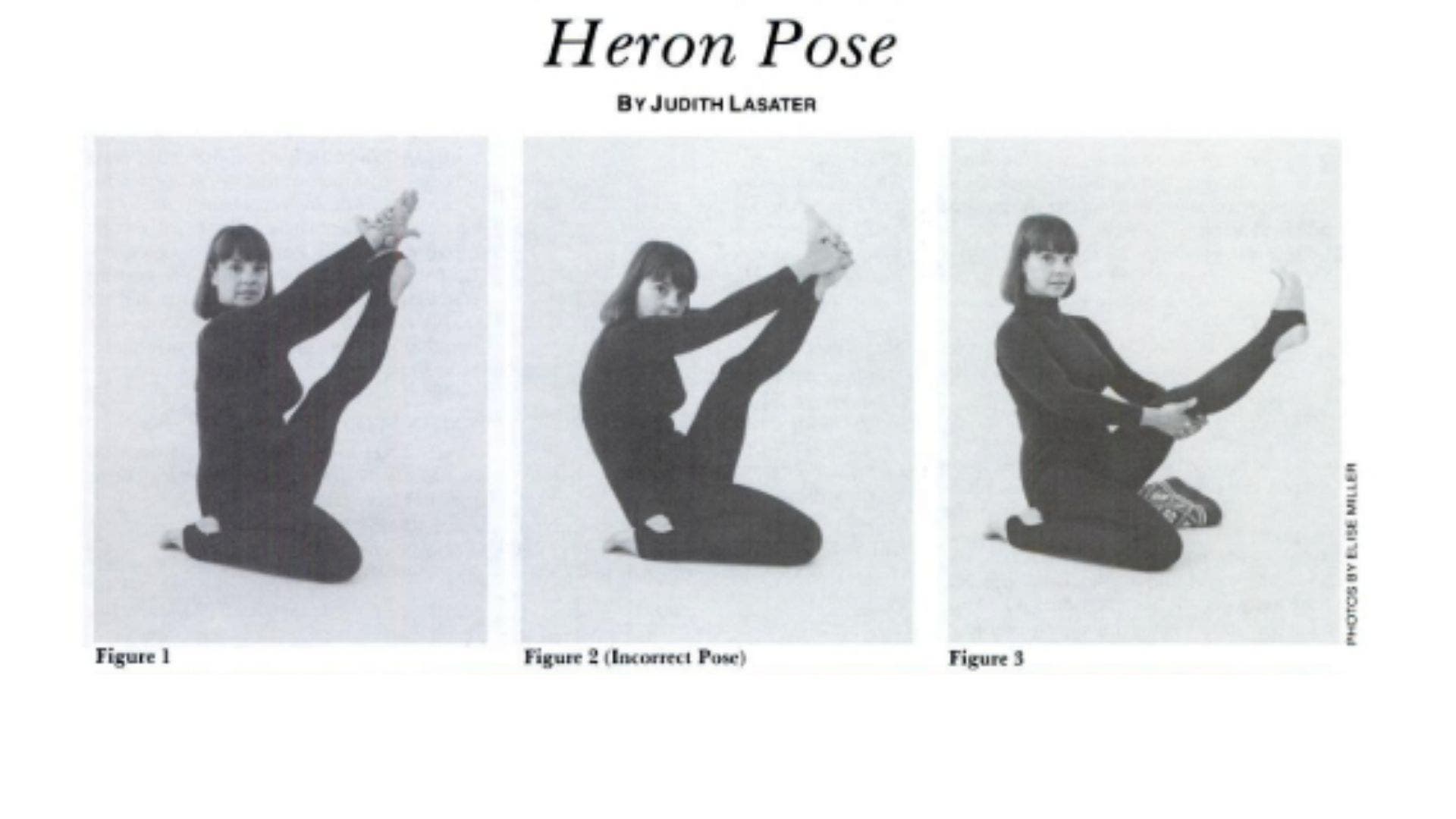
Begin the asana by bringing the right thigh toward the chest and placing the right foot on the floor, heel near the buttock. On an exhalation, straighten the right knee and hold at the back of the knee, the calf, or preferably the foot. If all the positions are too difficult, try the pose as shown in Figure 3. Also shown in that photo is the use of a blanket under the buttock, which can help tilt the pelvis forward into the correct position. Be careful not to bend the right knee or so let the vertebral column round. Keep the breath soft and even.
Raise the right leg slowly on a series of exhalations. Never compromise the lift of the spine for a higher leg position. The spine should not resemble the spine demonstrated in Figure 2. Hold for half a minute with the leg as high as possible without rounding the back. Release, take a couple of breaths, then repeat on the other side. Paschimottanasana, or full forward bend, is a good pose to follow Krounchasana.