Published February 18, 2026 02:25PM
Yoga Journal’s archives series is a curated collection of articles originally published in past issues beginning in 1975. This article first appeared in the September-October 1990 issue of Yoga Journal.
In contemporary society, where even the basic positions of sitting and standing are frequently distorted, the safe and correct practice of Shoulderstand (Sarvangasana) requires patience, preparation, and understanding. Forcing the body into this pose prematurely can lead to neck, head, and circulatory problems. But practicing it intelligently will bring the many benefits listed above, and more.
To understand the essence of any posture, we must return to Mountain Pose (Tadasana), from which all the other asanas derive. First we must ask ourselves: What is the natural action of the body in a proper Mountain Pose, and what postural distortions have I accumulated that inhibit this natural action? Then we need to ask: What additional distortions might arise as a result of the new relationship between body and gravity introduced in Shoulderstand? We can then determine what we must do to prepare for the pose, and what props or adaptations we can use to restore the Mountain action in our practice of Shoulderstand.
The Flow of Prana
In a well-balanced Mountain Pose, each bone in the body is centered and evenly spaced in relation to all contiguous bones. This centering affords the joints maximum movement and stability and frees the muscles to contract and release efficiently. In a healthy, undistorted body, the muscular action follows certain patterns. In some areas, the muscles naturally tend to lift; in other areas, they tend to pull downward.
When this natural action of the muscles is not inhibited, one can experience it as a circuit of energy flowing through along the inner lining of the skin. For lack of a better term, I refer to this wave of muscular energy as “postural prana.”
Postural prana follows specific pathways, especially along the spinal column. As long as these pathways are open and the prana is moving in the proper direction, a pose will be steady and comfortable. Whenever the energy is blocked by misaligned bones or pushed in the wrong direction by poor posture (so that muscles are clenched where they should be releasing or limp where they should be lifting), pain and pressure will build.
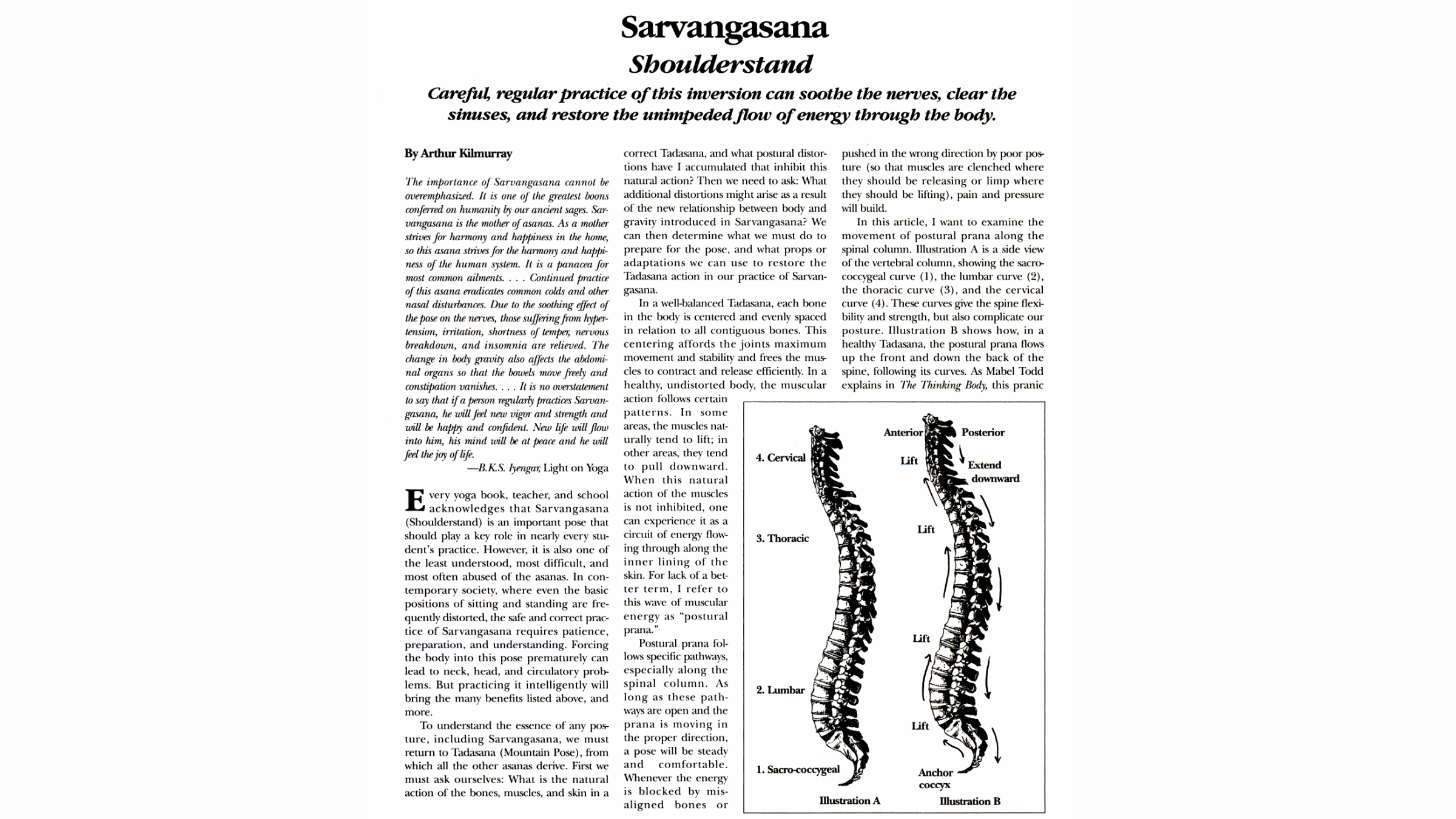
Illustration A is a side view of the vertebral column, showing the sacrococcygeal curve (1), the lumbar curve (2), the thoracic curve (3), and the cervical curve (4). These curves give the spine flexibility and strength, but also complicate our posture. Illustration B shows how, in a healthy Mountain Pose, the postural prana flows up the front and down the back of the spine, following its curves. Notice that as it passes over the head, the prana flows up the back and down the front.
When we look at the flow of the postural prana in the context of the shape of the spine, we can see some potential problems.
At the four regions where the curves reverse, there is a tendency for the pranic flow to get stuck—in other words, for the muscles to harden or go limp so they fail to lift the bones up or draw them down in the proper places. This failure leads to distorted posture, which in turn blocks the pranic flow even more.
The sacrolumbar junction, at the base of the lower back, is the first of these problem spots. An inability to elongate the posterior sacrum and coccyx downward (the correct direction for the postural prana at this point) can lead to an overarched lumbar spine and compression at the juncture between the sacroiliac joint and the fifth lumbar vertebra. Another common problem in this region is an inability to lift the anterior coccyx and sacrum up out of the groins. Years and years of poor sitting habits contribute to this situation.
At the thoracolumbar junction, we find more potential for confusion. Tight iliopsoas muscles and poor posture lead to a sinking of the front lumbar spine, instead of the lifting that is appropriate. The solar plexus hardens, the breathing is disturbed, and the abdominal and pelvic organs are compressed. Yoga students will often compensate for this collapse by lifting the back lumbar spine up into the thoracic (mid-back) region, causing further distortion: The kidneys and the back diaphragm harden, and the back of the lungs cannot expand.
Where the thoracic spine joins the cervical spine at the base of the neck, two common and related postural distortions combine to seriously disturb the energy flow for most people. In the first, the shoulders, shoulder blades, and upper thoracic vertebrae are drawn toward the ears, blocking the downward flow of prana. The resultant freezing of the upper thoracic and lower cervical vertebrae and overuse of the middle and upper cervical vertebrae can cause serious neck problems. In the complementary distortion, the anterior cervical and thoracic regions collapse, putting further strain on the neck. As we shall see, these habits make it difficult to do a healthy Shoulderstand.
Finally, we come to the tricky transition zone between the cervical spine and the skull, where the neck meets the head. In the cervical spine, the prana continues to flow up the front and down the back. However, in the head, the prana flows up the back of the skull and down over the forehead toward the bridge of the nose and the cheek bones. Thus this region must be explored with great subtlety to discover where the energy is moving freely and where it is restricted.
Shoulderstand and Postural Prana
In Shoulderstand, exploring the proper flow of postural prana through these four problem points becomes even more complex. First of all, the body is upside down, reversing the pull of gravity. Secondly, the neck and skull are flexed onto the torso, and the skull, neck, and shoulders become the foundation of the pose.
The legs must work completely and intelligently in Sarvangasana to lift the weight of the body away from the neck and keep the prana moving properly at the sacrolumbar juncture. Training the legs in the standing poses is a prerequisite for Shoulderstand, for when the legs are awake, they can help create the correct action through the sacrococcygeal region. In a sloppy Shoulderstand, the gluteus maximus muscles are limp, the anterior sacrum and hip joints do not lift, and the legs fall forward. Instead, the gluteus maximus must work to lift the posterior coccyx and open the hip joints, and the anterior coccyx and sacrum must lengthen as the legs reach toward the ceiling.
The thoracolumbar junction, often constricted in Mountain Pose, becomes totally collapsed and frozen in Shoulderstand. It is difficult to lift the back spine through this region, because the leverage coming from the foundation, the neck and shoulders, is usually poor. Supporting the pelvis on a chair or on a wall makes it easier to feel the correct lifting action.
The foundation of Shoulderstand is the arms, shoulders, and cervothoracic junction, which, as I have already discussed, is usually the site of severe postural distortions. Thus all the weight of the body comes to bear on an area that is already congested and confused. These problems are compounded by the difficult transition that the postural prana makes between the top of the neck and the base of the skull. How, then, does a student begin to unravel the confusion, congestion, and compression in the delicate head and neck region so that Shoulderstand can be practiced safely?
How to Practice Shoulderstand
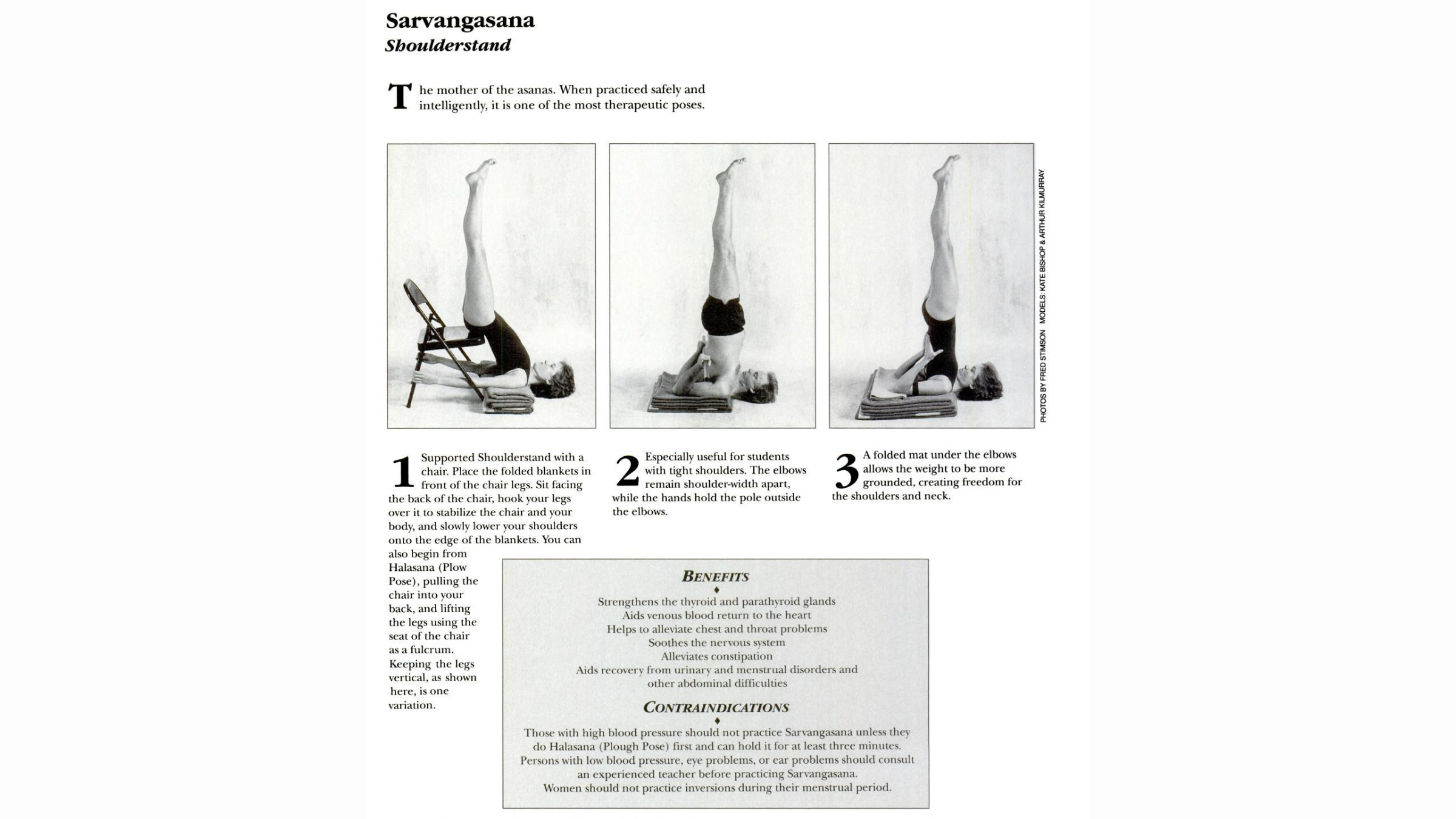
I suggest practicing the pose on a chair—frequently in the beginning, and periodically as your pose improves (Figure 1). Stack three or four folded blankets on the floor in front of the chair and spread a towel or thin blanket in front of them. Sit on the chair facing the back, hook your lower legs and knees over the back of the chair to hold it still, and lower your shoulders onto the blankets, an inch or two from the edge. The center of the sacrum should be balanced on the edge of the chair, and your shoulders should be securely grounded. (Depending on your height, you may need to use more blankets so your shoulders can reach.) Hold the legs of the chair with your arms, adjust the pelvis so the sacrum is centered on the edge of the chair, and adjust your shoulders and head so that your shoulders are almost to the edge of the blankets and your skull rests comfortably on the towel. Straighten the legs one at a time.
The advantage of a supported Shoulderstand is that you can take all the weight off the neck. The shoulders release down, hanging from the chair, while the back rib cage easily lifts (Figure 1). In this supported Shoulderstand, you can explore the relationship between the shoulder girdle and rib cage. Tightness of the shoulder girdle muscles frequently prevents beginning students from properly positioning the arms. To stretch these muscles, the shoulder girdle must move vertically away from the ribs, while the shoulders move laterally away from each other. When the weight of the torso is carried by the chair, gravity assists in the vertical stretch by drawing the shoulders away from the ribs. Holding the arms inside the legs of the chair (as shown in Figure 1) helps create a lateral stretch in the front shoulders. However, this position can also compress the back shoulders, ribs, and neck. If you feel compression, do not take the arms inside the chair legs, but rather stretch them diagonally outside the chair legs to create a lateral opening at the back as well as the front of the shoulders.
Once the shoulder girdle is properly placed, with sufficient vertical and lateral opening, the upper ribs must be adjusted.
Intermediate students tend to overstretch the shoulder girdle by pulling the collarbones too far back and jamming them into the frontal ribs. Instead, through the action of the anterior cervical and intercostal muscles, the first and second ribs should roll under the collarbones and around into the back body. The posterior cervical and upper thoracic muscles then continue the lift up the back body. As the frontal ribs roll toward the back body, the front cervical muscles must not be dragged toward the ribs, but must move toward the back of the ears, to release the throat.
Once you learn to open the shoulders and to create and maintain lift with the support of a chair, you can practice the pose without it, with the hands supporting the midback and the legs stretching upward (Figure 2). However, even experienced students should continue to use blankets under the shoulders to protect the cervical spine. Even when the cervical spine is in its deepest flexion relative to the torso, it does not form a 90 degree angle with the thoracic spine. (To verify this for yourself, stand up, drop your chin, and observe the angle between your neck and torso.)
By placing folded blankets under the shoulders and resting the head on the floor, you are retaining the natural relationship between the cervical and thoracic spines. By not using blankets, you are forc ing the cervical spine beyond its natural range of motion and straining the soft tis sues of the neck and throat. In addition, the vagus nerve, one of the key links in the parasympathetic system, runs through the center of the neck and must be protected if the benefits of Shoulderstand are to be realized.
In an unsupported Shoulderstand, the full body weight is taken onto the shoulder region, so shoulder restrictions again interfere with the proper flow of postural prana.
Because of front chest restrictions, the elbows often flare outward, the outer shoulders cannot ground, and the back body sinks. To counteract these tendencies, a pole can be used to align the shoulders.
Figure 2 shows the hands holding the pole in a way that allows the outer shoulders to drop and the elbows and upper arms to remain parallel.
Another way to overcome the shoulder restrictions is to use a belt to hold the upper arms parallel. The upper arms should press outward into the belt to widen the back body (Figure 3). If the shoulders are very tight, the tension on the belt can be lessened somewhat, letting the elbows spread a little wider apart. The belt must never compress the posterior thoracic region between the scapulae.
Another problem resulting from tight shoulders is the inability to ground the elbows. When the elbows float in the air, it is difficult to lift the back body, and the pranic flow becomes stuck. If a rolled-up mat is placed under the elbows (Figure 3), they can be pressed firmly downward, ensuring lift.
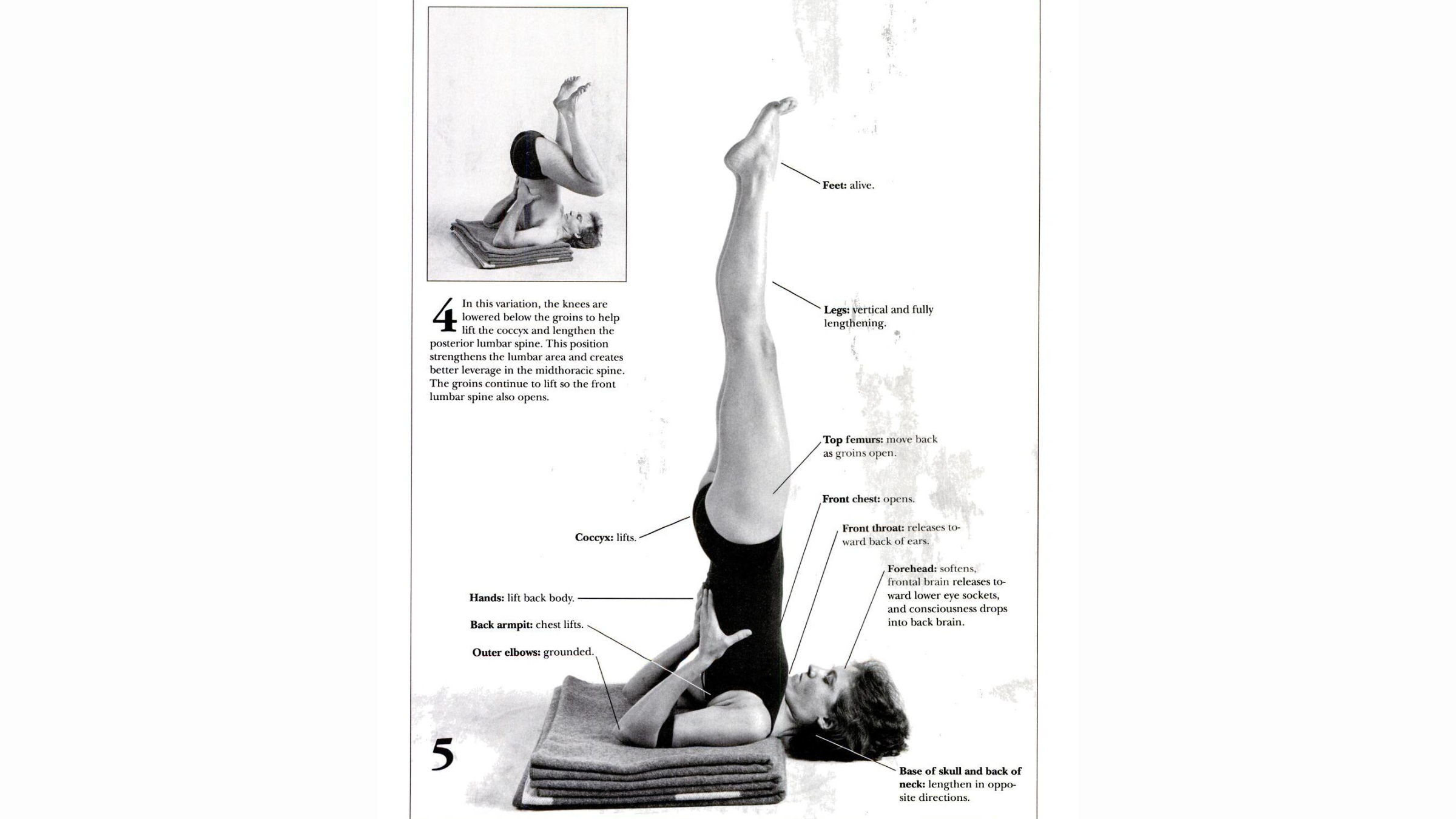
As I have mentioned previously, the posterior mid and lower thoracic vertebrae are difficult to lift. In the squatting shoulder-stand (Figure 4), the femurs are dropped down from the groins to lift the coccyx up. This action in turn improves the leverage on the midspine, making it easier to lift, and strengthens the sacrolumbar region.
Even though the knees are down, the groins should lift up away from the anterior torso, so as not to collapse onto the abdominal organs. A variation for those with weak sacrolumbar regions is to place the feet in Bound Angle Pose (Baddha Konasana), soles of the feet together, with the heels over the perineum. Both of these variations prevent the prana from being blocked in the middle and lower spine.
In classical Shoulderstand (Figure 5), the legs and torso fully lengthen, the shoulder girdle grounds, the neck remains free of constriction, and the brain rests quietly in the skull. The eyes rest on the lower lids, the frontal brain is passive, and the consciousness is turned inward. It is through this state of inner quietness and freedom that Shoulderstand leads to healing.
In our highly stressed culture, such healing is essential if we are to do the necessary work of restoring our planet. As B.K.S. Iyengar has said, in Shoulderstand the ancient sages have bequeathed us a powerful healing practice. If we can use it wisely, planetary healing will be facilitated as well.