Published February 26, 2026 12:21PM
Like Christians, Hindus believe that the Divine contains three separate and unique figures who together form a trinity. In Christianity, the three aspects of Divinity are the Father, Son, and Holy Spirit. In Hinduism, they are Brahma, the Creator; Vishnu, the Preserver; and Shiva, the Destroyer. The combined actions of Brahma, Vishnu, and Shiva enable life in the universe to manifest.
In one myth, Shiva flies into a rage when he is not invited to a great sacrifice being held by another god, Daksha.
According to John Dowson in A Classical Dictionary of Hindu Mythology and Religion, the sweat falling from Shiva’s brow springs up into the demon Virabhadra, “a being like the fire of fate, of most terrific appearance and powers.” Virabhadra and his army destroy the sacrifice and behead Daksa, replacing his head with a goat’s. During the disruption of the sacrifice, “the mountains tottered, the earth shook, the winds roared, and the depths of the sea were disturbed.”
It’s not surprising that Virabhadra is so terrifying. Our sweat symbolizes our essence, our vital juice. How potent must be the liquid essence of Shiva, a god who embodies the power of destruction, when he is full of rage! Virabhadra is the distillation of the primal force of destruction. He is the thunderbolt of Zeus, the wrath of the Old Testament Jehovah. The ancient yogis used the name of this demon to title three yoga asanas—Virabhadrasana I, II, and III.
While Virabhadrasana is generally translated as Warrior Pose, I feel that a more accurate translation, given its mythological origins, would be Destroyer Pose. Of course, since it evokes such ugly images, such a name is likely to meet our immediate resistance. The term “destruction,” implying the decay or dismemberment of something previously whole and complete, seems far from the ethereal world of the spirit. Why did the ancients wish yogis to assume the aspect of the Destroyer, and why were these particular asanas specifically indicated as conveying that energy?
To investigate these questions, we will look deeply into one of these three poses, Virabhadrasana II.
The Transformative Power of Warrior 2
Like all the Virabhadrasana poses, Destroyer II requires enormous stamina. Most of us will easily connect the myth of Virabhadra with our own experience of the pose: When we attempt to hold this asana for even a minute, we feel our own earth shake. Our inner sea is disturbed, and the mountain of our Tadasana may well totter. Who we are when we emerge from the pose is somehow different from who we were when we entered it, even though only a short period of time has elapsed.
The pose can feel like a lightning bolt, striking us with a power so intense that it dazes and disorients us. In fact, one of the other Virabhadrasana poses (Virabhadrasana I) is the sole pose in Light on Yoga about which B.K.S. Iyengar comments, “Even people who are fairly strong should not stay long in this asana.”
What we are experiencing is the power of the Destroyer. We can also see this Destroyer energy at work in the world around us. A gorgeous rosebud, as it unfolds fully, is already beginning to decay; within hours its petals will drop.
Life comes to the surface in summertime, manifesting its potential in an explosion of foliage and flowers. But the forest must burn periodically so new plants may sprout. For human beings to change and transform, we must cast off what we no longer need. As each individual creature reaches its fullest expression, it must step aside to make room for other beings to come into their own fullness. In this way, life can evolve. As Joseph Campbell says, “One can experience an unconditional affirmation of life only when one has accepted death, not as contrary to life but as an aspect of life.”
It is one thing to accept the reality of destruction; it is another to experience ourselves as the Destroyer. Yet, like it or not, we are occasionally cast in that role. Finding ourselves in a relationship that serves neither person, we may realize that we must take the initiative to end it, since our partner will not. We might reluctantly decide to fire an employee who is truly unsuited to his or her work. In the Bhagavad Gita, Arjuna faces the ultimate dilemma, that of the soldier on the battlefield who knows that he might actually take a human life. Arjuna cries out to the god Krishna:
“When I see all my kinsmen, Krishna, who have come here on this field of battle, life goes from my limbs and they sink, and my mouth is sore and dry; a trembling overcomes my body, and my hair shudders in horror…. Shall we not, who see the evil of destruction, shall we not refrain from this terrible deed?” Krishna, of course, reminds Arjuna that the nature of man is to act, and the key is to act without attachment to results: “If any man thinks he slays, and if another thinks he is slain, neither knows the ways of truth. The Eternal in man cannot kill: the Eternal in man cannot die…. For not even for a moment can a man be without action…. Perform therefore thy task in life.”
The Bhagavad Gita is unequivocal: We may be called upon to perform the work of the Destroyer. What is left ambiguous is how to know whether our actions are propelled by divine inspiration or our own egos. At one extreme, we would attack anyone who disagrees with or even annoys us. At the other extreme, we would be loath to swat a fly or cut the grass in our yards. The coward rejects the Destroyer energy altogether; the bully uses it only too readily. Perhaps the ancients gave us the Virabhadrasana poses as one way to practice working with the volcanic and dangerous energy of destruction. If we become familiar with experiencing and using power within the safe context of yoga practice, we may learn to handle it with dispassionate wisdom in other parts of our lives.
One of the memorable images of Indian art depicts the god Shiva, surrounded by rings of flame, manifesting himself as Nataraja, the dancer. Joseph Campbell points out that “in Shiva’s hair is a skull and a new moon, death and rebirth at the same moment.” Shiva is dancing atop a small creature, representing ignorance, or avidya, which is destroyed by Shiva’s terrible power. In one hand he holds “the drum of time, which shuts out the knowledge of eternity.” In the other hand, a flame burns away the illusion of time, opening the mind to a larger reality. Though Shiva Nataraja is a destructive image, the overall sense is one of joy: The small and temporal is being destroyed so that something great and eternal may be created. Virabhadrasana 1, like all the Virabhadra poses, allows Shiva to perform this work of transformation inside us. As we enter the posture, it envelops us in a purifying flame, inside of which we shake and tremble. If we surrender to this fire, a phoenix may rise from the ashes, with the strength and wisdom to do the work of the Divine.
How to Practice Warrior 2
Benefits
- Strengthens legs
- Opens hip joints
- Combines stamina and flexibility
- Teaches correct body alignment
Contraindications
- Do not practice this pose if you have heart problems, fever, or diarrhea.
- Pregnant women may do this pose but should not hold it long.
Beginners: Imagine a tall building whose mass lies in the center, with one supporting column placed off to one side and the other sloping at a 45-degree angle. Now imagine the architect of that building: He or she would immediately be fired! This is the seemingly crazy challenge presented by Virabhadrasana II.
To hold ourselves up when our vertical base of support has been kicked out from under us, we must develop and draw upon deep reserves of power. First, we must learn to align and distribute our weight. Begin by separating your feet by four and a half to five feet (the exact distance will vary, since leg length differs from person to person).
Upon completion of the pose, the knee of the front leg should be positioned directly over the heel (Figure 5). This placement allows the shinbones of the front leg to function as an upright pillar supporting the body’s weight. If the feet are placed either too wide or too close, the pillar of the lower front leg will tilt, and the thigh muscles will have to work harder.
Turn your right foot out 90 degrees and your left foot in approximately 30 degrees. Lift your arms to shoulder height. The extension of the arms should continue clear into the fingertips; don’t block the stretch at the wrist joints, or the hands will hang like dead fish! If the arms are fully stretched, you may even feel the shoulder blades drawing away from the spine. The lift of the arms must not cause the shoulders to rise toward the ears; instead, visualize the skin on top of the shoulders flowing down the back. This instruction is important, since many of us tend to respond to stressful situations by unconsciously tightening and lifting our shoulders.
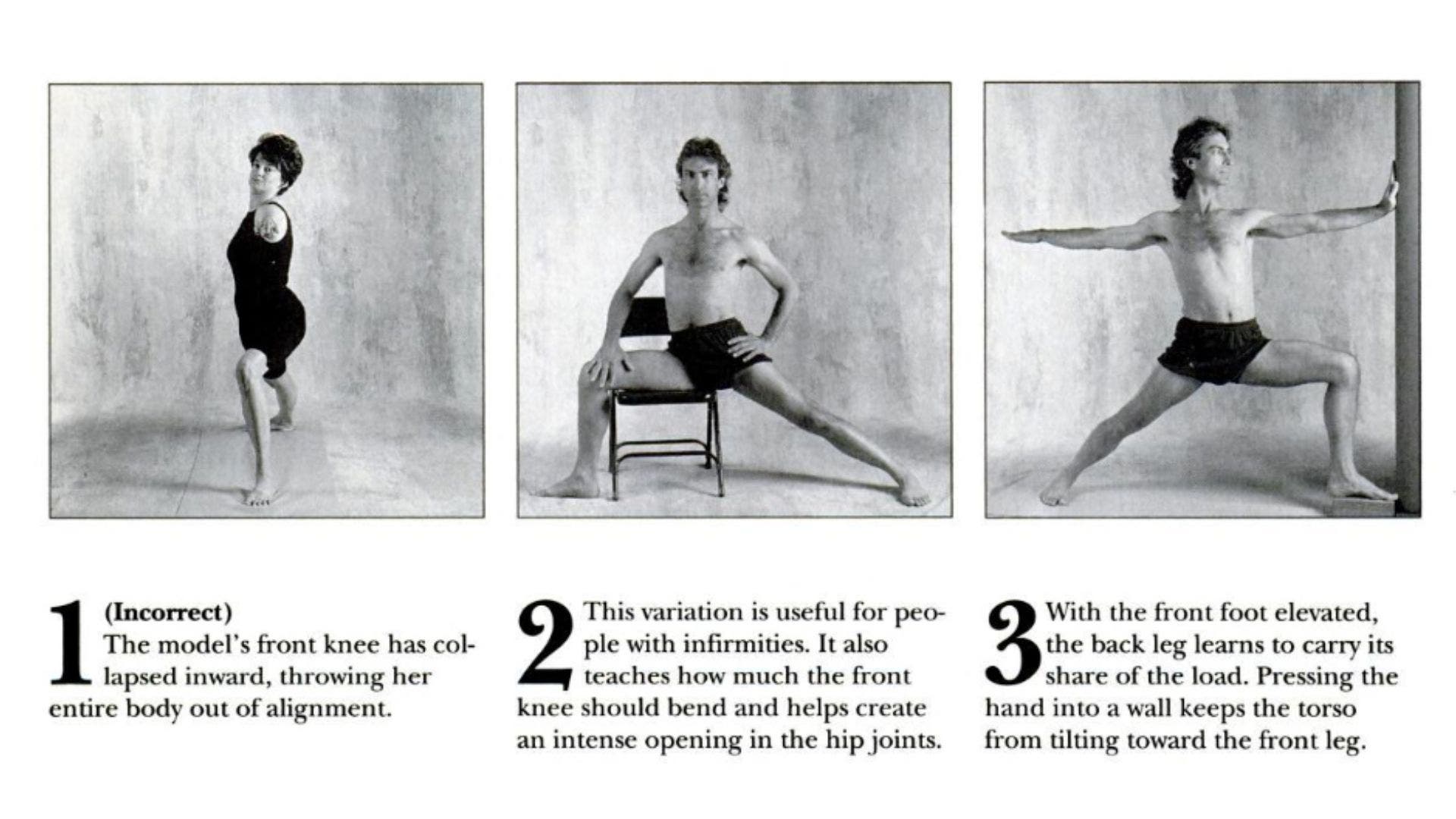
Lift the kneecap on the left knee by contracting the front thigh muscles. This knee must remain straight the entire time you are in the pose. Externally rotate the entire right leg within its socket so your right kneecap is facing in the same direction as your toes. Now bend the right knee until the right thigh runs parallel to the ground. Don’t allow the front knee to cave inward as shown in Figure 1—this position is not only unstable, but potentially injurious to the knee.
Instead, keep the knee directly over the heel of the front foot. Hold the pose for 20 to 30 seconds at first, working up to a minute or more on each side. Then come up and perform the pose on the other side, with the right foot turned in and the left foot turned out.
To help open the hip joints, practice Virabhadrasana Il using a chair for support (Figure 2). Notice that only the thigh of the front leg rests on the chair seat; no part of the back leg is supported by the chair. (If the chair is too high for your feet to reach the ground easily, place a book beneath each foot. If it’s too low, pad the chair seat with a folded blanket.) The model in Figure 2 is demonstrating how to use the hands to create greater openness in the hip joints.
Since his front knee tends to roll incorrectly toward the camera, he is using his right hand to press that knee away from the camera. If you try this action yourself, you will find that as the front knee is pressed back, the back hip will swing forward: Such is the treachery of the body!
Therefore, use your other hand to restrain the back hip, creating a powerful stretch across the groins. This variation has several benefits. Since the body’s weight is supported by the chair, the need for stamina is eliminated, making the pose accessible even to students who are very weak or recovering from recent illness. Stronger students can benefit from this variation, because it can be held longer and with greater precision than the free-standing Virabhadrasana. Finally, because the chair seat is parallel to the ground, it gives instant feedback on how far you must descend to get the front thigh parallel to the ground.
Increasing flexibility at the expense of developing strength is not a good policy, however. Also, the full spirit of the pose can only be experienced when we are struggling to support ourselves. Thus, Destroyer-on-the-Chair should be practiced only occasionally by students with normal physical capacity.
Continuing students: As we continue to work in Virabhadrasana Il, two major challenges present themselves. The first is to descend deeply enough into the pose that the underside of the front thigh runs exactly parallel to the ground. Virtually all yoga students stop a few inches short of this completed position, yet the intense power of the pose is only generated when the leg drops quite low. While the use of mirrors in yoga practice is generally discouraged because it draws consciousness outward, for this one pose I suggest that you occasionally check your position in a mirror. Even advanced students may be shocked to see that they do not descend fully into the pose. Drop an additional two inches and see what happens.
The second (and seemingly contradictory challenge is to bring the weight to the back leg. When we bend the left knee, the weight tends to shift onto the left leg, and the spinal column itself may tilt in that direction. Yet endurance will rapidly flag if the right leg doesn’t carry its share of the load. Figures 3 and 4 show two ways to learn this important action.
In Figure 3, the front foot rests on a brick placed against a wall. With the front foot elevated, more weight will naturally shift to the back leg, especially if the hand also pushes against the wall. This variation trains the back leg to remain strong and solid and helps the spinal column remain upright instead of tilting to the side.
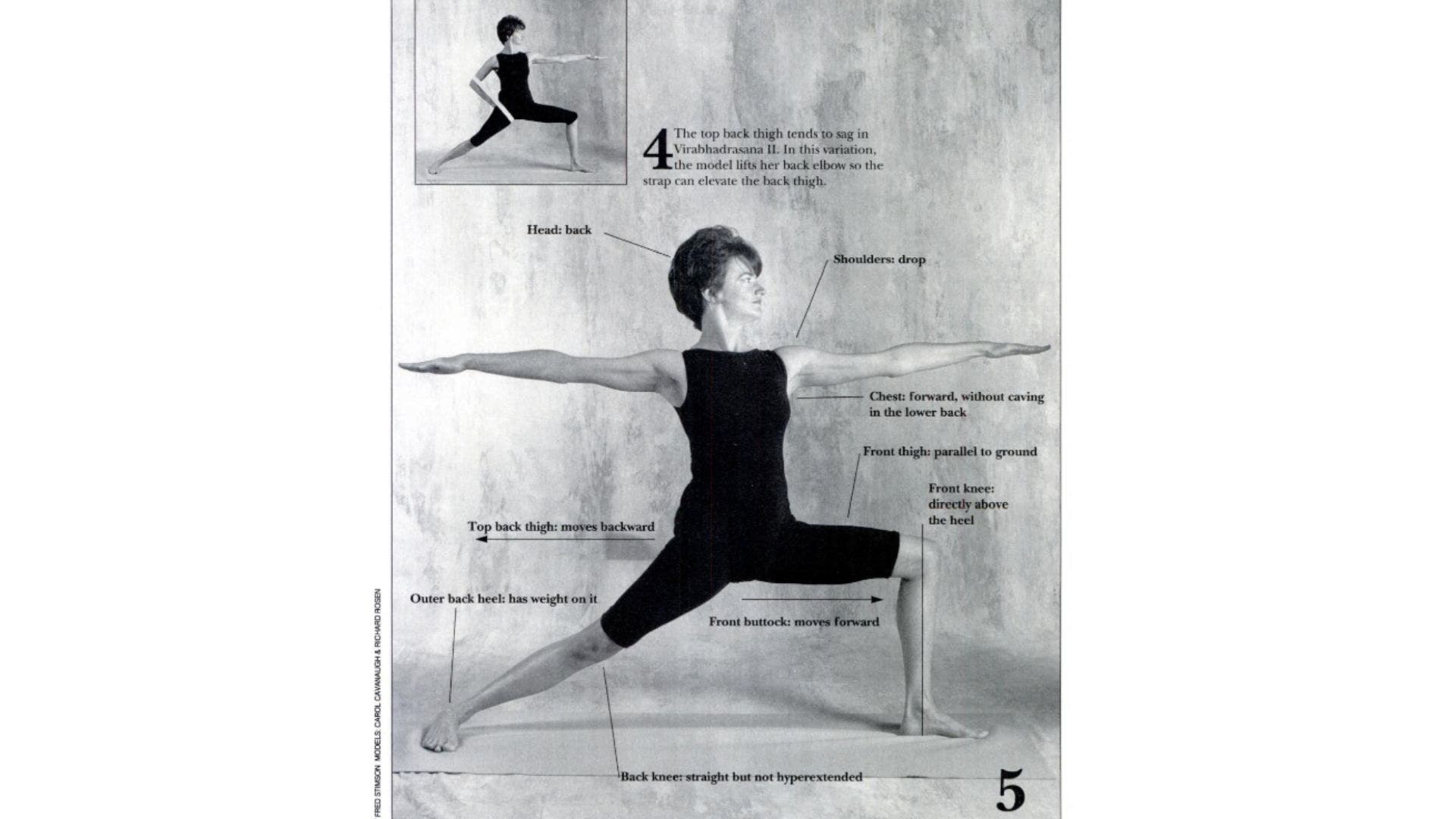
Figure 4 shows a different way of activating the back leg. Whereas Figure 3 creates a horizontal opening, this variation emphasizes balanced vertical movement. The top third of the back thigh-bone tends to sag toward the ground, yet it absolutely must lift upward if the back leg is to support the body’s weight. Buckle a belt to create a loop. Step into the loop with your back leg and place the other end around your upper arm just above the elbow. Rest your fist on the outer hip crease of the back leg and tighten up any slack in the belt. As you bend your front knee, raise the belted elbow slightly. The belt will lift up on precisely that section of the back thigh that tends to collapse.
Thus the body is given two contradictory messages simultaneously. The front knee must drop deeply into the pose, while the back leg lifts as if to come out of the pose. Here we feel the Warrior aspect of Virabhadrasana: The front and back legs are at odds with one another. But curiously, when these two opposing actions exactly match each other in strength, harmony results. The work of the pose is evenly distributed, stability slowly develops, and endurance grows.
Experienced students: Virabhadrasana II is probably equally daunting to the beginner and to the advanced pupil. The many challenges this pose presents to the experienced student may be summed up in a single concept: Bring the body onto its center axis. Take another look at Figure 1. When the model’s left knee moves forward, her left buttock goes backward. To compensate, her lower back and neck move forward.
When she realizes her head is misaligned, she throws it back. This pose has no center, and the student is easily thrown off balance. Contrast your pose with this gruesome picture. Can you open the front hip so much that the outside of that knee runs exactly in line with the buttock? Can you allow the skin of the inner front thigh to flow toward the knee, and the skin of the outer front thigh to flow from the knee toward the buttock? As you created that action, the back thigh probably thrust forward; can you draw it back without hyperextending the back knee?
Thus, in every movement and every limb, a small battle is fought between two sides so the exact center may be determined. In Virabhadrasana II, we seek to find the physical center so no body part has to carry more than its share of the load. On a deeper level, we seek to find the spiritual center, to uncover the wisdom at our core that may be entrapped by layers of superficiality.
When we are centered in this core, we cannot be swayed by passion or egotism. We must pray that the work of the Destroyer will only be done by those people who can connect with and operate from that dispassionate core of wisdom.