Published March 19, 2026 02:26PM
Yoga Journal’s archives series is a curated collection of articles originally published in past issues beginning in 1975. This article first appeared in the September-October 1993 issue of Yoga Journal.
As yoga practitioners, many of us feel alienated by the mainstream approach to “fitness” in our culture. We find it hard to understand how a person can ride a stationary bicycle to nowhere while reading The Wall Street Journal or attend a step class to disco music after a day of climbing the corporate ladder.
Like it or not, however, we’re part of a society that views fitness, the body, and health in ways that have become deeply embedded in the collective psyche. We may not realize how much we have unconsciously internalized our culture’s ideas about health and fitness—and embodied them in the way we practice yoga.
A brief perusal of a fitness magazine can give us some sense of how we have come to consider the human frame. Today the body is generally thought of as a machine: “Fuel those muscles with high-test performance protein powder!” In circles where material status symbols have become “uncool” or environmentally or politically incorrect, body image has become the ultimate symbol of power and achievement, as fitness video after fitness video attests. In fact, some workout tapes cover just a single body part or area, taking to the extreme our tendency toward a reductionistic view of the body.
We might wish to consider ourselves and our fellow yoga practitioners as a distinctly separate group with different concerns, but every book, advertisement, and movie we encounter affects our unconscious.
Changing How We View Physical Fitness
The Western concept of fitness has reduced the body to a musculoskeletal system with a rapidly pounding heart inside it. Unlike Eastern forms of exercise such as t’ai chi, which emphasize the correct internal movement of chi (or life force) through the body, Western forms of exercise are obsessed with the outer wrappings of the body—the muscles. How we look is far more important to us than the healthy functioning of our liver, lungs, or lymph system, not to mention the purity of the blood, the strength of the kidneys, or the effectiveness of the organs of digestion, assimilation, and elimination.
Unfortunately, all the muscle definition in the world will not keep us alive should our vital organs fail. In that respect fitness is not necessarily health.
Even yoga is often practiced from this limited perspective. As a teacher, I’ve observed that most people visualize their bodies as bony scaffolding held together by muscles and ligaments. They move according to this abbreviated awareness. You might think of the musculoskeletal system as the outer container of the body, providing support, power, leverage, and a specificity and directness to your movements. Moving from the muscles and bones is not incorrect, but it is incomplete.
Learning How to Move From the Inside Out
The organs comprise the inner contents of the body. When we become more aware of these vital organs, we access our ability to initiate movement from them. When action is initiated from these central places, the quality of our movements and our experience of our bodies dramatically change. Movement slows down. Postures unfold as a result of an inner opening and expansion that is communicated to the outer container.
When we initiate movement from the core, our inner experience becomes more and more congruent with our outer actions. Rather than being tyrannized by externally referenced ideas of how far we should be able to go or what we should look like in a posture, we can begin to listen to the voice of our inner perceptions, trusting for the first time what we may have blindly ignored for years.
Some teachers refer to this sensibility as “moving from the inner body,” “moving from the core,” or “moving from the center.” When we talk about the body in these terms, we’re talking about a definite physical location (the organ system), but we’re also talking about a psychological space within ourselves that has no specific locus. As Bonnie Bainbridge Cohen, director of the School for Body-Mind Centering in Amherst, Massachusetts, describes it, “Organs are the primary habitats for our emotions, aspirations, and memories of our inner reactions to our personal histories.”
How to Practice Jathara Parivartanasana
The pose that we’re going to investigate here, Jathara Parivartanasana (Revolved Belly Pose), deeply massages the internal organs. We can dramatically increase the potential benefit of this and other postures by focusing our awareness on these crucial centers of health.
While musculoskeletal initiation, support, and alignment are important, sometimes an overemphasis on this system can exhaust us. By bringing awareness to the organ system, we allow dormant aspects of our consciousness to emerge while the musculoskeletal system rests and recuperates.
Beginners’ Practice
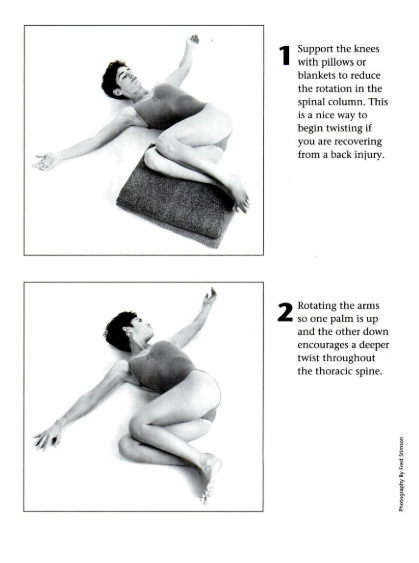
This is a good beginning movement for people who have had back pain. The two pillows or folded blankets will decrease the rotation in the spine, making the pose more accessible to those who are just beginning to move again after injury.
Lie on your back with your knees bent and your feet flat on the floor. Experiment with the position of your feet (varying the distance between the feet and the distance between the feet and the sitting bones) to require the least amount of muscular effort. Place your pillows or folded blankets on either side of you and then extend the arms out to the sides with the palms facing up.
Bring your awareness down into your abdomen, feeling the way the breath swells and recedes. Scan the entire torso from the floor of the pelvis to the tops of the lungs, checking for areas that feel dense, nervous, congested, or contracted. You may find the diagram of the major internal organs helpful in directing your attention. Also scan for sensations of heat (especially burning) or cold. If you’ve been having a health problem such as constipation, can you identify the location of the sensations you feel?
Bring the knees one at a time into the chest. Inhale and, with the next exhalation, roll the knees to your right side and rest them against the pillow (Figure 1). Extend through both arms but do not force the left shoulder onto the floor. If the left shoulder has come off the floor, you may need to raise the height of the pillow.
Allow the contents of the abdomen to completely relax. Sucking in the abdomen is a deep-seated habit that often begins at a very young age. Every few breaths, return your awareness to your belly and check if you are tightening in any way. (This “awareness check” is good to practice throughout your day, especially if you have digestion or elimination problems.)
Jathara Parivartasana is one pose where you can literally “let it all hang out” to good effect. The more you can relax and breathe into the belly, the more the internal organs will be massaged and squeezed. When you release the twist, new blood and fluid will flow into the belly. This exercise also manipulates the large intestine to improve elimination.
Roll the knees into the chest on an exhalation and repeat the pose to the left side.
Variation
This is a modified version of an exercise presented in Thomas Hanna’s Somatics: Reawakening the Mind’s Control of Movement, Flexibility, and Health. As in the previous variation, begin by lying on your back with your knees bent and the palms facing up. With the arms extended to the sides, roll one shoulder down toward the floor so the palm turns down. Roll the other shoulder up so the palm faces up.
In a very relaxed way, alternate rolling the shoulders and arms, feeling how the shape of the upper body changes as you move more deeply into the rolls. Feel free to let your elbows bend slightly so the shoulders can roll more freely.
After about 10 passes, roll the knees into the chest one at a time. On your next exhalation, roll the knees to the side where the palm is facing down (Figure 2). As you change the position of your arms, roll the knees to the other side.
Continue to alternate side to side for about 10 passes on each side. You may notice that your head naturally tends to turn toward the upturned palm. Let this movement happen with as little effort as possible. Notice how this exercise is initiated through the skeleton with the organs following in tow. You might imagine the bones as a washing machine agitator and the soft organs as wet clothes being moved, rolled, and turned by the action of the agitator/bones.
Advanced Practice
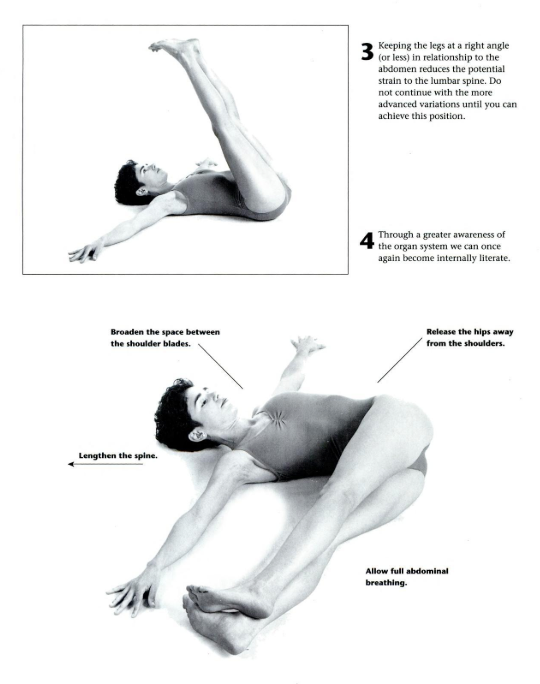
Lie on your back with the knees bent and the arms extended out to the sides in line with the shoulders. Raise the buttocks off the floor and shift the pelvis four to six inches to the left. Now roll the knees up toward the chest, then lower them to the right. Shifting the pelvis to the left will align the curves of the spinal column in a more neutral position, allowing the twist to work more deeply. On your next exhalation, extend the legs until they are straight (Figure 4). To deepen the stretch across the sides of the hips and in the lumbar spine, you may want to hold the soles of your feet with your right hand.
Now focus your attention on the movement of your breath throughout the torso. Allow the belly to swell and recede so the spine undulates between extension and flexion. To broaden the shoulders and increase the space between the shoulder blades, soften and expand the lungs out toward the sides of the chest cavity. As your lungs begin to expand to fill the rib cage and shoulder blades, adjust the position of the right shoulder blade by “walking” it away from the spine. This action will allow the left shoulder to drop farther into the floor.
Feel the relationship between the bones and muscles and the soft internal body. As you visualize the shape you would like to make with the body, let the inner organs move to create that shape.
To lengthen the torso, direct the breath along the vertical axis of the body as if you were sculpting the body from the inside. To broaden the body from the breastbone out into the collarbones and from the spinal column out into the ribs on each side, direct your attention to your heart. Initiate the inhalation from the level of the heart, letting the breath expand out through the breastbones, muscle, and skin. Then adjust the outer container of the body to make even more room for the expanding inner body. Stay in the pose for one to three minutes, then repeat it on the other side.
For students who have strong abdominal muscles and no preexisting weakness in the lower back, prepare to repeat the pose on the first side by shifting the buttocks to the left and then straightening the legs up toward the ceiling. Only continue with this variation if the legs are at a right angle or less to the abdomen (Figure 3). On an exhalation, let the contents of the abdomen fold back toward the spine and, maintaining full extension through the legs, lower them slowly to the floor. This variation will create a stronger massage of the internal organs, as the outer musculature of the body squeezes and twists the soft interior.
To switch to the other side, let the contents of the belly drop back toward the spine as you drop the lungs into the shell of the shoulder blades on an exhalation.
Keeping the legs together so they can be controlled more easily, draw the legs in a swift motion back toward the chest and up toward the sky. Then repeat to the other side.
Again feel the relationship between the outer and inner body. Each shapes and influences the other. At certain moments, it will be more effective to initiate movement predominantly from the musculoskeletal system, with the action usually traveling sequentially from the periphery (the feet, hands, or head) to the center and out again to the periphery.
Observe how the inner body feels when movement is created this way. At other times, movement is more effectively initiated from the center, radiating out to the periphery. How do the muscles respond to movement initiated in this way?
Every asana is an interplay between the inner contents and the outer container of the body, each communicating with and influencing the condition of the other. The challenge of integrating these two systems also shows up in our everyday lives. By focusing on and perceiving the state of the inner body, we can begin to map how sensations correspond to feelings. As we become internally literate, we know more and more what we feel at any given moment and can navigate our actions accordingly.
Moving from our deepest selves with this clarity can powerfully impact our personal lives, the lives of those around us, and the larger container of the surrounding environment.