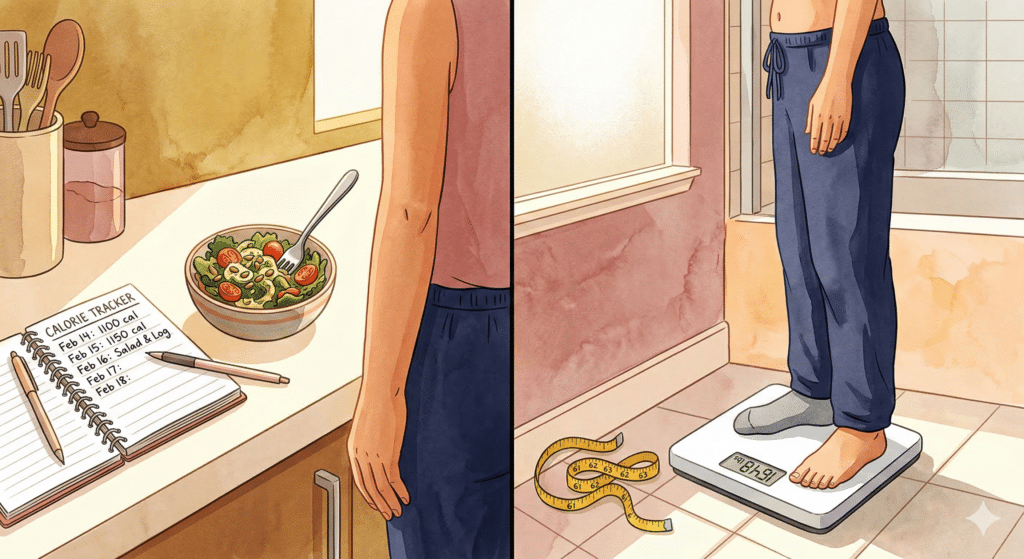

You were good today. Really good.
You skipped breakfast because you weren’t hungry — or because you were trying to be disciplined. You had a salad for lunch. You drank your water. You said no to the office cookies. You stayed strong through every craving, every temptation, every moment your coworkers ordered pizza.
And then 6pm happened.
You walked through your front door, opened the refrigerator, and became a completely different person. Ravenous. Frantic. Eating standing up over the sink, reaching for anything, unable to stop until the discomfort finally forced you to. And then came the guilt. The familiar, crushing feeling that you have no willpower. That you’re broken. That you’ll never figure this out.
Sound familiar?
Here’s what nobody has told you: that moment at the refrigerator wasn’t decided at 6pm. It was decided at 7am.
Your body runs on hormonal rhythms — and those rhythms are set early. Cortisol, your primary stress hormone, doesn’t just spike and disappear. It builds. It cascades. It quietly reshapes your metabolism hour by hour, until by evening, your biology is working completely against you.
And most people are unknowingly flooding their system with cortisol before they’ve even had their first cup of coffee.
Once you understand how this pattern works, you can change it. Not through more willpower — but by addressing what’s actually driving the cycle.
The Day That Was Already Over Before It Started
Picture this. The alarm goes off at 6:30am and your body jolts awake — heart pounding, already behind. You grab your phone before your feet even hit the floor. There’s a stressful email from your boss. A news alert that makes your stomach drop. Three texts you need to answer.
You’re already running late, so you skip breakfast. You’re trying to be good anyway, right? Less food, less weight. You sit in traffic for forty minutes, arrive at work frazzled, and spend the next three hours putting out fires.
By 10am, you feel exhausted. By noon, you eat a small salad and call it discipline. By 6pm, you’re standing in front of the refrigerator eating cold leftovers straight from the container — and you genuinely cannot stop.
Sound familiar?
Here’s what most people don’t know: that evening didn’t happen because you have no willpower. It was decided at 7am.
Every single moment of that morning — the alarm, the phone, the skipped breakfast, the commute — wasn’t just an inconvenience. It was a biological event. Each one triggered your adrenal glands to pump cortisol, your primary stress hormone, directly into your bloodstream.
The Science: Your adrenal glands cannot distinguish between a physical threat and a psychological one. The moment your nervous system perceives danger — whether that’s a lion or a loaded inbox — it releases cortisol. The hormonal response is identical.
Your body can’t tell the difference between a deadline and a lion.
And here’s where it compounds. Cortisol spikes aren’t isolated events that resolve and reset. Cortisol is cumulative. Each new stressor hits before the previous cortisol wave has fully cleared. By the time most people reach the office, they’re already carrying a full cortisol load — and their metabolism has already shifted into emergency survival mode.
Your Morning Cortisol Trigger List
Each of these common morning experiences registers as a biological threat signal — spiking cortisol before most people have finished their first cup of coffee:
- Jarring alarm (startle response = immediate cortisol release)
- Checking your phone within minutes of waking
- Skipping breakfast (your body reads this as a famine signal)
- Sitting in traffic or rushing to commute
- Opening a stressful inbox or calendar
Consider Sarah. She’s careful with food all day. Small lunch, no snacking, plenty of water. She genuinely tries. But her mornings are chaotic — rushed, anxious, always behind. By evening, she feels like a completely different person. Ravenous in a way that feels almost desperate.
She blames herself. She shouldn’t.
Jon Gabriel describes this exact pattern from his own experience. At his heaviest, Jon wasn’t failing because of what he ate. He was failing because of what his body believed about his safety. His stress response — not his salad choices — was the primary driver. His mornings were programming his metabolism for the entire day, and he didn’t even know it was happening.
In the Gabriel Method framework, this is what’s known as your FAT Programs activating. FAT stands for Famine and Temperature — the ancient survival signals that tell your body to store fat and conserve energy. Chronic morning stress is one of the most powerful triggers of those programs.
Your body isn’t broken. It’s doing exactly what it was designed to do — preparing for an emergency by holding onto every calorie it can.
You didn’t fail your diet by dinner. Your biology was already working against you by breakfast.
Once you understand that, everything changes.
Cortisol 101 — The Hormone That Was Never Meant to Stay
Before you can change the pattern, you need to understand what you’re actually dealing with.
And the first thing to understand is this: cortisol is not your enemy.
In the right context, cortisol is a survival masterpiece. It’s the hormone that floods your system when you need to act fast — when you need to sprint, fight, or get out of danger. It raises your blood sugar almost instantly so your muscles have fuel. It sharpens your focus. It temporarily shuts down “non-essential” functions — like digestion, reproduction, and immune response — so every ounce of energy can go toward getting you to safety.
It’s remarkable, actually. Your body’s ability to mobilize resources in a crisis is extraordinary.
The key word in all of that? Temporarily.
The entire cortisol system was designed for acute stress — with recovery built in. You sense danger. Cortisol floods in. You run. You reach safety. Cortisol drops. Your body exhales, resets, and returns to baseline. The whole system works beautifully — when the threat has an ending.
Here’s the problem with modern life: the threat never ends.
The inbox doesn’t empty. The financial pressure doesn’t lift. The traffic happens again tomorrow. The social anxiety follows you onto your phone at 11pm. There’s no moment where your nervous system gets to say, “Okay. We made it. We’re safe now.” So cortisol keeps circulating. Day after day. Low-grade, constant, relentless.
And that’s where the metabolic damage begins.
What Cortisol Does to Your Metabolism — In 4 Steps
Step 1 — Blood Sugar Spike: Cortisol raises blood sugar rapidly to fuel a “fight or flight” response you’re never actually completing.
Step 2 — Insulin Surge: High blood sugar triggers insulin release. Insulin’s job is to clear that sugar — and it does so by driving it into fat cells.
Step 3 — Muscle Breakdown: Chronically elevated cortisol breaks down muscle tissue to keep blood sugar supplied. Less muscle means a slower metabolism.
Step 4 — Leptin Disruption: Cortisol suppresses your sensitivity to leptin — the hormone that signals “I’m full.” When leptin stops working, the off-switch for hunger disappears entirely.
That last one is critical. Leptin is your body’s “enough” signal. When cortisol corrupts it, you can eat a full meal and still feel like something is missing. You’re not being dramatic. The signal isn’t arriving.
The Science: Chronically elevated cortisol suppresses leptin sensitivity, disrupts insulin signaling, and instructs the body to prioritize fat storage — particularly around the abdomen — regardless of how many calories you’ve consumed that day.
Think of it like a thermostat.
When cortisol is chronically high, your body’s fat thermostat gets stuck on “store.” It doesn’t matter how small your lunch was. The setting doesn’t change based on what you eat. It changes based on what your nervous system believes about your safety.
Jon Gabriel understood this the hard way. At his heaviest, he wasn’t eating recklessly. He was trying. But the real variable — the one nobody had pointed to — was his stress response. His body had decided, based on everything it was experiencing, that storing fat was the smart survival move. No salad was going to override that signal.
Here’s the analogy that brings it home.
Imagine you’re locked in a room with very little oxygen. You start gasping. You become desperate, frantic, consumed by the need for air. Would anyone call you “greedy” for wanting to breathe? Of course not. You’re not being excessive — you’re starving for something your body cannot function without.
The person standing at the fridge at 9pm, eating when they promised themselves they wouldn’t, is not weak. They are biologically starving — not for food, but for a signal that says “you are safe.” Cortisol has hijacked their hunger system. Their body is searching for relief and reaching for the only tool it knows: calories.
Chronic cortisol doesn’t just make you stressed. It makes you fat.
And it does it quietly, invisibly, through every other hormone in your system. That’s what makes it so frustrating — and so important to understand.
The Cortisol Clock — How Morning Sets the Tone for Everything
Your body runs on a schedule. A very precise, very elegant biological schedule that has been refined over hundreds of thousands of years of human evolution.
And cortisol is one of its most important timekeepers.
Here’s something most people don’t know: cortisol is supposed to spike in the morning. In fact, there’s a specific term for it — the Cortisol Awakening Response, or CAR. About 20 to 30 minutes after you open your eyes, your cortisol naturally surges. This is healthy. This is your body doing exactly what it should do.
That natural morning peak is your internal alarm system — the biological equivalent of your body saying, “Okay, it’s time. Let’s get moving.” It sharpens your focus, mobilises your energy, and prepares your metabolism for the demands of the day ahead.
After that peak, cortisol is designed to gradually decline throughout the day. By evening, it should be at its lowest point. That drop in cortisol is what signals your body to shift out of high-alert mode and into rest, repair, and recovery. It’s what allows you to wind down, sleep deeply, and wake up restored.
That’s the ideal arc. And it’s genuinely beautiful when it works.
Here’s what goes wrong.
When you pile on additional stress triggers before that natural morning peak has even finished — the jarring alarm, the anxious phone scroll, the skipped breakfast, the panicked commute — you are stacking artificial cortisol spikes on top of the natural one.
Instead of one clean peak followed by a gradual decline, your cortisol curve looks more like a jagged mountain range. It spikes, partially drops, spikes again, partially drops, spikes again. It never fully resolves.
The Science: Research shows that when the Cortisol Awakening Response is disrupted or amplified by psychosocial stress, the entire diurnal cortisol rhythm is thrown off — leading to elevated cortisol levels persisting well into the evening hours, directly impairing the body’s ability to enter fat-burning and recovery mode.
What does that mean for you practically? It means that by the time you sit down for dinner, your cortisol levels are still elevated when they should be dropping. Your body is still in emergency mode when it should be shifting into restoration mode.
And in that emergency state, your brain gets a very specific signal: eat. Store. Survive.
The cravings you feel at 8pm aren’t random. They are a direct downstream consequence of the hormonal environment you created at 8am.
Your Cortisol Arc: What It Should Look Like vs. What Stress Does to It
Healthy Pattern: Cortisol peaks 20–30 minutes after waking, then steadily declines throughout the day, hitting its lowest point by evening — allowing for rest, repair, and fat-burning overnight.
Stress-Disrupted Pattern: Multiple cortisol spikes through the morning and afternoon keep levels artificially elevated. By evening, cortisol is still high when it should be low — triggering intense hunger, fat storage signals, and poor sleep that resets the whole cycle the next morning.
There’s another layer to this that makes it even harder to escape.
Poor sleep — which is itself a consequence of elevated evening cortisol — resets the next morning’s cortisol response at an even higher baseline. One stressful morning bleeds into a poor night’s sleep, which bleeds into a more reactive stress system the following day, which bleeds into another evening of cravings and overeating.
This is not a willpower cycle. This is a hormonal cycle.
Jon Gabriel spent years living inside this cycle without knowing it. The mornings were chaotic, the evenings were out of control, and no amount of discipline during the day could break the pattern. It wasn’t until he understood that his body’s internal clock had been hijacked — that his stress response was overriding everything else — that things finally began to shift.
The good news? Rhythms can be reset. And it starts earlier in the day than you think.
If you’re ready to stop fighting your body and actually start working with it, I invite you to experience the complete step-by-step system inside the 12-Week Total Transformation Program.