(Photo: Tony Anderson | Getty Images)
Published December 19, 2025 05:33AM
In Yoga Journal’s Archives series, we share a curated collection of articles originally published in past issues beginning in 1975. These stories offer a glimpse into how yoga was interpreted, written about, and practiced throughout the years. This article first appeared in the March-April 1985 issue of Yoga Journal. Find more of our Archives here.
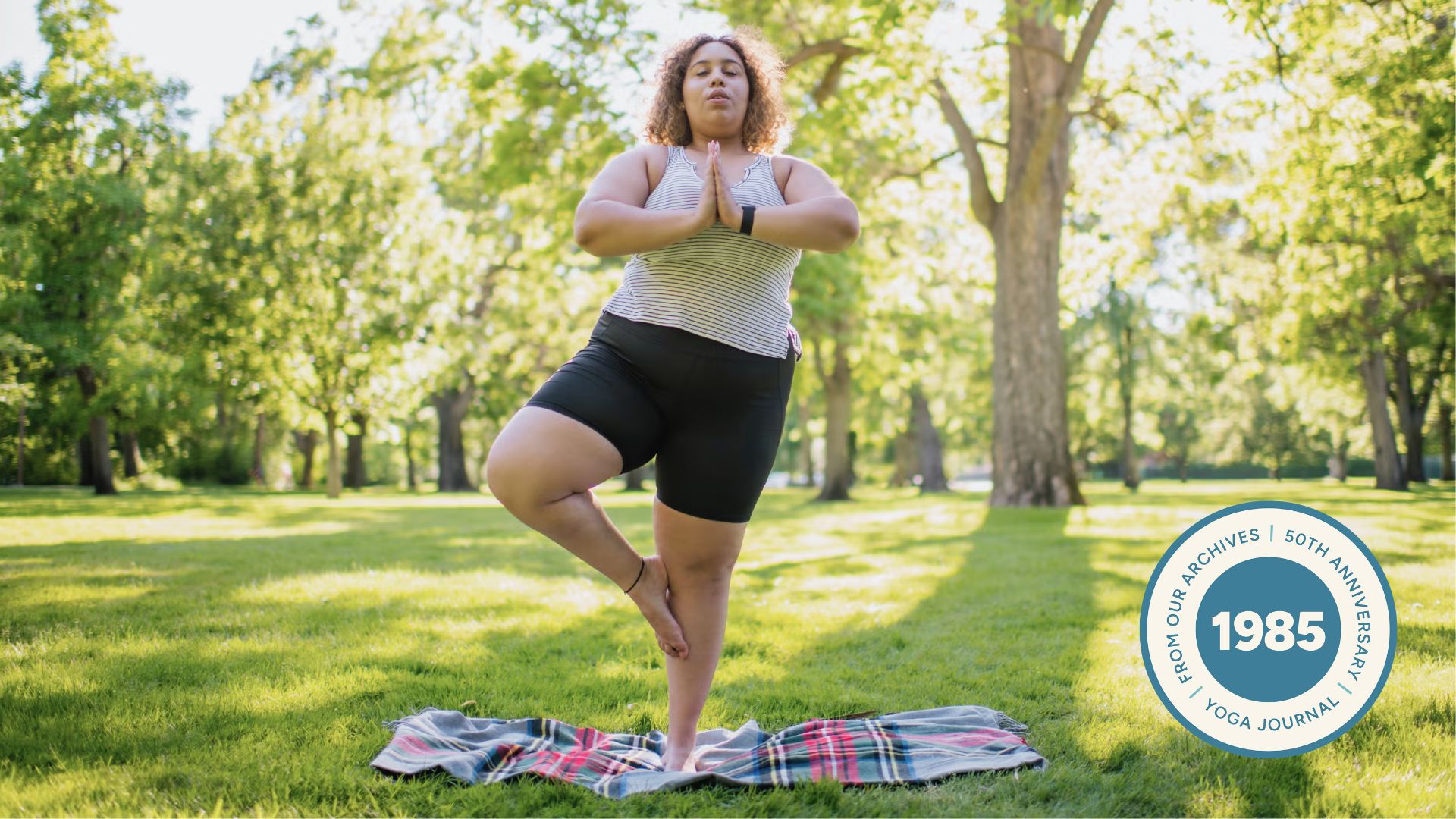
Balance is a critical concept in the practice of yoga asana. Tree Pose (Vrksasana) teaches the beginning student balance as well as the concentration necessary to achieve that balance.
Tree Pose requires strength in the quadriceps (front thigh) muscle of the supporting leg as well as flexibility in the hip joint of the opposite leg. But the difficulty of the pose is chiefly in maintaining the elongation and stability of the vertebral column when one leg is raised. In normal standing, the vertebral column rests evenly on the superior surface of the sacrum. As the leg is lifted in Tree Pose, one side of the pelvis is usually tipped, causing the vertebral column to bend to the side as in Figure 2 (below). With concentration, however, the student learns to raise the leg and actively stretch the vertebral column in order to maintain its vertical lift.
This is an example of the dynamic motion of asana. Outwardly, Tree Pose appears still; inwardly, attention is exercised to maintain the evenness of the vertebral column and the balance of the body.
This outward stillness and inward dynamism means that the student’s attention cannot waver. Learning not to waver is at the core of the philosophy of yoga. Learning not to waver in a posture is termed asana. Learning not to waver in the energy of the breath is termed pranayama. And learning to keep the mind from wavering is called meditation. Mircea Eliade, in Yoga, Immortality, and Freedom, calls yoga “the great refusal.”
Asana is the student’s refusal to move physically and requires a mental stillness that leads to the state of meditation. The refusal to move and change is an important part of the discipline of yoga. This discipline is expressed in Tree Pose by the refusal to disturb the vertebral column and the refusal to lose the balance. A mental attitude of balance and equanimity is engendered that expresses the silence of body and mind. When silence of body and mind asana is perfected. It should be remembered that the “refusal” spoken of by Eliade is not an arbitrary one, born of willfulness and egoism, but rather the considered and mature refusal of the mind disciplined from inside to grow quiet and equanimous in the face of difficulty. This is the true meaning of balance in Tree Pose.
How to Practice Tree Pose

In order to practice Tree Pose well, one must have a good understanding of Mountain Pose (Tadasana). In Mountain, the student learns to stand with awareness on two feet while maintaining the vertebral column in a balanced position. In Tree Pose, one leg is lifted; however, the student concentrates on keeping the vertebral column in a position as similar to Mountain Pose as possible.
To begin, shift the weight onto the left foot. Then lift the right foot and place the heel in the center of the left groin. The difficulty will be in keeping the pelvis level and not tipping it as in Figure 2. If the pelvis is tipped, the spinal column will be curved too much, thus disturbing the balance of the pose. If the heel cannot be lifted this high, place it lower on the inner thigh, but be sure that it is placed in the middle of the thigh and not too far forward or back.
This movement should be done on an exhalation. Be careful not to turn the supporting foot out, as this will change the position of the pelvis.
Keep the eyes focused straight ahead and the breathing easy. Maintain a firm concentration in the quadriceps (front thigh) muscle of the supporting leg. Inhale, and with an exhalation bring the hands together in front of the sternum (breastbone) without actually touching the body. The pose may also be practiced with the arms stretching overhead as in Figure 3. If this variation is attempted, however, the elbows should not be bent, and the hands should not necessarily touch. The emphasis should be on stretching up; if the hands touch, that is a bonus and not the goal of the pose.
Too many students touch the palms over the head, letting the elbows bend, and thus lose the feeling of extension in the arms.
When the arms are fully stretched upward (actually termed full flexion of the shoulder joints), the entire trunk feels the action, especially the sides of the rib cage. The scapulae (shoulder blades) are allowed to move freely and naturally upward while the throat is softened. Be sure to keep the breath free and easy while maintaining the pose.
After holding for several breaths, release the arms and leg and return to Mountain Pose.
Take a few breaths, then repeat to the other side. A variation for more experienced students (not shown) is to place the bent leg into lotus position. Beginning students can use the wall for balance, practicing with the back facing the wall but not touching it. Then the student can reach out with one hand to touch the wall if necessary.
Tree Pose is clearly a pose for improving physical balance. But the lessons it teaches can also be used for improving mental balance and for bringing about more balance in one’s life in general.