Published December 30, 2025 05:08AM
In Yoga Journal’s Archives series, we share a curated collection of articles originally published in past issues beginning in 1975. These stories offer a glimpse into how yoga was interpreted, written about, and practiced throughout the years. This article first appeared in Yoga Journal in 2017. Find more of our Archives here.
You finally get to your mat. As you begin to slow your breath and find the familiar shapes of poses, you can feel the emotional relief. You can also feel the nagging thoughts about that email you didn’t return and the ruminations about that meeting that you’re still reliving. Or maybe by the time you land in Warrior I you’ve already half-written a mental grocery list. You’re checked out of your practice. Again.
Yoga can be defined as the yoking of body, mind, and consciousness—a full-on present moment experience. When you’re in your body and lost in your breath, you experience that unity that keeps you coming back to your practice. Yet when your mind wanders, yoga isn’t exactly happening.
So how do you stay in the present moment? Yes, it’s a perpetual practice, although trying something new is a pretty sure-fire strategy to keep you focused. It could be as bold as taking a Handstand worshop or as quietly inward as exploring yin yoga or yoga nidra. Doctors, neuroscientists, and yoga teachers say going beyond your tried-and-true yoga practice can bring big benefits for your brain, body, and mood—and there’s ample scientific research to support that.
How Changing Your Yoga Practice Can Change Your Life
A surprising number of neurological changes take place when you forego the familiar.
1. It Keeps Your Brain Young
You’ve probably heard that learning a new language or musical instrument forms new connections in the brain. Figuring out how to come into an arm balance or transition from one pose to the next in a novel manner also boosts your memory, concentration, and creativity by creating new neural pathways, or thought patterns, in the brain.
Psychotherapist and vinyasa teacher Coral Brown likens neural pathways to samskaras, or the impressions of our past actions—positive or negative—as described in yoga philosophy. These repeated actions form our habits and perceptions of the world and literally form grooves, or neuropathways, in the brain. She suggests keeping the brain plastic by creating positive samskaras through trying new poses, sequences, teachers, and styles.
Longtime Iyengar practitioner and Manhattan-based physician Loren Fishman seconds that. He explains that learning yoga improves hand-eye coordination, thickens the cerebral cortex—the higher brain that governs language, perception, creativity, and planning—and changes the way we observe the world. Each new pose requires us to coordinate muscles differently, and our brain has to adapt in kind.
It all comes back to perception. “You have that sense of what everyone is trying to capture all the time—liberation, enlightenment, a new world, a rebirth,” Fishman says. “A new yoga pose almost inevitably opens another door. It takes you to a place you’ve never been.”
2. It Makes You More Resilient to Stress
A demanding boss, unhappy client, screaming child, and intense traffic can cause your heart rate, stress hormones, and anxiety to surge. Yet neuroscientists assert you can train your brain to better handle stressful situations by placing yourself in a controlled setting—such as a yoga studio—and expanding your comfort zone.
Brown explains that learning new poses or styles of yoga is a form of modern biofeedback. If you’re consistently doing the same thing, new things will likely be perceived as stressful. Your world shrinks—and so does your brain.
“The more adept we are at experiencing new practices, people and places, the better we can handle stress,” says Brown. “The less likely we are to have adrenal overdoses and the more likely we are to get a serotonin boost.”
“Say you’re balancing in an uncomfortable and new posture,” says Mithu Storoni, a physician, brain researcher, and yoga teacher. “Your mind is racing and you think ‘Oh, I’m going to fall out’ or ‘I can’t hold this anymore.’ You’re forcing yourself to use your prefrontal cortex to suppress your emotional reactivity.”
Storoni explains that early yoga described in the Samkhya around 400 BCE emphasized ridding the mind of emotions as a way to experience transcendence. This training makes you better equipped to handle stress outside your yoga practice without overreacting.
3. You May Discover (or Rediscover) Something You Love
“A lot of teachers and students suffer from being-in-the-rut syndrome,” says Brown. You can’t know whether or not you like something until you try it—and that means allowing yourself to take a chance on trying something.
Brown says rediscovering something you enjoy can have a similar effect as trying something for the first time. Having first trained in Iyengar Yoga, before moving to Jivamukti and vinyasa, she appreciates returning to Iyengar classes now and again to refresh her alignment.
Mainly, Brown suggests letting your own inner guide take you to unexplored places and embrace a beginner’s mind. “We turn to inspiration outside ourselves, like Instagram or social media, and we try to do that. Instead of using an external locus of control, use your own internal wisdom and memory. Be the yoga detective by studying different yoga asana and reading different styles of yoga philosophies.”
4. It Gets You in the Zone
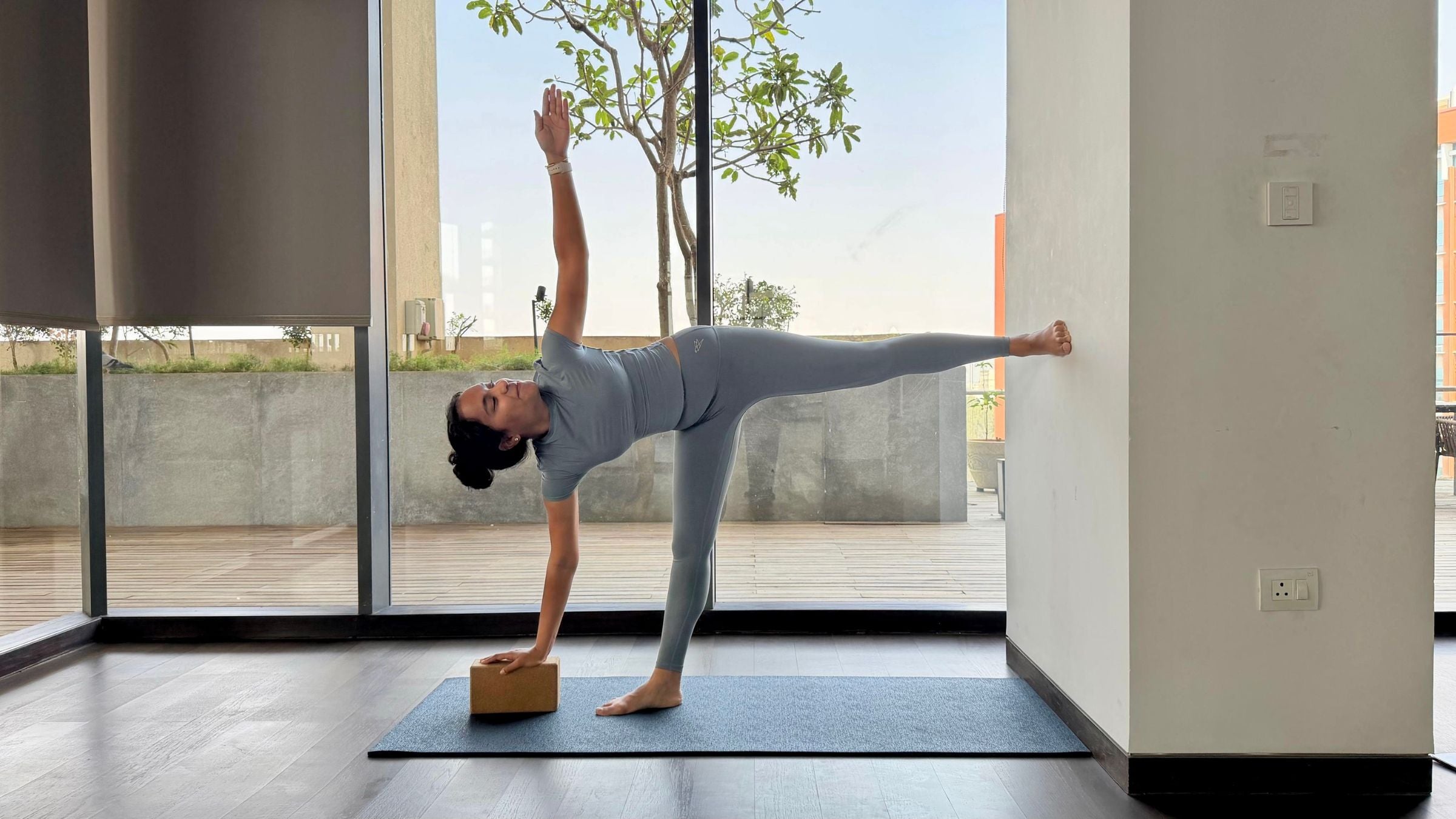
You know the experience of being in the zone. Whether you’re trying a new recipe, solving a problem, or balancing in Ardha Chandrasana, time seems to cease, your mind goes blank, and you’re lost in the seemingly effortlessness of your experience. That’s the peak performance state psychologists call “flow.” It’s a form of yoga, or union, and studies show it boosts creativity, productivity, and happiness.
But flow doesn’t happen when we’re bored.
Trying new things necessitates that we shift out of autopilot and focus, which facilitates finding that flow state. “We need challenge,” says Storoni. “Most of us are guilty of stagnating.” She explains that when you’re practicing the same sequence, the challenge must be self-generated by asking yourself to focus on your alignment or not rushing through the pose.
But novelty provides a built-in opportunity for challenge. The trick is the challenge mustn’t be so great that it makes you dread it. You want it to remain sparkling and tempting.
5. It Makes You Happier
Remember that elation you felt balancing in Bakasana for the first time? Or the pleased surprise you experience when flowing through a new sequence with your fave teacher? It turns out that learning stimulates brain connections that make us happy.
Storoni explains that acquiring a new skill strengthens neural pathways that release feel-good neurotransmitters, including serotonin and dopamine. This can lead to surges of joy, even euphoria, that are further enhanced by the endorphins that spike during exercise.
On the other side of the spectrum, with depression or early dementia, the prefrontal cortex stops growing in complexity, which means it releases less feel-good chemicals.
“The brain is a plastic organ,” Storoni says. “It’s always growing. It’s always changing. Learning stimulates the connections and networks within so it will thrive and feel happy.”
This article has been updated. Originally published January 2, 2017.