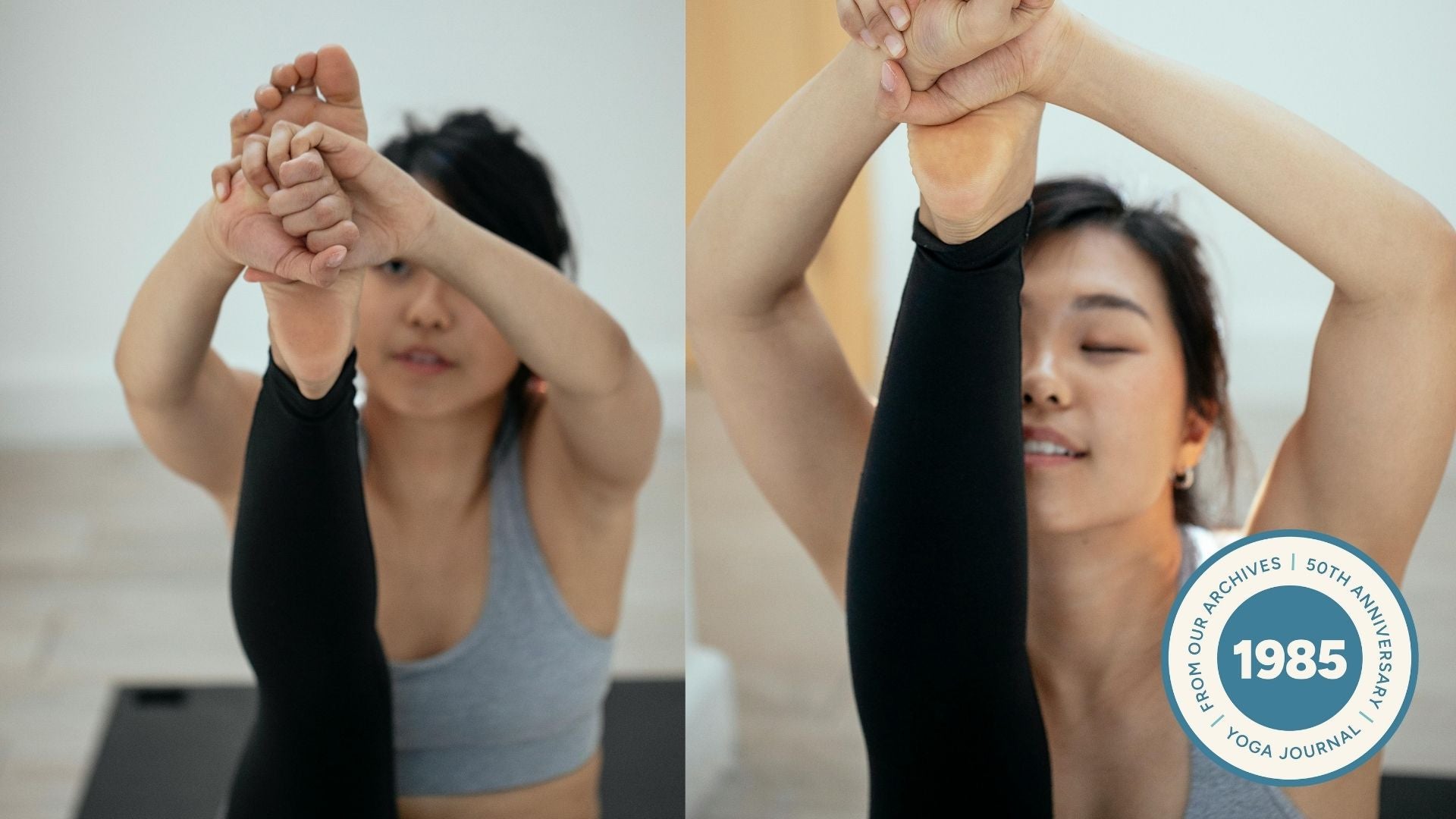
Reclining Big Toe Pose can be a warm-up leg stretch or a cool-down pose—either way, it will stretch your hamstrings.

(Photo: Calin Van Paris/Canva)
Published January 8, 2026 08:49AM
In Yoga Journal’s Archives series, we share a curated collection of articles originally published in past issues beginning in 1975. These stories offer a glimpse into how yoga was interpreted, written about, and practiced throughout the years. This article first appeared in the November-December 1981 issue of Yoga Journal. Find more of our Archives here.
Reclining Big Toe Pose (Supta Padangusthasana) is beneficial both as a warm-up leg stretch for beginners and a cool-down pose for more experienced students. It is a good pose to use after the practice of Shoulderstand (Sarvangasana) to relieve any tension in the neck or shoulders.
Because this pose is such a strong stretch for the hamstring muscles, it teaches the physiology and psychology of stretching. One of the most important aspects of yoga asanas is the effect stretching has upon the soft tissues such as the ligaments, tendons, and muscles. While stretching is not the only benefit of yoga, it does enhance circulation and create the suppleness necessary to maintain joint health and prevent injury. B.K.S. Iyengar states that this particular pose is especially helpful for stiffness in the hip joints.
Stretching also has a psychological component. It is symbolic of moving beyond one’s present state, of expanding one’s possibilities. In order to benefit from the stretch of Reclining Big Toe Pose, one must move at the speed of the body rather than the speed of the mind. One begins the pose slowly, allowing the body to adjust to the new position, and then moves further into the pose. The body exists in the past, the mind in the future. The breath allows one to wait for the body to respond and is the only thing that truly responds to the moment, speeding up and slowing down in exact response to what is going on at the moment with the body and mind. Paying attention to the breath is a technique which invariably brings one into the present.
Therefore, in order to stretch well in Reclining Big Toe Pose, one begins at a point a little under one’s ability, then with the breath, one slowly brings the leg further down. This allows the neuromuscular mechanisms which control the length of the hamstrings to adjust the muscles to the new length without the injury that speedy movement could bring. In addition, attention to the breath concentrates the mind, bringing it into the center of the action.
Stretching, like all of yoga, can be done from the “outside” or can be done from the “inside,” as was discussed above. If stretching is done from the “outside” or with an emphasis on range of movement and not quality, then a certain hardness pervades the body, the breath is often held, and the mind wanders. If the pose is practiced, however, by allowing the body to adapt, the mind to concentrate, and the breath to remain soft, then the asana expresses that softness. This softness is a result of stretching the “inner body” or allowing the feeling self rather than thinking self to experience the pose.
When this happens, not only does the technical performance of the pose improve, but harmony will also be experienced with the mind and emotions. And harmony of body, mind and spirit is the requisite for entering the stillness that is the state of yoga.
How to Practice Reclining Big Toe Pose
Begin with a symmetrical lying posture. Make sure the pelvis is tucked under, the shoulder blades are flat, and the head is not turned to one side.
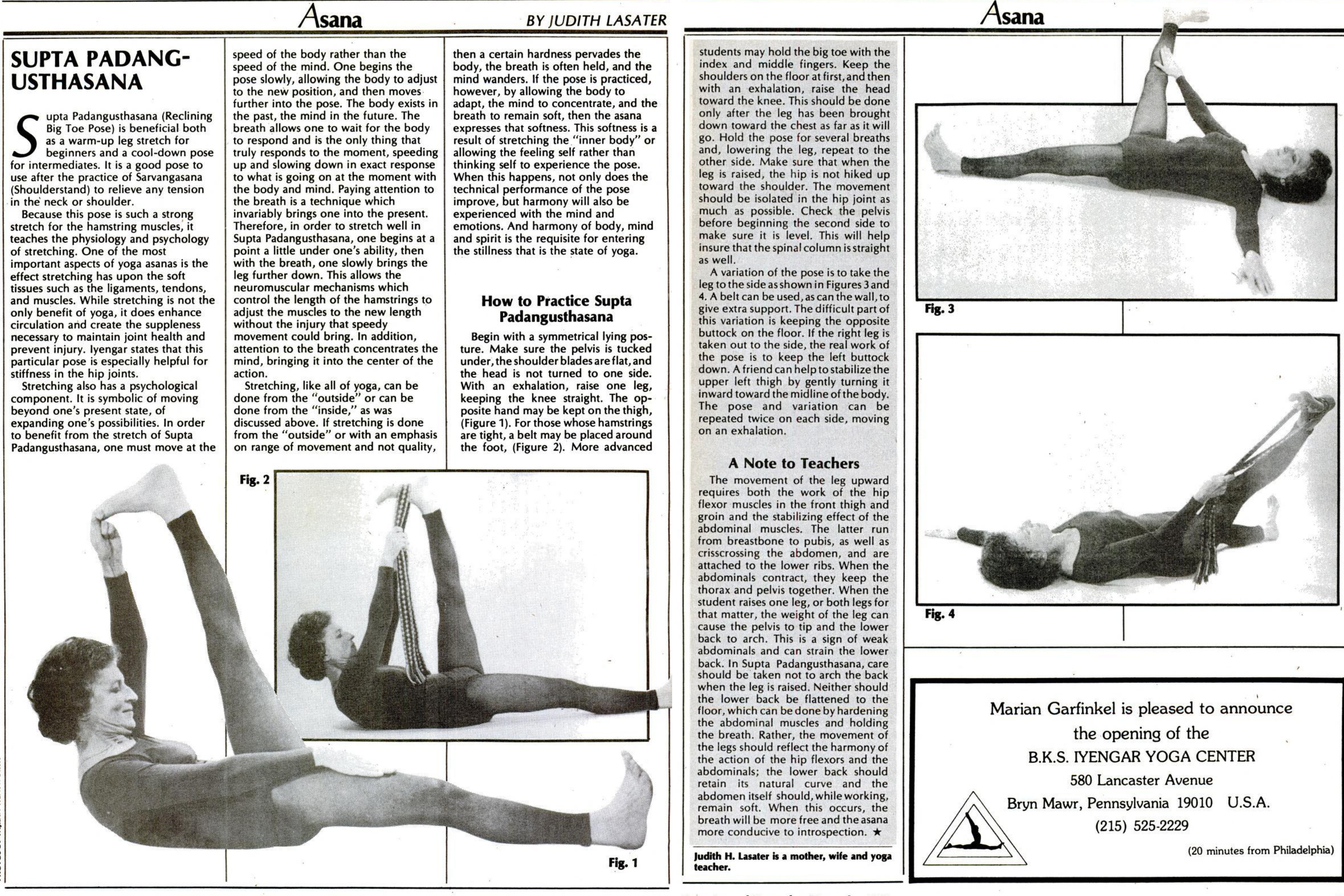
With an exhalation, raise one leg, keeping the knee straight. The opposite hand may be kept on the thigh, (Figure 1). For those whose hamstrings are tight, a belt may be placed around the foot, (Figure 2). More advanced students may hold the big toe with the index and middle fingers. Keep the shoulders on the floor at first, and then with an exhalation, raise the head toward the knee. This should be done only after the leg has been brought down toward the chest as far as it will go. Hold the pose for several breaths and, lowering the leg, repeat to the other side. Make sure that when the leg is raised, the hip is not hiked up toward the shoulder. The movement should be isolated in the hip joint as much as possible. Check the pelvis before beginning the second side to make sure it is level. This will help insure that the spinal column is straight as well.
A variation of the pose is to take the leg to the side as shown in Figures 3 and 4. A belt can be used, as can the wall, to give extra support. The difficult part of this variation is keeping the opposite buttock on the floor. If the right leg is taken out to the side, the real work of the pose is to keep the left buttock down. A friend can help to stabilize the upper left thigh by gently turning it inward toward the midline of the body.
The pose and variation can be repeated twice on each side, moving on an exhalation.
Teaching Reclining Big Toe Pose
The movement of the leg upward requires both the work of the hip flexor muscles in the front thigh and groin and the stabilizing effect of the abdominal muscles. The latter run from breastbone to pubis, as well as crisscrossing the abdomen, and are attached to the lower ribs. When the abdominals contract, they keep the thorax and pelvis together. When the student raises one leg, or both legs for that matter, the weight of the leg can cause the pelvis to tip and the lower back to arch. This is a sign of weak abdominals and can strain the lower back.
In Reclining Big Toe Pose, care should be taken not to arch the back when the leg is raised. Neither should the lower back be flattened to the floor, which can be done by hardening the abdominal muscles and holding the breath. Rather, the movement of the legs should reflect the harmony of the action of the hip flexors and the abdominals; the lower back should retain its natural curve and the abdomen itself should, while working, remain soft. When this occurs, the breath will be more free and the asana more conducive to introspection.