Published January 13, 2026 09:19AM
Yoga Journal’s archives series is a curated collection of articles originally published in past issues beginning in 1975. This article first appeared in the November-December 1984 issue of Yoga Journal.
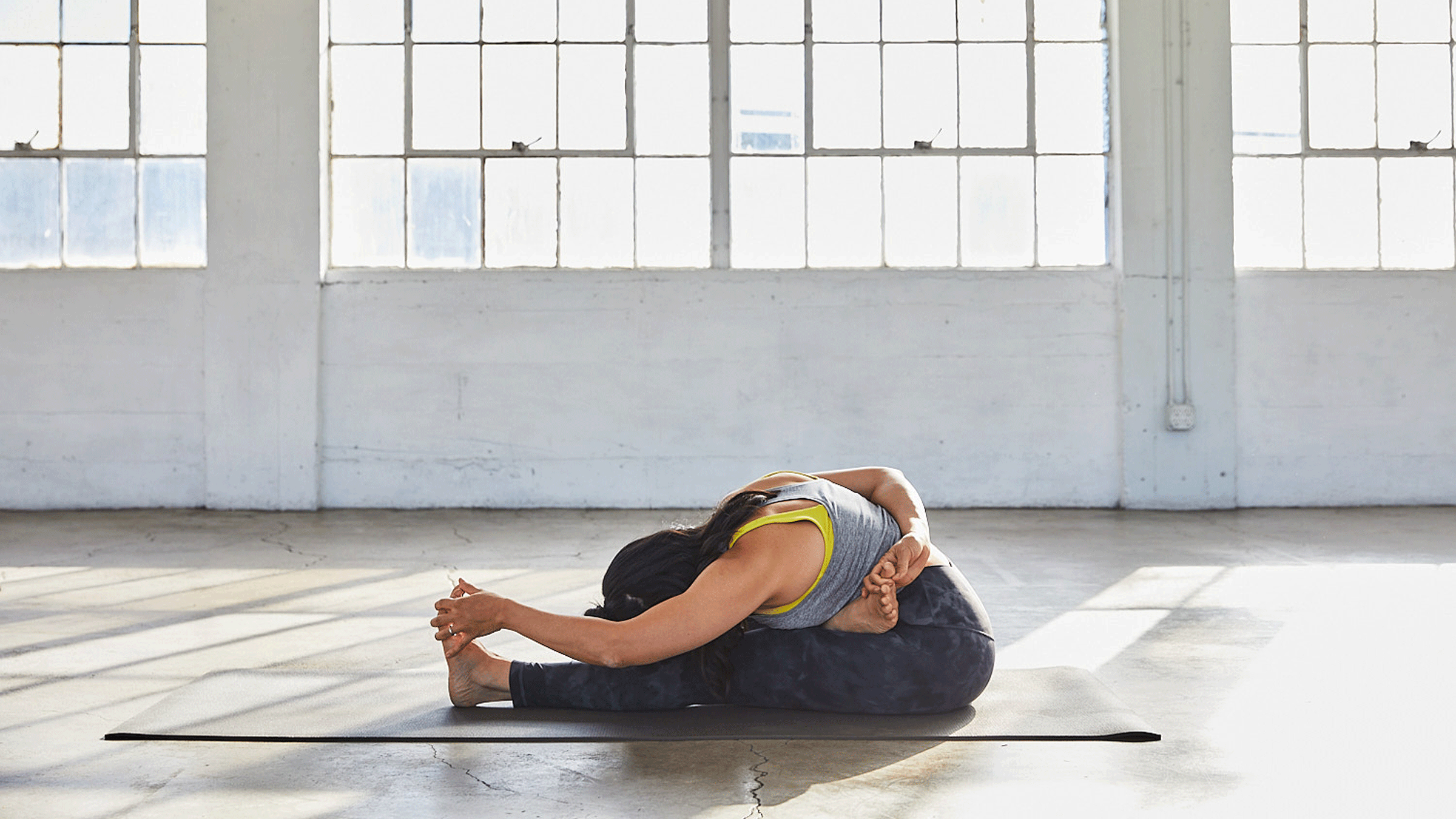
Half-Bound Lotus Forward Bend, as the Sanskrit name of this pose translates to, involves a stretch for the straight leg as well as the opposite hip joint, the spine, and the arm that encircles the body. Like all forward bends, Ardha Baddha Padma Paschimottanasana requires flexibility in the hamstring muscles of the thigh. As these muscles along the back of the leg are gradually stretched, the pelvis can more easily tip forward, allowing the vertebral column to remain in a virtually neutral position.
If a forward bending asana like this one is practiced in such a way that the inward curve in the lumbar spine (lower back) is reversed, the soft tissues—discs, ligaments, tendons, and muscles—are stressed and strain to the lumbar area is likely. If the normal lumbar curve is maintained, there is minimal stress and the pose does not disturb the body but rather enhances its structure.
This beneficial approach to movement can be generalized from this pose to all the other asanas. The lumbar curve, as well as the other curves of the column—the inward curve of the cervical spine (neck), the outward curve of the thoracic spine (midback), and the outward curve of the sacrum (near the buttocks)—should be maintained as much as possible in all movements. In forward bending, then, one should bend from the hips, disturbing the lumbar, thoracic, and cervical curves as little as possible. As soon as these curves are disturbed, the spine is actually shortened. Thus, to maintain the maximum length of the column, the curves should, whenever possible, be enhanced and maintained.
This way of moving is beneficial for the student of yoga for several reasons. First, it minimizes strain on the structures of the spinal column. Second, it requires concentration and constant awareness. Thus the asana becomes a point of concentration rather than an exercise. Only when concentration is perfected can meditation begin. Third, this way of moving reminds one that movement should be used to understand stillness.
By working in this manner in Ardha Baddha Paschimottanasana, one is protecting the body from injury, concentrating the mind, and expressing the silence of the soul. For yoga, by definition, is a state of absolute stillness. By moving in such a way that the natural state of the spine is enhanced and maintained, one is expressing the philosophy of yoga.
The Yoga Sutras of Patanjali, written in the second century A.D., teach that each of us is not separate from the perfection of the universe. If we practice yoga with the intention of becoming different and better, the practice becomes oriented to some external ideal. Instead, according to the Sutras, the entire “journey” of yoga is to recognize that we are the perfection itself, and not the outer layers of agitation with which we usually identify ourselves.
To practice Ardha Baddha Padma Paschimottanasana from the inside out is to practice from the stillness outward. This inner stillness quiets the disturbed layers of consciousness. Then one can experience true quietness. One cannot create this quietness, for it already exists. By using the asana as an expression of what is, the pose becomes internal, equanimous, and healthful all at once. To move in such a way that all the inherent curves of the column are enhanced and maintained is a metaphor for the understanding that we are already free beings. The only change necessary in our consciousness is to remove the impediments to that freedom and to express what is most natural about us–our oneness with the universe.
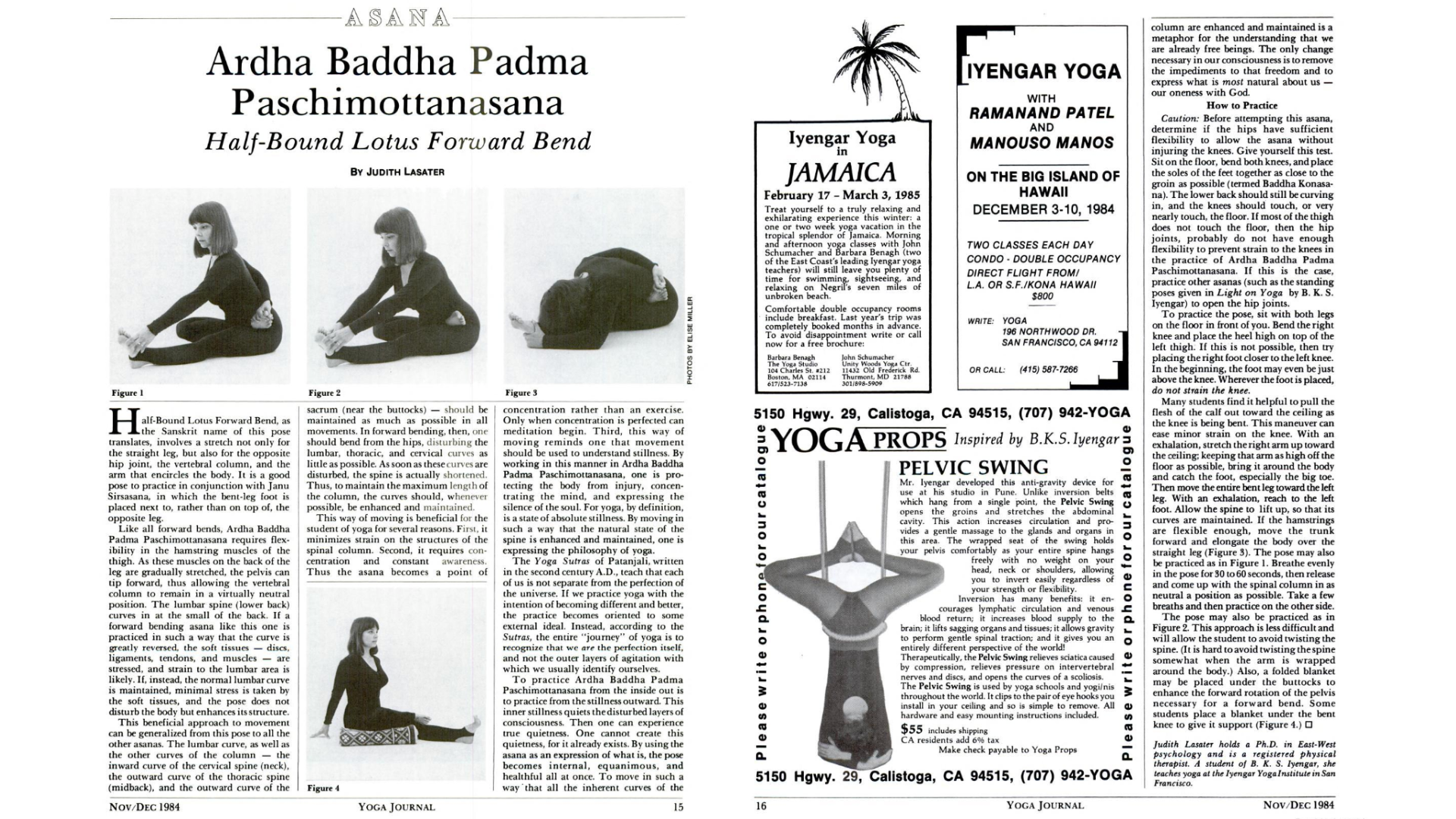
How to Practice Half-Bound Lotus Forward Bend
It is a good pose to practice in conjunction with Janu Sirsasana, or Head to Knee Pose, in which the bent-leg foot is placed next to, rather than on top of, the opposite leg.
Caution: Before attempting this asana, determine if the hips have sufficient flexibility to allow the asana without injuring the knees. Give yourself this test. Sit on the floor, bend both knees, and place the soles of the feet together as close to the groin as possible (termed Baddha Konasana or Bound Angle). The lower back should still be curving in, and the knees should touch, or very nearly touch, the floor. If most of the thigh does not touch the floor, then the hips probably do not have enough flexibility to prevent strain to the knees in the practice of Ardha Baddha Padma Paschimottanasana. If this is the case, practice other asanas (such as the standing poses given in Light on Yoga by B. K. S. Iyengar) to open the hip joints.
To practice the pose, sit with both legs on the floor in front of you. Bend the right knee and place the heel high on top of the left thigh. If this is not possible, then try placing the right toot closer to the left knee. In the beginning, the foot may even be just above the knee. Wherever the foot is placed, do not strain the knee.
Many students find it helpful to pull the flesh of the calf out toward the ceiling as the knee is being bent. This maneuver can ease minor strain on the knee. With an exhalation, stretch the right arm up toward the ceiling; keeping that arm as high off the floor as possible, bring it around the body and catch the foot, especially the big toe.
Then move the entire bent leg toward the left leg. With an exhalation, reach to the left foot. Allow the spine to lift up, so that its curves are maintained. If the hamstrings are flexible enough, move the trunk forward and elongate the body over the straight leg (Figure 3). The pose may also be practiced as in Figure 1. Breathe evenly in the pose for 30 to 60 seconds, then release and come up with the spinal column in as neutral a position as possible. Take a few breaths and then practice on the other side.
The pose may also be practiced as in Figure 2. This approach is less difficult and will allow the student to avoid twisting the spine. (It is hard to avoid twisting the spine somewhat when the arm is wrapped around the body.) Also, a folded blanket may be placed under the buttocks to enhance the forward rotation of the pelvis necessary for a forward bend. Some students place a blanket under the bent knee to give it support (Figure 4).