A lesser-known pose that’s as helpful for tight hamstrings as it is for focus.
(Photo: Canva)
Published January 27, 2026 01:25PM
Yoga Journal’s archives series is a curated collection of articles originally published in past issues beginning in 1975. This article first appeared in the May-June 1982 issue of Yoga Journal.
Akarna Dhanurasana is a pose of focused attention. “Karna” means the ear and the prefix “a” means near or toward. Since “dhanu” means bow, the image is of an archer pulling back a bowstring. Besides flexibility in the hip joints and vertebral column, the pose demands good balance.
Beginning and intermediate students can both benefit from Akarna Dhanurasana. It can relieve back fatigue after vigorous asanas, stretch the hamstrings (back thigh muscles) of the straight leg, and open the hip joint of the bent leg.
What You Need to Know About This Pose
Like any asana, this one reflects poise between opposite forces. The mind must be balanced between the forward reach of the front arm and the backward movement of the bent arm pulling the leg up and back. Physically, the pose requires abdominal strength; mentally, it takes one-pointed concentration (ekagrata), which is a crucial lesson of yoga.
According to The Yoga Sutras of Patanjali, gathering one’s self inward to examine the relationship between movement and stillness is asana, the concentrated examination of breath is pranayama, while the detached examination of the effect of the senses upon the mind is pratyahara. These are part of Patanjali’s eight steps of yoga, and each requires increasing discipline to observe and channel one’s energy. Gradually the energy of the mind (citta) is focused more clearly inward, bringing its innate fluctuations into harmony, and ultimately into stillness.
If this philosophical background of yoga is understood, asana finds its natural place both as a preparation for the other steps and as an expression of the psychophysical stillness attained. When one places the body in a state of stillness, the mind can experience stillness. Likewise, when one concentrates the mind, the body will be still. This is what asana practice is all about. Of course, yoga has documented physiological benefits, but these eventually become secondary to the mind’s calm, focused, and intuitive state, created in asana and, with practice, maintained in daily life.
How to Practice Akarna Dhanurasana
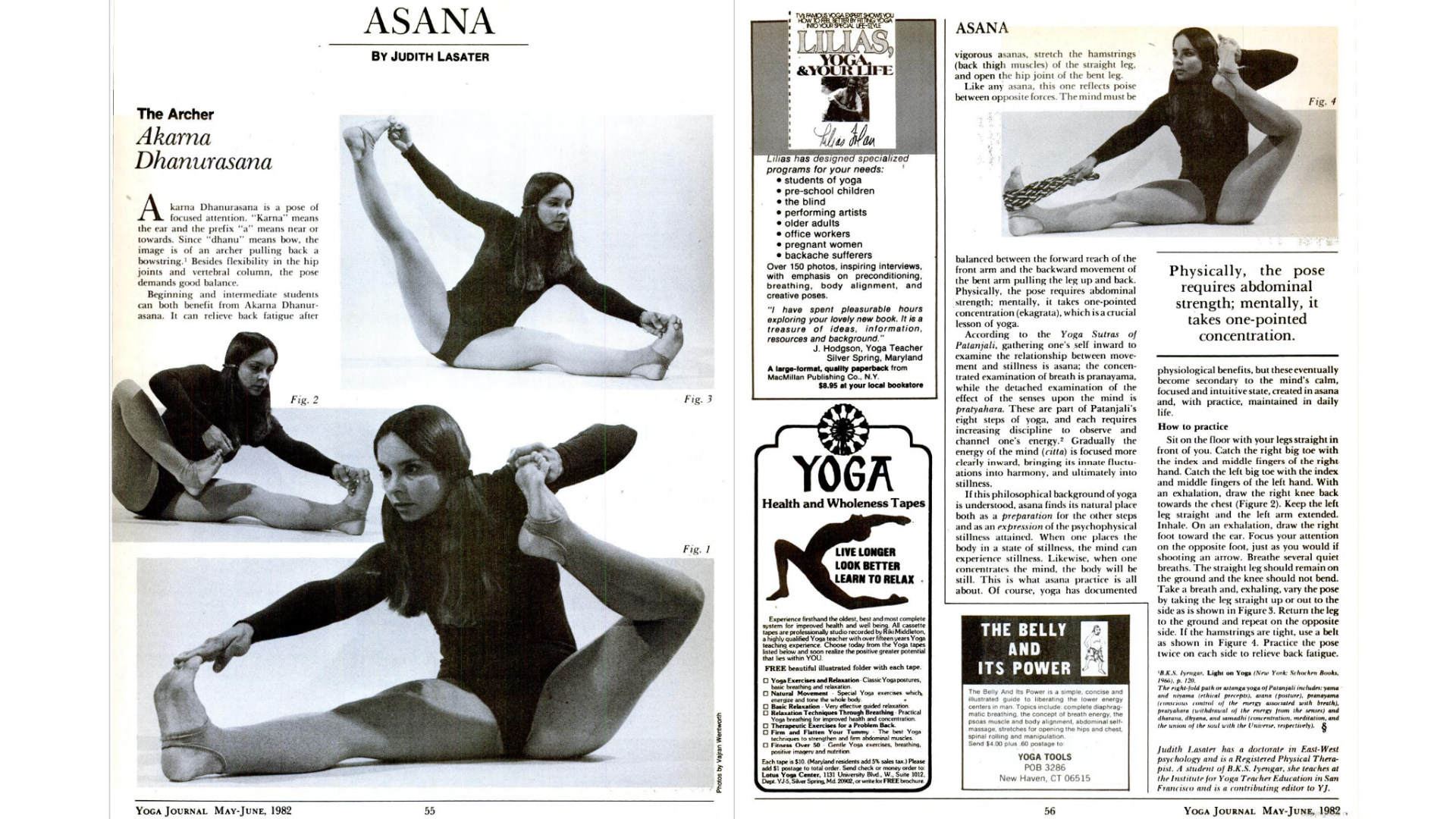
Sit on the floor with your legs straight in front of you. Catch the right big toe with the index and middle fingers of the right hand. Catch the left big toe with the index and middle fingers of the left hand. With an exhalation, draw the right knee back toward the chest (Figure 2). Keep the left leg straight and the left arm extended. Inhale.
On an exhalation, draw the right foot toward the ear. Focus your attention on the opposite foot, just as you would if shooting an arrow. Breathe several quiet breaths. The straight leg should remain on the ground and the knee should not bend.
Take a breath and, exhaling, vary the pose by taking the leg straight up or out to the side as shown in Figure 3. Return the leg to the ground and repeat on the opposite side. If the hamstrings are tight, use a belt as shown in Figure 4. Practice the pose twice on each side to relieve back fatigue.