Published January 28, 2026 12:43PM
Yoga Journal’s archives series is a curated collection of articles originally published in past issues beginning in 1975. This article first appeared in the November-December 1983 issue of Yoga Journal.
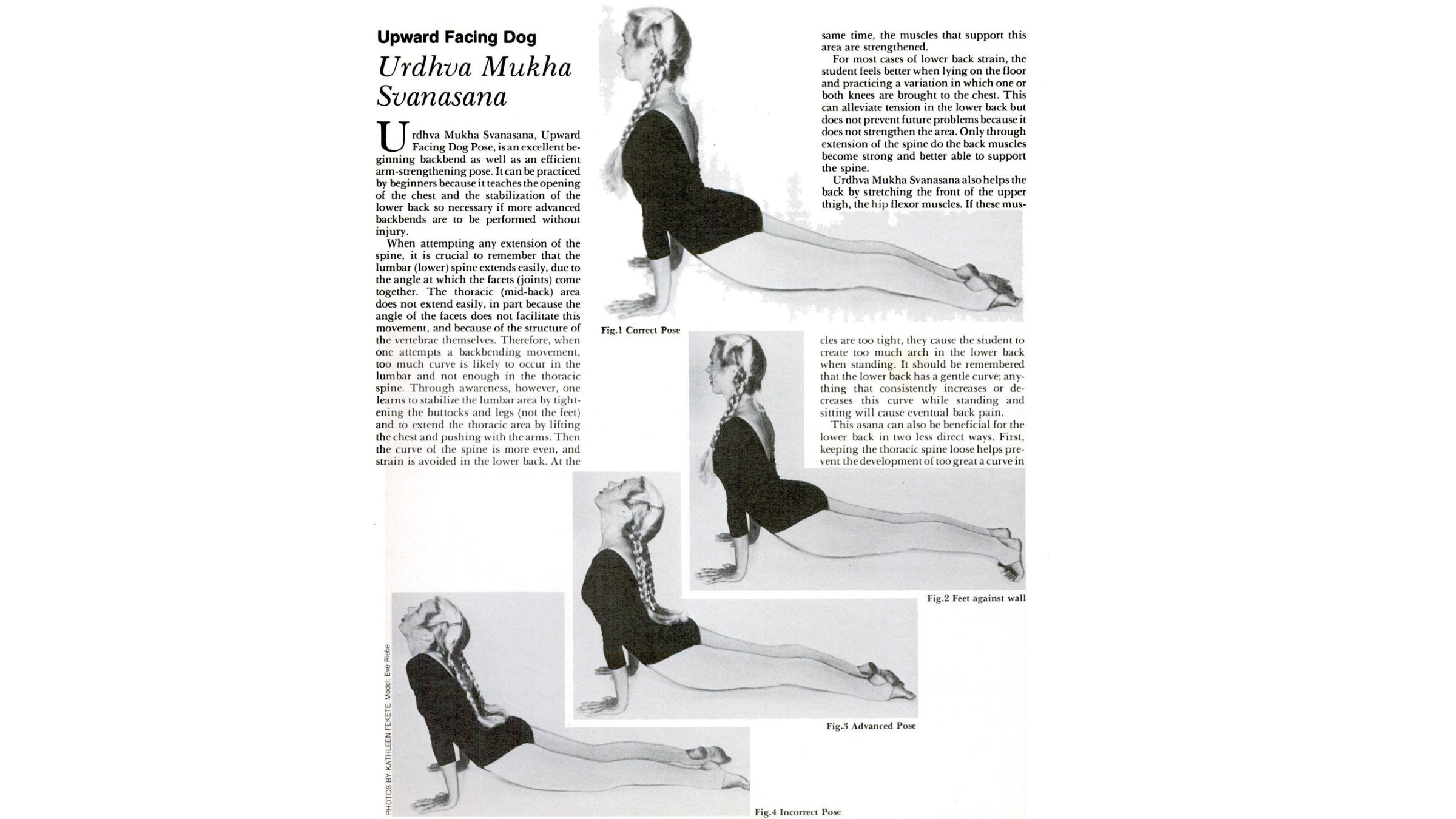
Upward Facing Dog Pose (Urdhva Mukha Svanasana), is an excellent beginning backbend as well as an efficient arm-strengthening pose. It can be practiced by beginners because it teaches the opening of the chest and the stabilization of the lower back—so it’s necessary if more advanced backbends are to be performed without injury.
According to B.K.S. Iyengar, Upward Facing Dog, when practiced well, can rejuvenate the spine, expand the lungs and increase blood flow to the pelvic region. This pose also helps the back by stretching the front of the upper thigh, the hip flexor muscles. If these muscles are too tight, they cause the student to create too much arch in the lower back when standing. It should be remembered that the lower back has a gentle curve; anything that consistently increases or decreases this curve while standing and sitting will cause eventual back pain.
Upward Facing Dog and Your Lower Back
When attempting any extension of the spine, it is crucial to remember that the lumbar (lower) spine extends easily, due to the angle at which the facets (joints) come together. The thoracic (mid-back) area does not extend easily, in part because the angle of the facets does not facilitate this movement, and because of the structure of the vertebrae themselves. Therefore, when one attempts a backbending movement, too much curve is likely to occur in the lumbar and not enough in the thoracic spine.
Through awareness, however, one learns to stabilize the lumbar area by tightening the buttocks and legs (not the feet) and to extend the thoracic area by lifting the chest and pushing with the arms. Then the curve of the spine is more even, and strain is avoided in the lower back. At the same time, the muscles that support this area are strengthened.
For most cases of lower back strain, the student feels better when lying on the floor and practicing a variation in which one or both knees are brought to the chest. This can alleviate tension in the lower back but does not prevent future problems because it does not strengthen the area. Only through extension of the spine do the back muscles become strong and better able to support the spine.
This asana can also be beneficial for the lower back in two less direct ways. First, keeping the thoracic spine loose helps prevent the development of too great a curve in this region, which can cause one to flatten out the lumbar spine. As we discussed above, this flattening can cause lower back pain. By keeping the thoracic spine in good alignment, the lumbar spine is more likely to be healthy.
The second way Upward Facing Dog can indirectly aid the lower back is by helping to keep the arms strong. During daily life, most of us have to lift, carry and move heavy objects occasionally. If the trunk, shoulder and arm muscles are strong and able to work efficiently, it is less likely that the back will have to overwork. This asana is quite good for strengthening the arms, especially if it is practiced in conjunction with its partner pose, Downward Facing Dog Pose, in which the buttocks are held high and the head down. The process of coming from Downward Facing Dog to Upward Facing Dog strengthens the arms, as does holding Upward Dog.
Strength and Softness
Upward Facing Dog is a beautiful expression of the blending of strength and softness. The arms represent strength, as the student pushes away from the pull of gravity and works to lift and open the chest.
Strength is also expressed by the activity of the legs; the knees are tight, the thighs grip the bones, and the feet are active. Because of this correct use of strength, the spine can then be softened and allowed to move into the body. Please note that this softness of the spine is in no way a weakness or a collapse. Collapse of the lower back, which may occur if the pose is practiced incorrectly, usually causes immediate pain. But softness in the spine is experienced as a feeling of lightness and freedom, often bringing a smile to the student’s face. The joy of Upward Facing Dog, therefore, must move like a wave from the base of the spine, the coccyx, up the spine to the head, allowing the head to drop and the chest to open.
With this openness comes the desire to do more, to lift more, to experience the pose more. This is a sign that the pose is being practiced correctly. If the pose is incorrect, the mind can force the body to perform, but there is no joy. If, on the other hand, the body is enjoying the pose, there is an irresistible pull to move more deeply into the pose, and the mind spontaneously quiets.
This is the difference between working from the ego and working from the heart. When this difference is understood, the student is beginning to understand the difference between asana and exercise and to move toward a wider understanding of what yoga is all about.
How to Practice Upward Facing Dog
Beginners may find it helpful to work at the wall. The feet are placed as in Figure 2, with the toes curled under and the heels toward the wall. The student then lifts up from a lying position so that the chest is high, the arms straight, hands under the shoulders, buttocks tight, knees lifted and heels push back toward the wall. The advantage of the wall is that the beginner will more readily remember to use the legs and push through them. Breathing is quiet; the pose is held for up to one minute, followed by lying on the stomach on the floor, then repeated.
By standing on the toes, the beginner will be less likely to get cramps in the feet from overworking these muscles and will not drop the lower back too much. The more experienced student can practice the pose as shown in Figure 3, with the weight resting on the tops of the feet and the head thrown back. Be careful not to compress the back of the neck while dropping the head. This can be avoided by lifting the back of the neck first and being careful to stretch back from the base of the neck rather than thinking of the head itself as dropping back.
An incorrect posture can be seen in Figure 4. Here, the student is compressing the neck, sinking the shoulders, overarching the lumbar and not using the legs correctly, allowing them to turn out. This incorrect posture shows lack of knowledge, concentration and awareness. Without these, the asana does little for disciplining the mind and can injure the body.