Published February 25, 2026 01:04PM
Yoga Journal’s archives series is a curated collection of articles originally published in past issues beginning in 1975. This article on Ardha Chandrasana (Half Moon Pose) first appeared in the November-December 1992 issue of Yoga Journal.
There is a quality of awareness that develops as we move to a deeper level in our practice of yoga. At first, our bodies seem dense and impervious, our muscles thick from exertion. Slowly we begin to differentiate and reclaim the various parts of our body. We learn the placement of the feet, the work of the legs, the lift of the rib cage, the lengthening of the spine, the carriage of the arms and head. An understanding of anatomy helps us to appreciate the relationship of one part of the body to another.
Initially our sense of alignment, of proper relationship, is intellectual and arbitrary, imposed from outside. But gradually we begin to understand the concept of alignment from our internal experience of the poses. We give up our expectations of finding “the right way” to do a pose and allow ourselves to be “guided by natural line,” led by our intuitive sense of what feels right. At this point, we are ready to explore the hidden spaces of the body—the joints and cavities, the spaces between the bones. Our awareness now penetrates the “secret openings” of the body.
How to Find the Hidden Spaces of the Body
Stand in Tadasana (Mountain Pose) with your big toes together and your heels about an inch apart. Feel how the weight of your body rests on the ankle joints. For most of us, the weight falls more heavily on the outer rear portion of the ankle, because we tend to hold ourselves erect from the work of the outer thighs rather than the inner thighs. Think of each ankle joint as a circular plane parallel to the floor and distribute your weight evenly around its circumference. Notice any shift in the position of your legs, pelvis, and torso as you make this adjustment. As you bring more weight to the front inner portion of the ankle joints, find that the muscles around the inner knee begin to strengthen and engage.
Then bring your awareness to the knees, and once again distribute your weight evenly around the circumference of the joints. What information do your knee joints give you about the way you balance on your legs? Let your mind penetrate deep into the space of the joints. Does your left knee joint feel broad and open or compressed and narrow when compared to your right knee joint? How can you create more space in a joint that feels compressed?
Now take your awareness deep into the hip joints. What shape do your hip joints take? If you stand in Tadasana with your tailbone tucked under and your buttocks clenched, your hip joints will assume an oval shape, somewhat flattened at the sides. If, however, you stand with your pelvis tilted forward and your lower back arched, the front of your hip joints will feel thin and compressed but the back of the joints will mushroom out. Only when your pelvis is in a neutral or balanced position in relation to the thighs will the space in the hip joints feel completely circular.
From Tadasana, come forward into Uttanasana (Standing Forward Bend) and cross your forearms to take hold of the elbows. Then bring your awareness deep into the hip joints, creating a broad, circular space within each joint. Allow your spine and upper body to release out of the space within the hip joints. Notice how light the body becomes, how much freedom and length the spine achieves. When you allow the movement of the pose to arise from the space within the joints, the muscles release their grip on the body and help you to extend without any sense of effort.
To find the secret spaces of the body and release their hidden energy requires patience, clarity of mind, and years of practice. Now refine your awareness of the spaces of the body as you practice the following variations of Ardha Chandrasana (Half-Moon Pose).
How to Practice Ardha Chandrasana (Half-Moon Pose)
These variations of Ardha Chandrasana are helpful for beginners or anyone who wants to focus on the most subtle aspects of the pose.
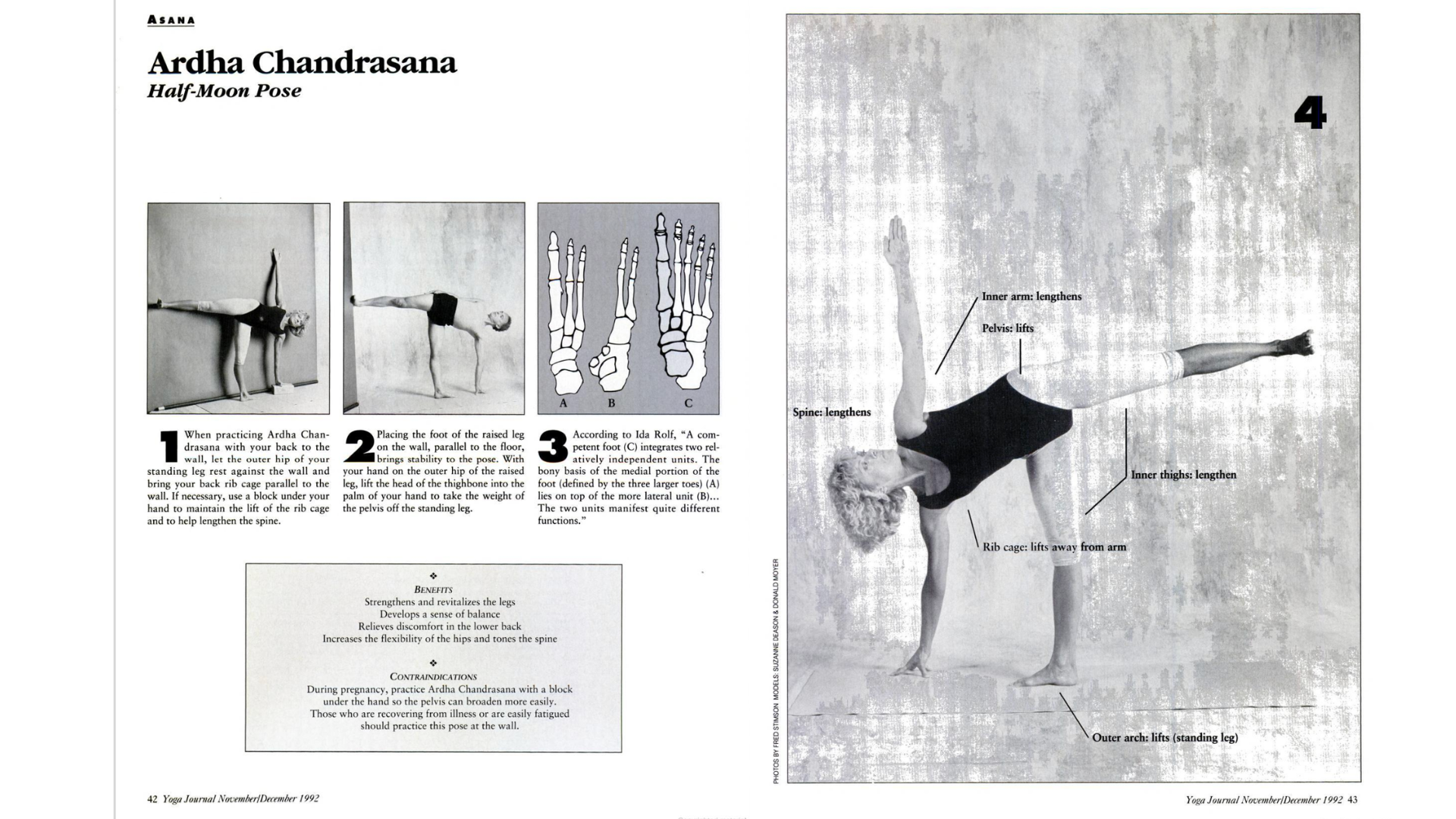
1. Half Moon Pose at the Wall
The first variation of Ardha Chandrasana is especially helpful for beginning students, pregnant women, and those who have difficulty balancing on one leg.
Start by standing in Tadasana (Mountain Pose) with your legs together and your back to a wall, so your buttocks are lightly touching the wall. Shift your weight to your left foot and step your right foot out to the side one full stride (about one leg’s length). Then turn your right foot out 90 degrees, so it is parallel to and about 3 inches away from the wall. Turn your left foot in approximately 30 degrees, with the heel about an inch from the wall. Your right buttock should now be resting on the wall without you leaning backward.
With an inhalation, raise your arms to shoulder level. With an exhalation, swing your pelvis toward the left and extend the right side of your rib cage over your right thigh. Place your right hand on your right shin or on a block placed between your ankle and the wall, and extend your left arm toward the ceiling with the palm facing forward, as for Trikonasana (Triangle Pose). Remain in Trikonasana for 2 or 3 breaths, lifting the left side of your pelvis toward the ceiling and bringing your back rib cage parallel to the wall so your whole chest opens. Allow your spine to lengthen and keep your breath soft.
Now bend your right knee and bring your right fingertips onto the floor about 12 to 15 inches in front of your right foot, or slide your block forward if you are using a block. (I recommend using a block under your hand if your hips or hamstrings are tight, or if you find that your spine sinks toward the floor in Ardha Chandrasana. When you keep the spine parallel to the floor, as in Figure 1, you maximize spinal extension.)
Then come up onto the toes of your left foot and shift your weight onto your right leg. Straighten your right leg by drawing the front thigh muscles up as you raise your left leg to the level of the pelvis. Draw your outer right hip back against the wall to stabilize the pelvis and bring your upper back rib cage parallel to the wall.
Extend your left arm toward the ceiling, pressing the back of your left hand against the wall. Let your head face directly forward to avoid any discomfort in the neck and allow your chest to open. Hold Half-Moon Pose for half a minute to a minute, extending through your inner raised leg and lengthening your spine.
Then bend your right knee directly over the toes, extend your left leg back down to the floor, and return to Trikonasana (Triangle Pose). Once again draw your outer right hip back against the wall and bring your back rib cage parallel to the wall to open the front chest. Remain in this position for 2 or 3 more breaths, then return to Tadasana. Repeat the pose to the opposite side.
2. Ardha Chandrasana With One Foot at the Wall
The next variation of Ardha Chandrasana uses the wall to support the foot of the raised leg.
Stand in Tadasana (Mountain Pose) with your left side toward the wall and step your feet about three feet apart. (Your right foot should be about one leg’s length from the wall, so that when you lift into Ardha Chandrasana, the right leg is directly vertical, as in Figure 2) Place the heel of your left foot at the base of the wall with the toes turned in, and turn your right foot out in line with the arch of the left foot. Bring your left hand to your outer waist and lengthen your spine.
With an inhalation, open your chest and raise your right arm to shoulder level. With an exhalation, bend your right knee and extend the right side of your rib cage along your right thigh, placing the fingertips of your right hand on the floor to the outside of your right foot. Reach your hand as far forward as possible to maintain the extension of your whole right side. (Use a block under your right hand if it is helpful.)
Then come up onto the toes of your left foot, shift your weight onto the right leg, and straighten the leg by lifting the front thigh muscles. Place your left foot on the wall parallel to the floor and extend your left arm along the left side of your torso, so the palm of your left hand rests on your outer left hip. Bring the crown of your head into alignment with the tailbone and lengthen the front of your spine.
Now that you have established the basic alignment of Half-Moon Pose, you can look for the “secret openings” and “hidden spaces” within the body. First take your awareness deep within the hip sockets and feel how the head of the thighbone fits into the socket. On your raised-leg side, let the head of the left thighbone lift directly up into the palm of your hand. Feel how this adjustment lifts the pelvis off the standing leg and softens and widens the groins. On your standing-leg side, your hip socket now has the space to balance directly over the head of the right femur so your weight is distributed more evenly on the inner and outer leg.
Maintaining the space in the hip joints, shift your attention to the upper back. Feel how the muscles of your upper back tend to grip the right shoulder blade against the rib cage, constricting the right shoulder joint as well. Bring your awareness to the anterior surface of the shoulder blade. As you create space between the right shoulder blade and the rib cage, release the right shoulder blade toward the right arm and simultaneously lift the rib cage in the opposite direction. As your rib cage lifts and turns away from the shoulder blade, your head is free to turn toward the ceiling without any strain on the neck. Maintain this position for several breaths, feeling the lightness and space in the joints and lengthening the spine. Then come out of the pose and repeat to the other side.
3. Awareness of Your Feet in Ardha Chandrasana
Not all the body’s spaces lie beneath the skin. For instance, both the inner ears and the nostrils are surface cavities which we perceive as being inside the body. Likewise, the arches of the feet define a space which is outside the body yet somehow part of the body, the way a bay is defined by the land which surrounds it.
The arch of the foot is composed of an inner arch and an outer arch (Figure 3). According to Ida Rolf, “A competent foot (C) integrates two relatively independent units. The bony basis of the medial portion of the foot (defined by the three larger toes) (A) lies on top of the more lateral unit (B)….These two units manifest quite different functions.” The medial or inner arch is designed for weight-bearing and weight-distributing, while the primary function of the lateral or outer arch of the foot is for lifting and balancing. However, when we hear the instruction to lift the arches, most of us automatically lift the inner arches and allow the weight of the body to fall on the outer arches and outer legs. As we shall see, this makes balancing poses like Ardha Chandrasana all the more difficult.
To practice the lift of the outer arches, stand in Tadasana (Mountain Pose) with your big toes together and your heels slightly apart. Lengthen the outer edges of your feet from the outer heel to the little toe. With firmness and length at the outer edge of the foot, you can now lift the outer arch without collapsing the inner arch. Then press down the spaces between the metatarsal bones (the balls of the feet) especially the space between the big toe metatarsal and the second toe metatarsal to widen the front of the foot. Work with the spaces between the bones instead of the bones themselves. (If you push the big toe metatarsal itself into the floor, notice how your toes tend to curl up, tightening the tendons at the top of the foot, and how the muscles of the inner arch grow rigid and pull away from the sole of the foot.)
4. Ardha Chandrasana
Use this awareness of the feet as you move into the final version of Ardha Chandrasana (Half-Moon Pose) (Figure 4).
Start in Tadasana with your feet together. With an inhalation, spring your feet about three and a half feet apart and extend your arms out to the sides at shoulder level. On the exhalation, turn your left foot in 30 degrees and your right foot out 90 degrees. With an inhalation, lengthen down through your inner legs and create space in your hip sockets as you lift the spine. With an exhalation, lift the head of your left thighbone away from your right leg to maximize the space in the right hip joint. At the same time, extend the right side of your torso over your right thigh and bring your right hand onto your right ankle for Trikonasana (Triangle Pose).
Remain in Trikonasana for several breaths. Then bend your right knee and come up onto the toes of your left foot. Extend your right arm away from your torso, and rest your fingertips on the floor in line with your outer right foot.
Shift the weight of your body onto your right leg, balancing directly over the arch of your right foot. Then draw your right front thigh muscles up to straighten your right leg, and raise your left leg in line with your outer left hip. To improve your balance, gradually strengthen the standing foot. Lengthen the outside edge of your right foot from the heel to the little toe and slowly begin to lift the outer right arch. (If you make these adjustments too abruptly, you will throw yourself off balance. If your foot is very wobbly, try practicing with a sandbag on your standing foot to create stability.) At the same time, broaden your heel and press down the space between the first and second metatarsals to widen the front of the foot. As your outer right arch continues to lift, lengthen your inner right thigh from the groin down through the inner calf, so your weight is evenly distributed over the inner and outer leg.
When your balance feels secure, bring your awareness deep within the hip sockets. Lift the head of your left thighbone away from your right leg to create space in the right hip joint and to lift the pelvis. Create a circular space in your left hip joint as well, letting your left thighbone lengthen out from that space. Soften your inner groins and widen the base of your pubic bone. Broaden your abdomen and lengthen your spine. Then release your right shoulder blade down toward your right arm and lift your rib cage away from the shoulder blade. As your torso turns toward the ceiling, lengthen through the crown of your head and allow your head and neck to turn as well.
Create space deep within your shoulder joints so your arms can extend from the center of your back out to the fingertips in Half Moon Pose. Feel how the space deep within your hip joints and shoulder joints sustains you in the pose, making it light and effortless.
Then bend your right knee, continuing to lengthen through the crown of your head as you extend your left leg back to the floor and return to Trikonasana. Remain in Trikonasana for several breaths, then return to Tadasana and repeat the pose to the other side.