
You’ve done everything right. You cut the calories. You skipped the bread. You said no to the cake at the office party and yes to another sad desk salad.
And the scale barely moved.
Or maybe it did move — a little — and then the moment you exhaled, the moment you had one normal weekend, it came roaring back. More than before. Like your body was punishing you for trying.
Sound familiar?
You ate less. You suffered more. You white-knuckled your way through hunger headaches and 3pm crashes and the kind of irritability that makes you snap at people you love. And after all of that, your body held onto every ounce it could — and grabbed more the second it got the chance.
This is the loop millions of people live inside. Not because they’re weak. Not because they lack discipline. Not because they simply don’t want it badly enough.
It’s not a willpower problem. It never was.
What if I told you the problem was never your discipline? What if the problem was that your body — your brilliant, ancient, survival-obsessed body — thought you were dying?
That’s not a metaphor. That’s biology. And once you understand it, nothing about your relationship with food will ever look the same.
Why Your Body Works Against You When You Diet
Your brain cannot tell the difference between a diet and a famine. When calories drop, your body activates ancient survival programs designed to keep you alive — slowing your metabolism, increasing hunger hormones, and storing fat more aggressively. This isn’t failure. This is your biology doing exactly what it was built to do.
The Diet Trap — Why Trying Harder Only Makes It Worse
You wake up Monday with a plan.
This time is different. You’re committed. You have a list. You have willpower. You have reasons.
Breakfast is coffee. Maybe some eggs. You feel good about that. Lunch is a salad — the kind that doesn’t quite fill you up but you eat it anyway because you are doing this.
By 3pm, something changes.
There’s a low hum of hunger behind your eyes. A dull headache creeping in at the temples. Your concentration starts to slip. You’re irritable in a way you can’t quite explain — short with your coworkers, distracted, a little hollow.
You push through. Because this is what discipline looks like. Right?
Then comes 8pm. You’re home. You’re tired. And something in you just… breaks. Maybe it’s a handful of chips. Maybe it’s something worse. And just like that, the voice starts. You failed again. You have no willpower. What’s wrong with you?
Sound familiar?
Here’s what I want you to know: you are not alone in this. Hundreds of millions of people have lived that exact day. That exact cycle. Over and over and over again.
The diet industry is a multi-billion dollar business. And its best customers? People who keep coming back. Not because they’re weak. But because the method fundamentally does not work — and no one ever tells them why.
I know this cycle personally.
At my heaviest, I was over 400 pounds. And here’s the thing people don’t expect me to say: I wasn’t eating enormous amounts of food. I had tried dieting. I had tried restricting. I had tried harder and harder and harder. And every time, my body seemed to fight back with more force than I could muster willpower.
I thought I was broken. I thought it was me.
It wasn’t me. And it’s not you.
The Science: The body is not a passive container that simply stores whatever you put in it. It is an active, intelligent survival system — one that monitors your food intake as a signal about your environment, and responds accordingly. When you restrict calories, your body doesn’t just quietly accept less. It reacts.
Dieting isn’t a discipline problem. It’s a biology problem.
Think about Sarah. She’s been incredibly disciplined for three weeks. She’s tracked every meal. She’s said no to things she loves. She loses four pounds. Then the weekend happens — a birthday dinner, a glass of wine, a slice of cake — nothing outrageous. Monday morning she steps on the scale. She’s gained six pounds back.
That number isn’t measuring her failure.
It’s measuring her body’s survival response.
When you cut calories dramatically, something happens inside your body that has nothing to do with math. It has to do with survival signals. And those signals are ancient, powerful, and very, very loud.
Why the Diet Cycle Keeps Repeating
Every time you restrict food significantly, your body interprets the shortage as a threat — not a choice. It responds by slowing your metabolism, increasing hunger hormones, and making you mentally fixated on food. The harder you try to override this with willpower, the louder the survival signals become. This is not a character flaw. This is biology doing exactly what it was designed to do.
The harder you try, the more your body pushes back.
That’s not a motivational failure. That’s a biological fact.
To understand why dieting fails, you first have to understand what your brain actually hears when you skip a meal.
Meet Your Inner Caveman — The Ancient Brain That Runs Your Body
Deep inside your brain, there is a part that has nothing to do with spreadsheets, calendar apps, or 90-day transformation challenges.
It doesn’t know what year it is. It has never heard of a calorie counter. And it absolutely does not care about your reunion, your vacation, or the dress you want to fit into by June.
This part of your brain has exactly one job: keep you alive.
Scientists call it the limbic system. Jon Gabriel calls it the animal brain. Whatever you call it, understand this — it is ancient. We’re talking hundreds of thousands of years of evolution ancient. This is the part of you that kept your ancestors breathing through ice ages, droughts, and winters so brutal they make your worst Monday look like a spa day.
It doesn’t think in weeks. It thinks in seasons.
It doesn’t understand “I’m doing intermittent fasting.” It understands one thing: is there food, or isn’t there?
And here’s where everything changes.
Your animal brain is constantly reading signals from your environment. It monitors how much you’re eating, how often you’re eating, and what nutrients are coming in. It uses all of that information to answer one critical question: Are we safe right now?
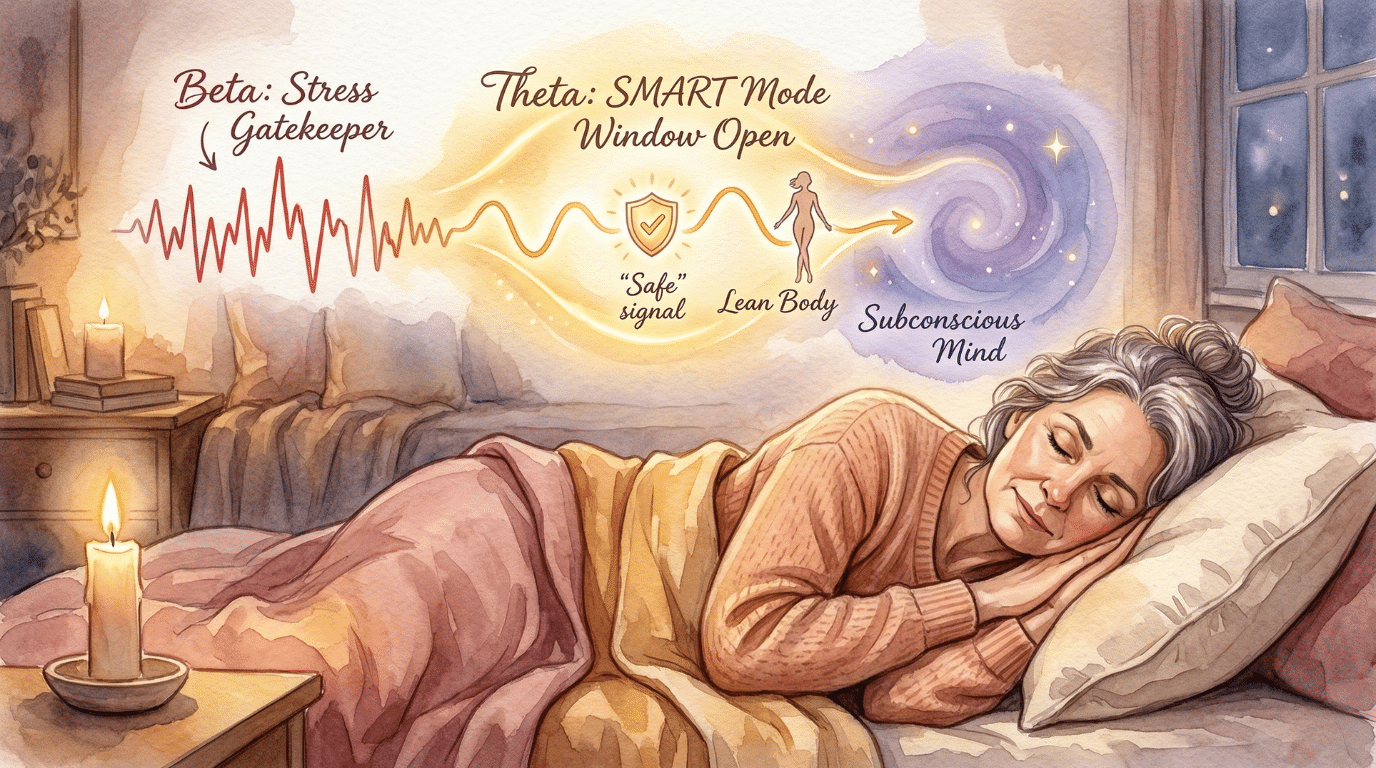
When food is plentiful, the signal it receives is clear. We’re safe. We’re thriving. Be lean, be energetic, be alive.
But when food starts getting scarce — even if you’re the one making it scarce — the signal it receives is very different.
Danger. Famine. Survival mode. Now.
The Science: When caloric intake drops significantly, the brain’s hypothalamus interprets reduced energy availability as an environmental threat — triggering a cascade of hormonal and neurological responses designed to maximize fat storage and minimize energy expenditure. This is an evolutionarily conserved survival mechanism, not a metabolic malfunction.
This is what Jon Gabriel calls the FAT Program.
FAT stands for Famine And Temperature — the two biggest survival threats your ancestors ever faced. When your brain detects either one, it doesn’t wait for permission. It flips a switch. And suddenly your body is doing everything in its power to keep you alive by storing fat, slowing your metabolism, and making you so hungry you’ll eventually override every gram of willpower you have.
Your brain cannot tell the difference between a diet and a famine.
Read that again. Let it land.
To your animal brain, skipping lunch on a Tuesday in a warm apartment near a fully stocked kitchen is biologically identical to a food shortage in the middle of a harsh prehistoric winter. The signal is the same. The response is the same.
Now close your eyes for a moment and imagine this.
It’s 40,000 years ago. Winter is arriving. The animals have moved on. The berries are gone. Your tribe hasn’t eaten a full meal in three days.
The people whose bodies learned to hold onto every calorie — to slow down, conserve, and store — survived that winter. The people whose bodies didn’t adapt? They didn’t make it.
You are descended from the survivors. Every single one of them. Their biology lives inside you right now.
In the 1940s, researchers at the University of Minnesota studied this firsthand. They put healthy, psychologically stable men on a calorie-restricted diet — not extreme by modern diet standards — and watched what happened. Within weeks, the men became obsessed with food. They were cold all the time. They were exhausted, depressed, and emotionally fragile. Their metabolisms crashed. Their bodies were doing exactly what bodies are supposed to do when a famine hits.
This wasn’t weakness. This was biology working perfectly.
Your Brain’s One Survival Rule
Your brain doesn’t know it’s 2024. It doesn’t know there’s a grocery store on every corner. It only knows one thing: less food equals danger. And when there’s danger, it stores fat. This response is not a flaw in your design — it’s the reason your ancestors survived long enough to have you. The problem isn’t the program. The problem is that the program has no off switch for the modern world.
This is not a flaw. It is a feature.
It just has absolutely no place in a world where you can order a meal to your door in twenty minutes.
So when your FAT Program activates — and on any significant diet, it will — here’s what starts happening inside your body:
- Your metabolism slows down to conserve energy
- Your hunger hormones spike, making food feel urgent and consuming
- Your body starts breaking down muscle for fuel while holding onto fat
- Your brain becomes hyper-focused on finding food — and less focused on everything else
- Your stress hormones rise, which signals your body to store even more fat
None of that is your fault. All of it is your biology doing exactly what it was built to do.
The next section is where we go deeper — into the specific hormones driving this cascade, and why understanding them is the first real step toward working with your body instead of against it.
What Actually Happens to Your Body When You Diet
You’ve felt it. The fatigue that sets in around day four. The cold hands. The brain fog. The way you start dreaming about food you don’t even normally eat.
That’s not weakness. That’s not your imagination. That’s your biology executing a precise, ancient survival program — right on schedule.
Here’s exactly what happens inside your body the moment you start restricting calories. Not the vague, hand-wavy version. The real version.
Step One: Leptin Crashes
Leptin is the hormone that tells your brain, “We have enough fat stored. We are safe. Everything is fine.”
When you eat less, your fat cells shrink slightly. And as they shrink, they release less leptin. Your brain reads this drop in leptin as an emergency signal.
It doesn’t know you chose this. It just knows the “we’re safe” message has gone quiet. And when that message goes quiet, your brain shifts into crisis mode.
Step Two: Ghrelin Surges
Ghrelin is your hunger hormone. Under normal conditions, it rises before meals and falls after you eat.
But when your brain detects a famine — including your Monday-morning diet — ghrelin doesn’t just rise before lunch. It floods your system around the clock.
This is why dieting hunger feels different from regular hunger. It’s relentless. It’s loud. It hijacks your thoughts at 2pm, at 9pm, at midnight. That’s not a craving. That’s a biological alarm your body will not turn off until it believes the famine is over.
Step Three: Your Metabolism Slows Down
Here’s where it gets brutal.
Your body is smart. If food is scarce, it doesn’t just make you hungry — it also makes you burn less. Your thyroid output drops. Your body temperature drops. Your energy drops. Your system does everything it can to make the food you do eat last as long as possible.
This is why after a few weeks of dieting, the scale stops moving even though you haven’t changed anything. Your body has adapted. It’s running on less fuel, spending less fuel, and storing whatever it can.
The Science: Research shows that caloric restriction can reduce resting metabolic rate by 15–30% — and in some cases, this metabolic slowdown persists long after the diet ends, which is why so many people gain the weight back faster than they lost it.
Step Four: Cortisol Takes Over
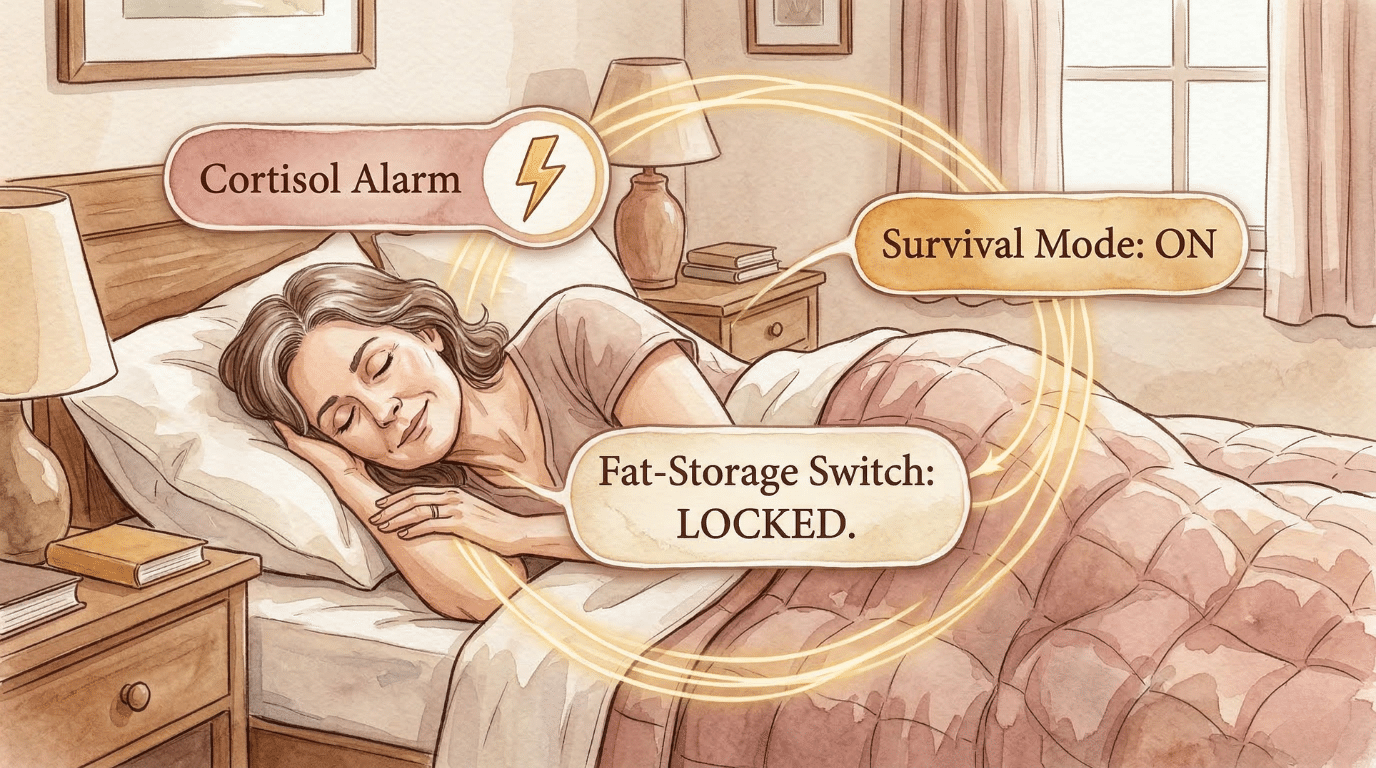
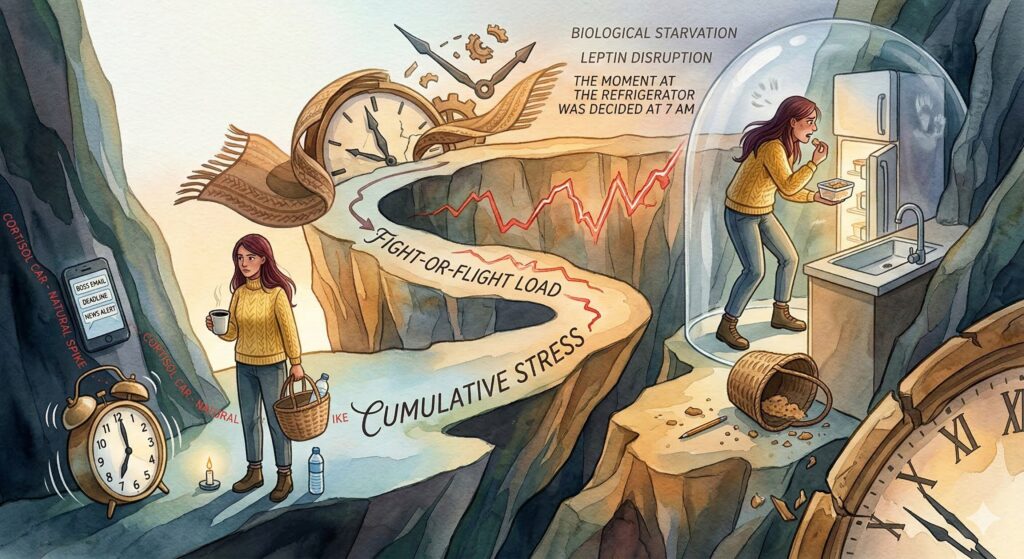
Your body now reads the situation as a threat. And threats trigger cortisol — your primary stress hormone.
Cortisol does something particularly cruel in this context. It signals your body to store fat, especially around your belly. It breaks down muscle for fuel instead. And it keeps your nervous system on high alert, making sleep harder and cravings stronger.
The very act of trying to lose weight is triggering the hormone most responsible for keeping fat on your body.
The Famine Response: What Your Body Is Actually Doing When You Diet
The moment caloric restriction begins, your body launches a four-part survival response: leptin falls (safety signal gone), ghrelin surges (hunger alarm activated), metabolism slows (conserve every calorie), and cortisol rises (store fat, break down muscle). This isn’t failure. This is your body working exactly as it was designed to — protecting you from starvation. The problem is it can’t tell the difference between a famine and a diet.
This is why Jon Gabriel, at over 400 pounds, wasn’t eating enormous amounts of food. His body had been in survival mode for years — storing, slowing, conserving. The diets he tried didn’t fix the problem. They made the signals louder.
And this is why the answer is never “try harder.” You cannot willpower your way past a biological survival program. You have to change what the program is responding to.
Which means the real question isn’t: how do I eat less?
The real question is: why does my brain think I’m starving?
That’s where everything changes.
If you’re ready to stop fighting your body and actually start working with it, I invite you to experience the complete step-by-step system inside the 12-Week Total Transformation Program.