Published December 17, 2025 10:13AM
In Yoga Journal’s Archives series, we share a curated collection of articles originally published in past issues beginning in 1975. These stories offer a glimpse into how yoga was interpreted, written about, and practiced throughout the years. This article first appeared in Yoga Journal in 2003. Find more of our Archives here.
Locust Pose (Salabhasana) falls into the category of strengthening postures that serve as useful foils for some of yoga’s more noodley contortions. This reliable workhorse cultivates strong hip and back muscles, revitalizes fire in the belly, and also promotes a pleasant sense of extension into the big, bright world beyond. It prepares the spine for deeper backbends, offers a wealth of variations to keep us challenged and curious along the way, and provides an opportunity to practice the fine art of growing strong without growing tough.
My young niece, Lucy, says that this pose looks less like a locust and more like a Viking ship. (She is onto something here, since some yoga traditions do call this shape Boat Pose, or Navasana.) For me, moving into Locust feels like flying. I envision myself as an Acapulco cliff diver, leaping upward and outward in a satisfying swan dive that reaches to the horizon. In this pose, we’re given the chance to defy not only gravity but also those sticky fears that conspire to keep us small. For a few sweet moments at least, we’re called upon to be bold and expansive. There’s no hiding in the swan dive of Salabhasana!
How to Practice Locust Pose
Locust is a beginning backbend that cultivates strong and resilient back muscles, making it an excellent preparation for more advanced postures that demand strength and stability in the spine. Lie on your belly, hands at your sides, with your head resting comfortably on the floor. Breathe quietly and easily. Send a surge of energy from your deep belly through your legs to boost them a few inches off the floor while simultaneously lifting your upper body. Extending fully through the arms and legs, sculpt the spine into a long and graceful arch, resting the weight of the body on your lower abdomen. Breathe steadily, keeping your mind cool and spacious. After several cycles of breath, slowly float back to the ground.
If you’re not quite ready to execute the pose in its fullness, try breaking it down, beginning with the legs.
Unraveling the Legs
Settle onto your belly, with your legs outstretched and your head resting comfortably on the floor, either facedown or turned to the side. Let your back body be broad and unfettered as you surrender to the pull of gravity’s embrace.
Layer by layer, from the outside to the core, let everything about you unravel. Exhale completely and greet the earth beneath you with a sweet sigh of relief. The softer your body grows, the more fully you’ll feel the tide-like ebb and flow of breath pouring into and pressing out beyond you. Can you feel your back waistband rising with the inhalation and falling as you exhale? Can you feel your hips and shoulders gently rocking as well? Let the breath be deep and calm, and invite every cell of your body to settle into its rhythmic cadence.
Let’s start by exploring Locust Pose limb by limb, taking care to maintain a spacious quality while initiating movement from the core. Draw your mind’s eye to your belly and trace a line from there through your right hip, knee, and heel.
Invite your energy to gently sweep along that path-like electricity running along its power lines-and slide your right leg away from the center of your body. Your leg should feel easy and elastic as it telescopes away from your core.
Hold this extension a few breaths and then release your leg to neutral. Repeat the action a few more times on your right side, eventually letting the thigh lift a few inches off the ground once you reach your maximum extension. Keep the leg long and straight, with the back knee full and vibrant.
Relax the right leg to the ground, and settle in for a rest, returning to the steady pulse of your breath. Compare your legs.
Does your right leg feel just a bit brighter and livelier? Maybe even a little longer than the left? Repeat the action with your left leg. Remember, this pose is more about extension than height, so resist the temptation to bend the legs or distort the hips just to create the illusion of lift. Keep the front of the thigh, knee, and foot looking down at the floor.
And also keep the pelvis squarely on the ground so that a small cat napping on your hips wouldn’t fall off to either side.
Once you have taken a bit of time to play around with this action on each of your legs, turn up the heat a little by lifting both legs at the same time, while resting the upper body softly on the ground. Let the legs hover a comfortable hip-distance apart. Tracing little tentacles of energy from the belly through the toes and beyond, slip your legs out, up, and away so that they feel long and never-ending. To avoid jamming the lower back, reach your tail toward your heels rather than up to the heavens.
Here’s an opportunity to tuck a little nap into your practice while your body absorbs the goodness of the movements just practiced. Simply rest on the floor and note the changes this Locust variation has evoked.
It’s likely you’ll feel a happy hum in your hips and hamstrings. You might also feel heat building in the midsection of your body—a welcome gift in the depths of winter. Settle into the support of the ground and the nourishing quality of the breath. If there’s any tension at all in your lower back, wiggle your hips from side to side to ease it out.
Incorporate Your Arms
When you feel called and well rested, you are ready to explore the top half of Locust, keeping the legs grounded while extending the arms into space. Remember, you want to move from your core rather than the extremities so that the spine can be washed in the exhilaration of the pose. This means lifting the spine first and letting the arms follow along like kite tails, instead of picking the hands up and asking them to drag the rest of the body along.
Send energy from your belly up through your spine to lift the chest, shoulders, and head off the ground, keeping the chin gently tucked and the back of the neck long. Send another wave of movement from your heart through the arms to draw the hands up off the ground and back toward your feet.
Slip your shoulder blades down your back and let your heart swoop forward and up. Stay here for a moment, breathing steadily and also noticing how your chest bobs up with the inhalation and down with the exhalation. Don’t freeze these waves out-ride them joyfully. Try this a few more times, keeping both the nape of the neck and the lower back long and unruffled.
The Full Pose
After another easy descent—another nap—you might like to combine the bottom and the top halves of the pose, leaving just the lower belly on the floor while the rest of you swims in space. First, soften completely, tune into your breath, and resist the urge to grow tough in anticipation of the challenge ahead.
Draw your awareness to your deep belly, the energetic source of this pose. Slide the thighs back and up and the heart forward and up. Let the rest of the body fol-low, lengthening out from the center as far as you can reach. Fill your back body with buoyant, sky-bound helium. Let the body undulate slightly as you draft on the cool currents of the breath. Keep your brain and eyes soft and friendly. Reach out bravely in all directions.
When you feel your soft and spacious swan dive giving way to fatigue, waft back down to earth. Rest quietly, sinking back into the breath’s refreshing rhythms. The hard work is over, and you’re left basking in the afterglow of the pose.
Even though you are back on solid ground, a part of you is still diving up and soaring outward in all directions. You’re resting happily at home while soft and shiny bits of you sail off into the far corners of the world.
Locust Pose Variations
Slight variations on traditional Locust can make the pose more accessible—or more demanding—depending on your practice preferences.
Locust Variation 1
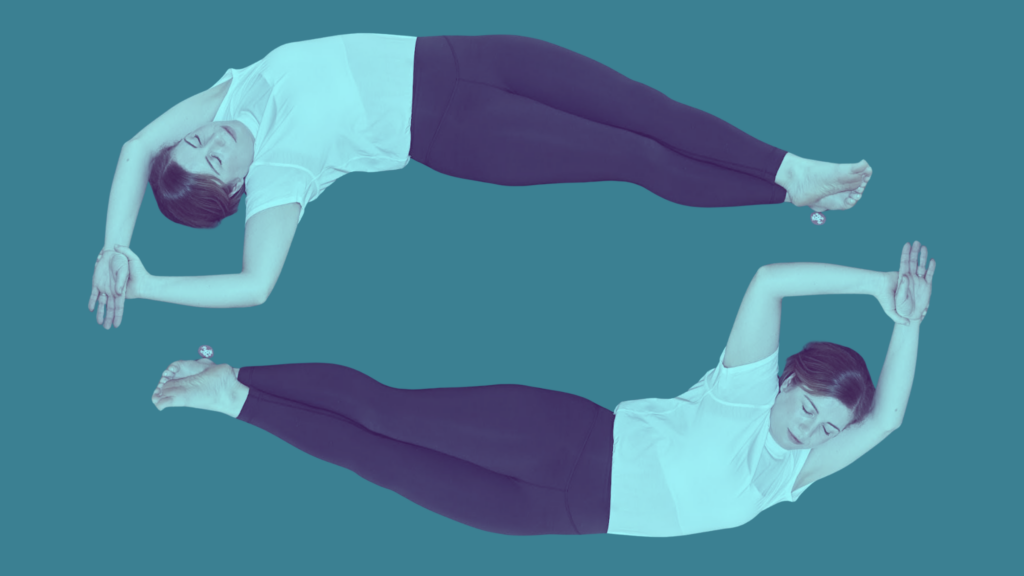
This variation is less demanding than the full pose and challenges the body in a diagonal line, helping to target imbalances in the hips and the spine. Resting quietly with the upper arms near your ears, imagine an internal line from your belly through the left arm and right leg. Extend outward along this diagonal in both directions, sweeping the arm and leg up and away from the center of your body.
Let the head lift gently. Keep the floating ribs and pelvis squarely on the floor so your midsection remains stable, and gently root the opposite arm and leg into the ground to counterbalance the diagonal movement.
Radiate fully through your left arm and right leg. Release the pose and repeat, lifting the opposite arm and leg.
Locust Variation 2
This demanding variation is an excellent preparation for more advanced backbends like Dhanurasana (Bow Pose).
Start with the hands on the floor near the ribs, elbows pointing toward your feet. Bend the legs to a right angle so the feet hover directly over the knees. Extend the thighs and knees toward the sky, while at the same time sliding the chest forward and up off the ground. Reach the arms toward your shins, and draw the shoulder blades toward the hips. Keep the lower back long, the weight of the body on the lower abdomen, and the legs and knees hip-width apart.
Breathe comfortably.