Calm your mind, free your spine.
(Photo: Calin Van Paris/Canva)
Published December 23, 2025 05:19AM
In Yoga Journal’s Archives series, we share a curated collection of articles originally published in past issues beginning in 1975. These stories offer a glimpse into how yoga was interpreted, written about, and practiced throughout the years. This article first appeared in the March-April 1983 issue of Yoga Journal. Find more of our Archives here.
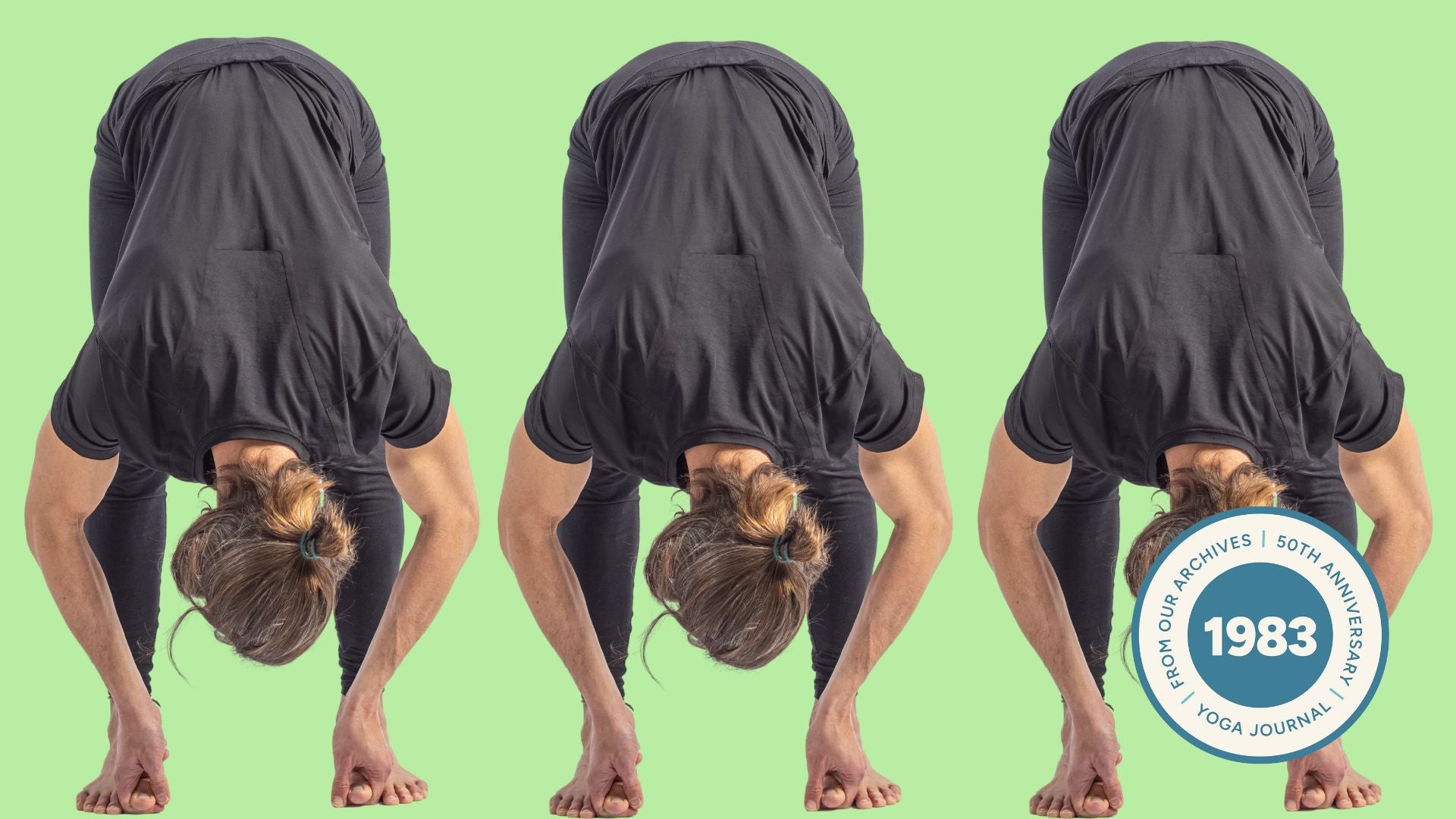
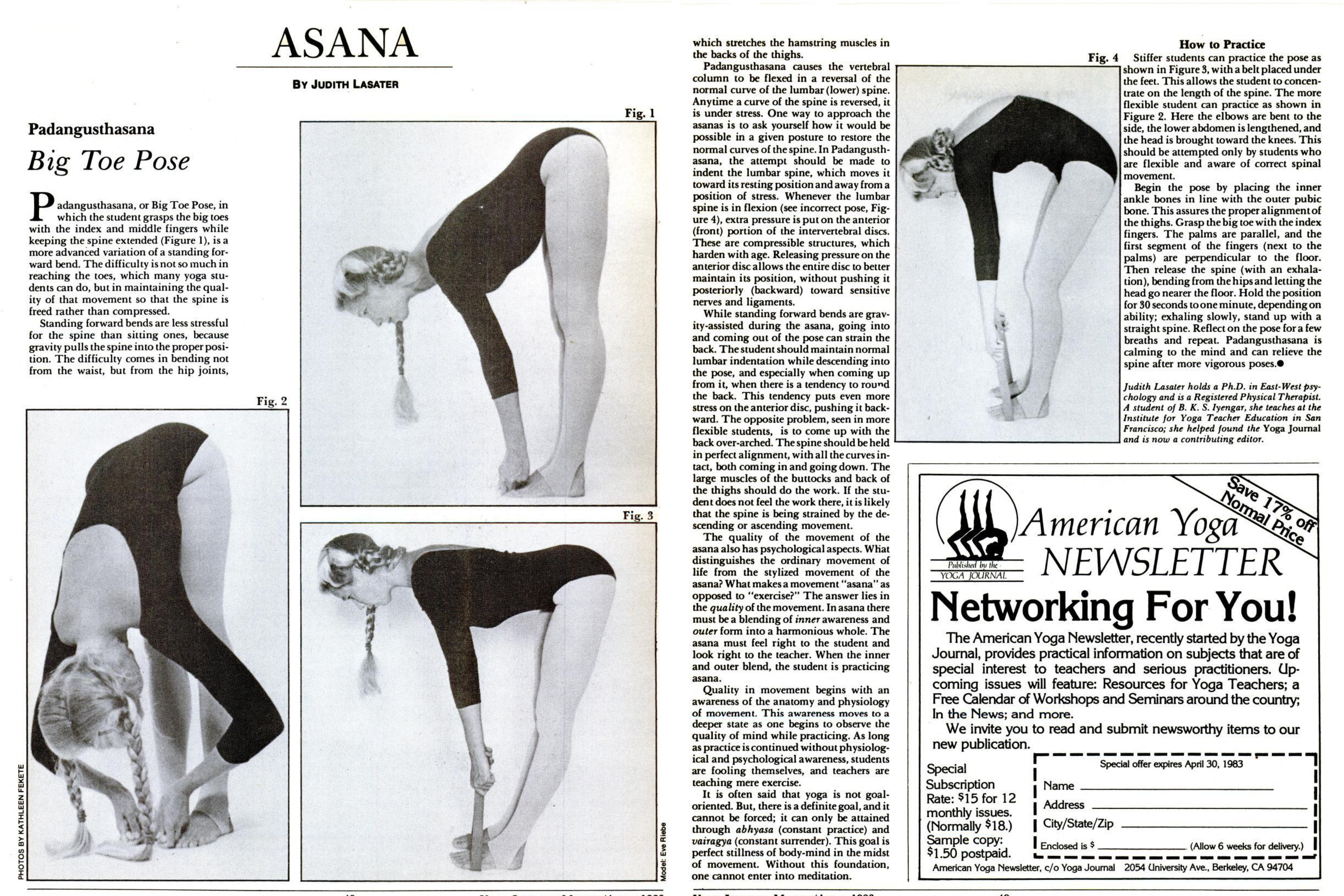
Big Toe Pose (Padangusthasana), in which the student grasps the big toes with the index and middle fingers while keeping the spine extended (Figure 1), is a more advanced variation of a standing forward bend. The difficulty is not only in reaching the toes, but in maintaining the quality of that movement so that the spine is freed rather than compressed.
Standing forward bends are less stressful for the spine than sitting ones, because gravity pulls the spine into the proper position. The difficulty comes in bending not from the waist, but from the hip joints, which stretches the hamstring muscles in the backs of the thighs.
It is often said that yoga is not goal-oriented. But, there is a definite goal, and it cannot be forced; it can only be attained through abhyasa (constant practice) and vairagya (constant surrender). This goal is perfect stillness of body-mind in the midst of movement. Without this foundation, one cannot enter into meditation.
Be Mindful of the Lower Back
Big Toe Pose causes the vertebral column to be flexed in a reversal of the normal curve of the lumbar (lower) spine. Anytime a curve of the spine is reversed, it is under stress. One way to approach the asanas is to ask yourself how it would be possible in a given posture to restore the normal curves of the spine. In Big Toe Pose, the attempt should be made to indent the lumbar spine, which moves it toward its resting position and away from a position of stress. Whenever the lumbar spine is in flexion (see incorrect pose, Figure 4), extra pressure is put on the anterior (front) portion of the intervertebral discs.
These are compressible structures, which harden with age. Releasing pressure on the anterior disc allows the entire disc to better maintain its position, without pushing it posteriorly (backward) toward sensitive nerves and ligaments.
While standing forward bends are gravity-assisted during the asana, going into and coming out of the pose can strain the back. The student should maintain normal lumbar indentation while descending into the pose, and especially when coming up from it, when there is a tendency to round the back. This tendency puts even more stress on the anterior disc, pushing it back-ward. The opposite problem, seen in more flexible students, is to come up with the back over-arched. The spine should be held in perfect alignment, with all the curves in-tact, both coming in and going down. The large muscles of the buttocks and back of the thighs should do the work. If the student does not feel the work there, it is likely that the spine is being strained by the descending or ascending movement.
The quality of the movement of the asana also has psychological aspects. In asana there must be a blending of inner awareness and outer form into a harmonious whole. The asana must feel right to the student and look right to the teacher. When the inner and outer blend, the student is practicing asana.
How to Practice Big Toe Pose
Students experiencing muscle stiffness can practice the pose as shown in Figure 3, with a belt placed under the feet. This allows the student to concentrate on the length of the spine. The more flexible student can practice as shown in Figure 2. Here the elbows are bent to the side, the lower abdomen is lengthened, and the head is brought toward the knees. This should be attempted only by students who are flexible and aware of correct spinal movement.
Begin the pose by placing the inner ankle bones in line with the outer pubic bone. This assures the proper alignment of the thighs. Grasp the big toe with the index fingers. The palms are parallel, and the first segment of the fingers (next to the palms) are perpendicular to the floor.
Then release the spine (with an exhalation), bending from the hips and letting the head go nearer the floor. Hold the position for 30 seconds to one minute, depending on ability; exhaling slowly, stand up with a straight spine. Reflect on the pose for a few breaths and repeat. Big Toe Pose is calming to the mind and can relieve the spine after more vigorous poses.